
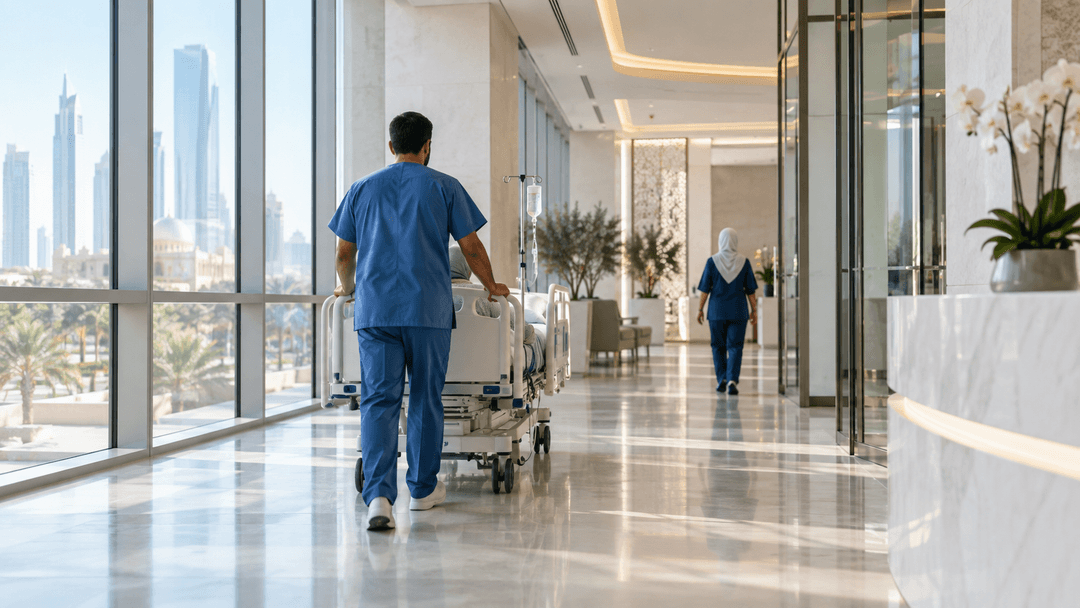
SEHA Tawam discharges 81-year-old rectal cancer patient in 3 days after stoma-sparing surgery
SEHA Tawam Hospital reported a stoma-sparing laparoscopic rectal cancer operation. UAE operators should watch referral, insurer and MDT criteria.
How Zavis verifies this coverage
Editorial standards, source rules, methodology, and review provenance are public.
SEHA Tawam Hospital in Abu Dhabi discharged an 81-year-old distal rectal cancer patient three days after laparoscopic surgery that avoided a temporary or permanent stoma, according to Gulf News on 6 October 2026.
For UAE operators, the case is a practical signal for colorectal oncology pathways. Dubai providers licensed by the Dubai Health Authority (DHA) must decide which rectal cancer patients can be managed locally, which need referral to higher-acuity colorectal teams, and what evidence insurers require before approving advanced minimally invasive surgery. The same question applies in Abu Dhabi under the Department of Health Abu Dhabi (DOH Abu Dhabi), and in the Northern Emirates under the Ministry of Health and Prevention (MOHAP).
What SEHA Tawam reported
The patient had distal rectal cancer, obesity, heart disease and a pacemaker history, Gulf News reported. Doctors at SEHA Tawam Hospital removed the tumour through small incisions and avoided creating a stoma. A stoma is an abdominal opening that diverts waste into an external bag.
"A minimally invasive approach allowed us to remove the tumour safely." — Dr Mahdi Al Taher, Consultant Gastrointestinal and Oncologic Surgeon, SEHA Tawam Hospital
Gulf News named the operating team as surgical, anaesthesia, operating room nursing and other hospital teams. That matters for medical directors because rectal cancer surgery is rarely a single-service decision. It usually needs tumour staging, anaesthetic risk assessment, colorectal surgical capacity, stoma counselling and post-operative recovery protocols.
The case also has a patient-acquisition lesson. Stoma avoidance is a strong search and referral theme for colorectal cancer patients, but it is not a universal promise. Eligibility depends on tumour location, staging, sphincter involvement, prior treatment, co-morbidities and surgeon assessment. Clinics should phrase patient materials around assessment and options, rather than guaranteed stoma avoidance.
Why it matters for Dubai, Abu Dhabi and the Northern Emirates
DHA's 2024 Oncology Services Standards apply to all DHA-licensed facilities providing oncology services. The standard lists oncology services that include bowel cancer screening, comprehensive tumour board, genomic testing, surgery, radiotherapy and second opinion. It also states that facilities adding oncology services must apply to DHA's Health Regulation Sector for permission.
For a Dubai COO, the action point is service-line mapping. A facility advertising colorectal oncology should be able to show where each part of the pathway sits: colonoscopy, imaging, pathology, tumour board review, surgery, ICU access, stoma nursing and follow-up. DHA's standard names hospital units, day surgical centres, cancer treatment centres, breast units and outpatient clinics as possible oncology service settings, but the required capabilities differ by service.
- Referral timing: high-risk rectal cancer cases should move to a colorectal MDT before surgery is booked.
- Insurer file: pre-authorisation should include diagnosis, staging, proposed approach, expected length of stay and alternatives.
- Patient consent: consent should cover stoma risk, conversion to open surgery and recovery expectations.
- Recovery metric: the reported three-day discharge is a benchmark to examine, not a tariff assumption.
In Abu Dhabi, DOH Abu Dhabi and the Abu Dhabi Public Health Centre recommend colorectal cancer screening for men and women aged 40 to 75. The official programme lists colonoscopy once every 10 years, annual FIT stool testing, and liquid biopsy once every 3 years for eligible people. It says IFHAS providers offer screening for Thiqa cardholders in that age group, while other insured patients should speak with their family doctor.
What insurers and clinics should do next
For CFOs, the main issue is authorisation discipline. Public UAE sources do not publish one reliable price for laparoscopic rectal cancer surgery, and complex cases vary by staging, theatre time, ICU risk, implants, consumables and length of stay. Clinics should get written estimates from the treating hospital and written coverage confirmation from the insurer before admission. Patients should ask whether surgeon fees, anaesthesia, pathology, imaging, stoma supplies if needed, and readmission are inside the approval.
Real insurer relevance depends on the patient's emirate, plan and network. In Abu Dhabi, Thiqa is explicitly named by the official colorectal screening programme for IFHAS eligibility. Commercial plans administered by insurers such as Daman or Sukoon may cover colorectal cancer care under different networks, but coverage should be verified case by case through the policy schedule and pre-authorisation portal.
For patients, the operational question is where to start. Dubai residents can check DHA-licensed facilities and professionals through the Dubai Medical Registry. Abu Dhabi patients can use DOH Abu Dhabi channels, and Northern Emirates patients should check MOHAP-licensed providers. For a UAE-wide search, use the UAE Open Healthcare Directory to compare licensed oncology providers by emirate, regulator, specialty and insurance network before booking a colorectal cancer consultation.
Zavis Intelligence
Healthcare Industry Desk
Contributing to UAE healthcare industry coverage
Related coverage



FAQ
What is happening in UAE healthcare industry?
SEHA Tawam Hospital reported a stoma-sparing laparoscopic rectal cancer operation. UAE operators should watch referral, insurer and MDT criteria.