
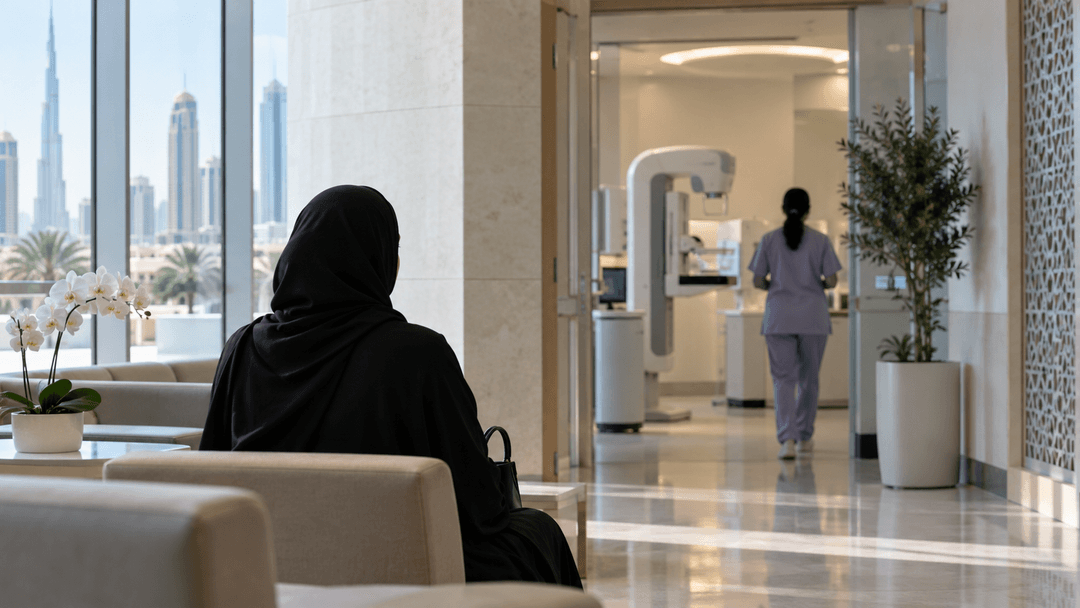
3 UAE breast cancer stories put screening costs and follow-up gaps in focus
Gulf News profiles three women after breast cancer. Clinics, insurers and patients should watch screening access, follow-up and cash prices.
How Zavis verifies this coverage
Editorial standards, source rules, methodology, and review provenance are public.
Gulf News on 11 October 2026 profiled three UAE women whose breast cancer treatment moved from diagnosis to chemotherapy, surgery, radiation and emotional recovery, with one patient saying: “I’m not going anywhere.”
The story matters beyond awareness month because breast cancer is the largest cancer category for UAE women. The Global Cancer Observatory estimates 1,774 new breast cancer cases in the UAE in 2024, equal to 39.1% of female cancer cases. For clinics, the operating question is whether screening, biopsy, oncology referral and psycho-oncology support can move fast enough after the first abnormal finding.
What the Gulf News patients described
Catherine Vander Cammen, now living in the UAE, told Gulf News she noticed an inverted nipple, pushed for a mammogram, then underwent a right mastectomy and dissection of 17 lymph nodes. She later needed chemotherapy, a PICC line for more than six months, infection-related admissions and a second surgery on the left breast after early detection.
Maria Sirotinina, a MedTech leader and biomedical engineer, was diagnosed in June 2022 at age 36 after a full-body check-up and ultrasound found a suspicious mass. Her chemotherapy started in July 2022, and she told Gulf News she was out of treatment by the end of that year.
Maelisa Hall discovered a lump in 2021 after severe itchiness. Gulf News reported she was diagnosed with Stage 3 triple-negative breast cancer and treated with 16 rounds of chemotherapy, immunotherapy every three weeks, three blood transfusions, a lumpectomy and 20 rounds of radiation.
“I’m not going anywhere.”
Maelisa Hall, breast cancer patient quoted by Gulf News
What clinics and insurers should act on
Dubai providers work under the Dubai Health Authority (DHA). DHA’s Periodic Health Screening Guideline, issued on 11 March 2024 and effective from 11 May 2024, says females aged 40 and over are advised to attend breast screening with a mammogram every two years. It adds that screening may start earlier for women with family history or known inherited genetic mutation, based on clinical advice.
For self-pay patients in Dubai, published provider prices give a usable range rather than a single market tariff. Mediclinic Middle East lists a mammogram and breast ultrasound package at AED 725. Novomed states that screening mammograms in Dubai and Abu Dhabi typically range from AED 300 to AED 1,200, depending on 2D or 3D imaging, diagnostic need, facility and consultation. Patients should confirm the current cash price and CPT or service code before booking.
- COOs should audit the time from abnormal mammogram to ultrasound, biopsy and oncology appointment.
- CFOs should separate screening packages from diagnostic work-up costs in payer and cash dashboards.
- Medical directors should treat nipple inversion, discharge, persistent itchiness and a lump as referral triggers.
- CMOs should target women aged under 40 with symptom-led messages, since two Gulf News patients were diagnosed before routine screening age.
Abu Dhabi and northern emirates context
In Abu Dhabi and Al Ain, the relevant regulator is the Department of Health Abu Dhabi (DOH). DOH’s breast cancer screening standard sets higher-intensity pathways for increased-risk women, including clinical breast examination every six to 12 months, annual mammography and annual MRI for defined high-risk categories. On 21 September 2026, DOH also designated Burjeel Cancer Institute at Burjeel Medical City, Cleveland Clinic Abu Dhabi and SEHA Tawam Hospital as breast cancer Oncology Centres of Excellence.
In Sharjah, Ajman, Ras Al Khaimah, Fujairah and Umm Al Quwain, operators should anchor patient information to the Ministry of Health and Prevention (MOHAP) and Emirates Health Services pathways. Patients with Daman, Thiqa, Sukoon or another UAE insurer should check whether screening is preventive, whether a GP referral is required, and which oncology network applies before biopsy or chemotherapy starts.
The next pressure point is continuity after treatment. Gulf News quoted Hiba Salem, a psycho-oncology and palliative psychology specialist at Sage Clinics, on distress after hospital visits stop. For UAE clinics, that means survivorship should include scheduled follow-up, recurrence checks, lymphoedema advice, fertility and menopause counselling where relevant, and access to mental health support. Patients comparing providers can start with the UAE Open Healthcare Directory to find licensed oncology providers across Dubai, Abu Dhabi and the northern emirates.
Zavis Intelligence
Healthcare Industry Desk
Contributing to UAE healthcare industry coverage
Related coverage


FAQ
What is happening in UAE healthcare industry?
Gulf News profiles three women after breast cancer. Clinics, insurers and patients should watch screening access, follow-up and cash prices.