
Exercise Therapy vs Return-to-Sport Programme
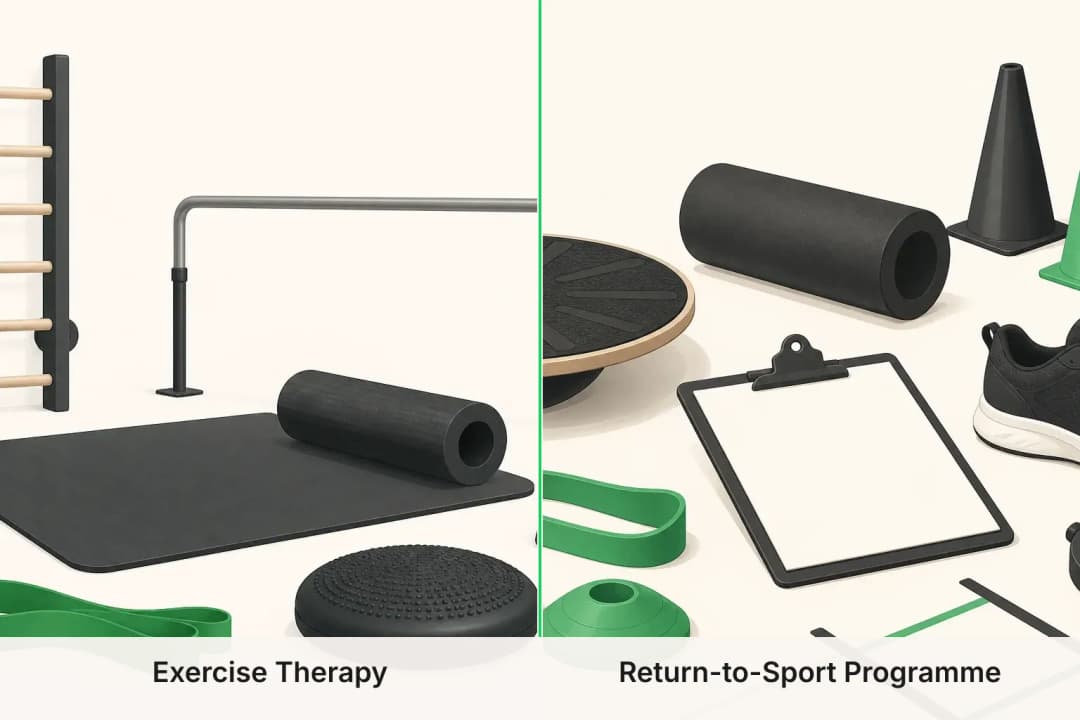
At a glance
- Exercise therapy
- Builds general physical capacity through planned movement.
- Return-to-sport programme
- Rehearses the demands of a chosen sport in stages.
- Sequence
- Sport-specific work often follows a foundation of strength and control.
Find care
Physiotherapy & Rehabilitation in Dubai
Licensed physiotherapy & rehabilitation listed in Dubai. Appearing here means a provider holds a UAE licence in this category — not that it offers exercise therapy vs return-to-sport programme, which is worth confirming with the clinic before you book.
Office 1510, SIT Tower, Dubai Silicon Oasis, Dubai, United Arab Emirates
Accepts: Daman, Thiqa, AXA, Cigna +23 more
- Physio Expert DubaiVerified
Renew and Revive Polyclinic, Al Wasl Rd, opposite J3 Mall, Umm Suqeim 2, Dubai, United Arab Emirates
Accepts: Insurance accepted
Kent Healthcare LLC, Nashwan Building - 208C Al Mankhool Rd, Al Raffa, Dubai, United Arab Emirates
Accepts: Thiqa, AXA, Cigna, MetLife +23 more
Index Building, Nad Al Hamar Road, Dubai Festival City, Dubai
Accepts: Thiqa, AXA, Cigna, MetLife +30 more
x24-1, England Z St 41/a, WARSAN FIRST, Dubai
Accepts: Daman, Thiqa, AXA, Cigna +24 more
Hilal Bin Sultan, 19a Street 19, AL RIGGA, Dubai
Accepts: Daman, AXA, Cigna, MetLife +21 more
Ordered by verification status and how complete each clinic's public record is, then alphabetically. This is a directory listing, not a ranking — Zavis does not rate or recommend providers.
A factual listing drawn from the DHA, DOH and MOHAP licence registers. It is not a referral, an endorsement, or advice that any of these providers is right for you.
The main difference
Exercise therapy builds general strength, mobility and control, while a return-to-sport programme prepares you for the running, cutting, landing, contact or skill demands of a particular sport.
Exercise therapy is often the foundation of recovery: it restores capacity in a controlled setting. A return-to-sport programme uses that capacity in increasingly realistic situations. The second option is not automatically harder or suitable for everyone; it is designed around a sport, position, training schedule and injury history.
Exercise therapy may be the better starting point if
Choose a general exercise focus when pain, stiffness, weakness or reduced balance still limits ordinary tasks. It can help you rebuild a base before adding sprinting, jumping, pivoting or repeated sport skills. It may also be the right emphasis for someone who does not plan to return to organised sport, or whose main goal is comfortable work, walking or recreation.
A return-to-sport programme may be appropriate if
A sport-specific programme becomes relevant when you can perform foundational exercises with reliable control but are unsure how to resume training. It can address the demands that ordinary strengthening misses, such as reacting to an opponent, decelerating, landing while tired or repeating a skill. The programme should reflect your sport and may include communication with a coach about training volume.
Risks of progressing too quickly
A return to sport can expose a healing area to rapid loading, twisting, impact or fatigue. Increasing several demands at once may make it difficult to identify what caused a flare-up. Exercise therapy can also irritate symptoms if resistance, range or volume rises too quickly. Use pain, swelling, movement quality and recovery after a session as information, not as a challenge to ignore. New instability, locking, marked swelling, loss of strength or worsening symptoms should prompt a clinical review.
When neither approach is ready to lead
Do not self-progress into sport drills after a major injury, recent operation or sudden loss of function without individual guidance. Urgent assessment is needed for a visibly deformed limb, inability to bear weight, severe pain after trauma, new numbness or a cold or pale extremity. If symptoms are still being investigated, diagnosis and protection of the area come before performance training.
How readiness can be judged
A clinician considers your diagnosis, healing stage, strength, range, balance, confidence and response to recent sessions. They may compare the injured side with the other side, observe sport movements and use repeated efforts to see how fatigue affects technique. Readiness is a process rather than a single feeling. Discuss the next training step, what to do the following day, and which signs mean that the load should be reduced.
Questions people ask
Is exercise therapy enough to return to sport?
It may provide the foundation, but sport-specific drills can be needed to prepare for speed, impact, decision-making and repeated efforts.
Can I start a return-to-sport programme while symptoms remain?
Some symptoms may be monitored during rehabilitation, but the clinician should define safe limits and decide whether the current stage matches your injury and healing.
Related
Related reading
Keep reading
Medical disclaimer. This page is general health information, not medical advice, and it cannot diagnose you. Always consult a licensed healthcare provider about your own symptoms and treatment. In an emergency in the UAE, call 998 for an ambulance.