
When Is Strength Training Rehabilitation Recommended for Gluteal Tendinopathy?
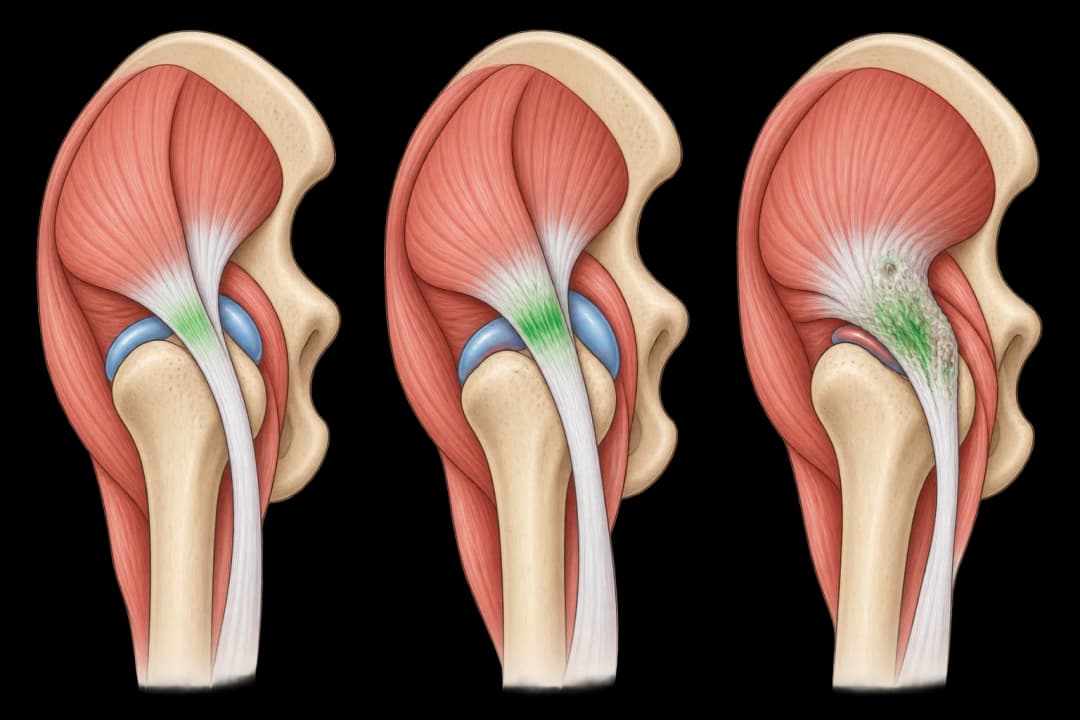
Short answer
Strength training rehabilitation is recommended for gluteal tendinopathy when pain is settled enough to tolerate controlled loading and a clinician can progress the exercises safely.
This answers one question. It is not a diagnosis and does not replace an assessment by a licensed doctor.
At a glance
- Main target
- Hip and buttock muscle capacity
- Progression
- Gradual loading matched to symptoms
- Useful support
- Physiotherapy assessment and exercise coaching
What this means
Gluteal tendinopathy affects the tendons that connect the buttock muscles to the hip. Irritation may be aggravated by lying on the painful side, crossing the legs, climbing stairs, or standing with the hip pushed out. Rehabilitation aims to improve the tendon’s tolerance and the hip muscles’ ability to share load. Early work may use gentle isometric contractions or supported movements. Later exercises can include bridges, sit-to-stand practice, step work, and controlled single-leg loading, depending on symptoms.
How to approach the programme
A physiotherapist can choose a starting resistance and position that keep symptoms manageable during exercise and after it. Increase one feature at a time, such as repetitions, resistance, range, or balance demand. Avoid suddenly adding hills, long walks, deep side-lying stretches, or repeated stair work while the tendon is reactive. Keep the pelvis level during standing and stepping, and use support when balance is uncertain. The [Strength Training Rehabilitation](/treatments/physiotherapy-and-rehabilitation/strength-training-rehabilitation/) guide explains the broader approach.
When to seek care
Arrange an assessment if outer-hip pain persists, limits sleep, or makes walking and stairs difficult. Seek prompt medical help after a fall or sudden injury with severe pain, inability to bear weight, marked swelling, fever, or new weakness. A clinician can check whether the symptoms fit gluteal tendinopathy and whether another hip or back problem needs attention. Read more about [Gluteal Tendinopathy](/conditions/gluteal-tendinopathy/).
Questions for your doctor or physiotherapist
Ask which exercise position is safest for your current irritability, how to judge an acceptable response after training, and when to add resistance or single-leg tasks. Ask whether your sleep position, work demands, or walking route should be modified while capacity builds.
Find care
General Clinics & Polyclinics in Abu Dhabi
That answer is general. If you want it applied to your own case, these are licensed general clinics & polyclinics listed in Abu Dhabi.
27 Ar Ruwwad St - Shakhbout City - MSH4 - Abu Dhabi - United Arab Emirates
Accepts: Daman, Thiqa, Cigna, MetLife +20 more
Al Ruwais, Al Dhafrah
Accepts: Daman, Thiqa, AXA, Cigna +16 more
Al Bahyah - Al Bahyah Old - Abu Dhabi - United Arab Emirates
Accepts: Daman, Thiqa, Cigna, Allianz Care +18 more
Abu Dhabi
Accepts: Daman, Thiqa, AXA, Cigna +27 more
Ordered by verification status and how complete each clinic's public record is, then alphabetically. This is a directory listing, not a ranking — Zavis does not rate or recommend providers.
A factual listing drawn from the DHA, DOH and MOHAP licence registers. It is not a referral, an endorsement, or advice that any of these providers is right for you.
Questions people ask
Can strengthening make gluteal tendinopathy worse?
A sudden increase in load or poorly controlled movement can flare symptoms. A graded programme allows the response to guide progression.
Should I stop all activity first?
Complete rest is not usually the goal. Reducing aggravating loads while maintaining comfortable movement can help preserve strength.
Related
Related reading
Keep reading
Medical disclaimer. This page is general health information, not medical advice, and it cannot diagnose you. Always consult a licensed healthcare provider about your own symptoms and treatment. In an emergency in the UAE, call 998 for an ambulance.