
What happens if head lice is not treated?
Short answer
If head lice is not treated, live lice can continue feeding and laying eggs, causing ongoing itching and allowing spread to close household or school contacts.
This answers one question. It is not a diagnosis and does not replace an assessment by a licensed doctor.
At a glance
- What sustains infestation
- Live lice can lay eggs that later hatch
- How it spreads
- Mainly close head-to-head contact and shared hair items
- Common complication
- Scratching can break the skin and cause infection
What untreated head lice can do
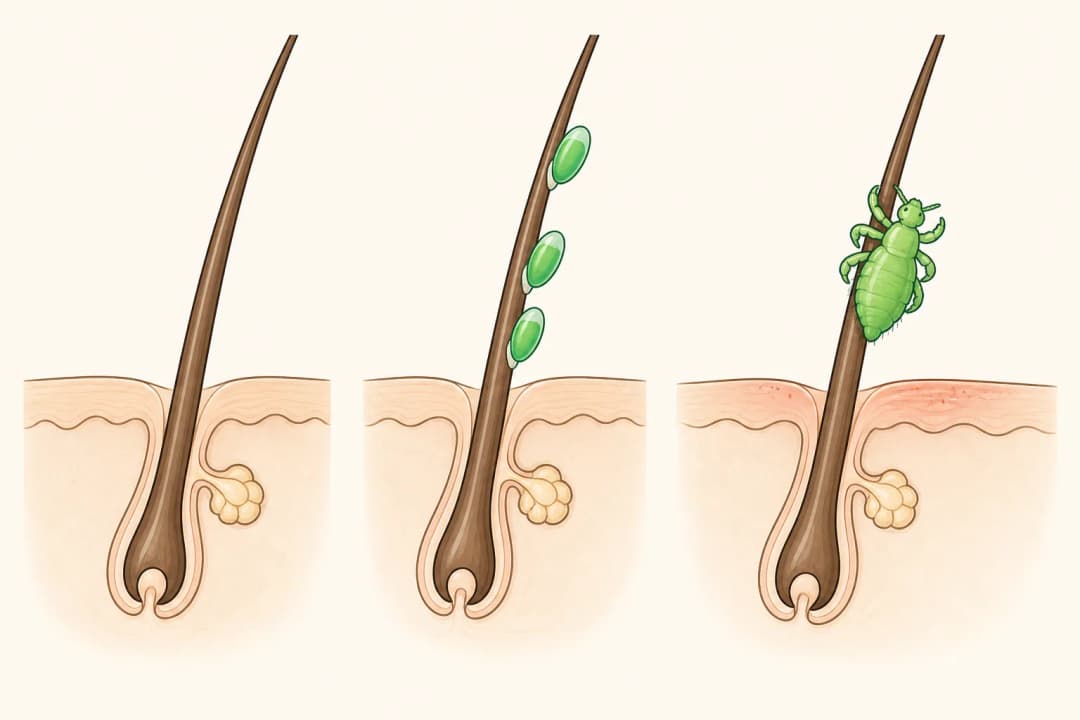
Head lice live on the scalp and feed on blood. As the infestation continues, itching may become more persistent and can be worse at night. Scratching may cause small sores, crusting, or irritation; broken skin can become infected. Eggs attached to hair shafts can hatch and maintain the infestation, so finding nits alone does not show whether live lice are still present.
Head lice do not jump or fly, but they can move through close head-to-head contact and shared items that touch the hair. An itchy scalp has other possible causes, so confirmation is useful before applying treatment.
What to do next
Check the scalp and hair under good light, concentrating behind the ears and near the nape. Use a treatment recommended by a pharmacist or clinician and follow its instructions, including any repeat application. Check close contacts and avoid sharing combs, brushes, hats, or pillows until advice is clear. A GP consultation can help when the diagnosis or treatment choice is uncertain.
When to seek medical care
Arrange care if scratching has caused sores, pus, spreading redness, or increasing tenderness, or if live lice remain after correctly following treatment instructions. Seek advice for a very young child, pregnancy, scalp disease, or an allergy to a proposed product. A clinician should review persistent symptoms when no live lice can be found.
Questions for your doctor
Ask how to confirm live lice, which treatment is suitable for your age and health, when it should be repeated, and how to check household contacts. Ask how to manage irritated skin and when continued itching needs a new diagnosis.
Find care
General Clinics & Polyclinics in Abu Dhabi
That answer is general. If you want it applied to your own case, these are licensed general clinics & polyclinics listed in Abu Dhabi.
27 Ar Ruwwad St - Shakhbout City - MSH4 - Abu Dhabi - United Arab Emirates
Accepts: Daman, Thiqa, Cigna, MetLife +20 more
Al Ruwais, Al Dhafrah
Accepts: Daman, Thiqa, AXA, Cigna +16 more
Al Bahyah - Al Bahyah Old - Abu Dhabi - United Arab Emirates
Accepts: Daman, Thiqa, Cigna, Allianz Care +18 more
Abu Dhabi
Accepts: Daman, Thiqa, AXA, Cigna +27 more
Ordered by verification status and how complete each clinic's public record is, then alphabetically. This is a directory listing, not a ranking — Zavis does not rate or recommend providers.
A factual listing drawn from the DHA, DOH and MOHAP licence registers. It is not a referral, an endorsement, or advice that any of these providers is right for you.
Questions people ask
Does untreated head lice go away on its own?
Live lice can remain and continue the infestation, so correct treatment and checking close contacts are usually needed.
Are nits proof of active head lice?
Nits show that eggs are attached to hair, but finding live crawling lice is more useful for confirming an active infestation.
Related
Related reading
Keep reading
Medical disclaimer. This page is general health information, not medical advice, and it cannot diagnose you. Always consult a licensed healthcare provider about your own symptoms and treatment. In an emergency in the UAE, call 998 for an ambulance.