
What should you know about a urine routine and microscopy test?
Short answer
A urine routine and microscopy test checks urine chemistry and uses a microscope to examine cells, crystals and other material.
This answers one question. It is not a diagnosis and does not replace an assessment by a licensed doctor.
At a glance
- Routine checks
- Urine appearance and chemistry
- Microscopy
- Cells, crystals, casts and organisms
- Interpretation
- Depends on the full clinical picture
Understanding microscopy findings
Microscopy may show red blood cells, white blood cells, epithelial cells, crystals, casts or microorganisms. Small amounts of some material can occur without serious disease, and epithelial cells may indicate that skin or genital material entered the cup. White cells can accompany infection or irritation. Crystals may relate to urine concentration and do not by themselves prove a stone. Casts have different meanings depending on their type. A clinician combines the report with symptoms, examination and other tests.
Before and after the sample
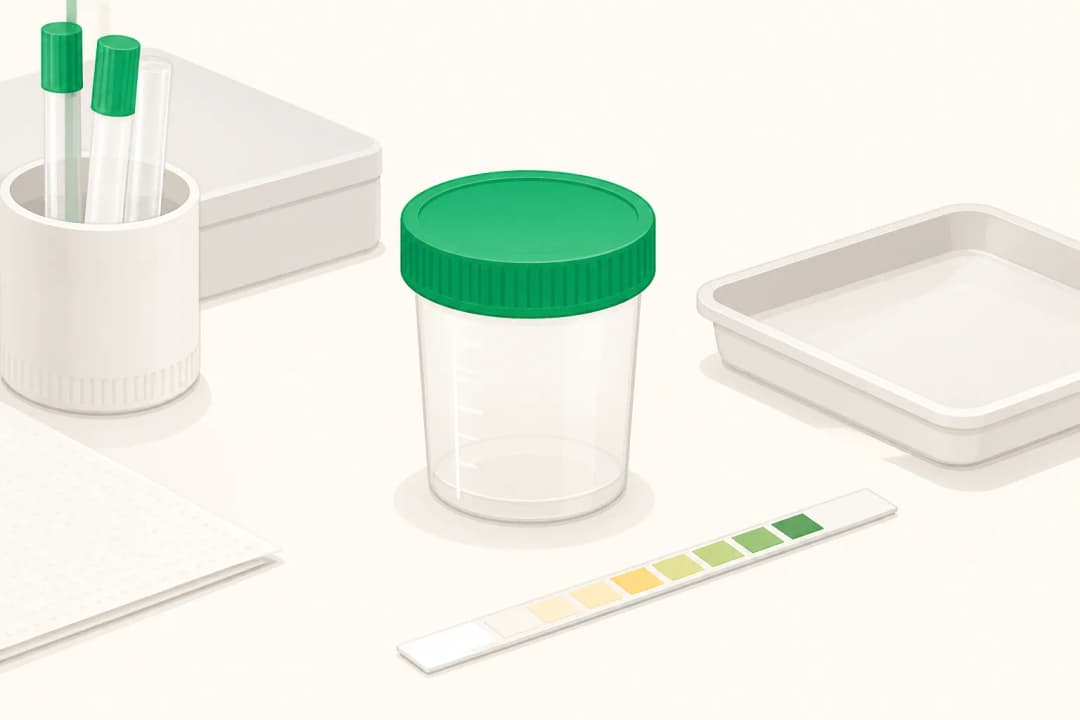
Collect the specimen in the supplied sterile container, following instructions about cleaning and midstream collection. Avoid adding water or transferring urine from another container. Tell the clinician about menstruation, vaginal discharge, recent exercise, urinary procedures and medicines, since these details can affect interpretation. If findings are unclear, the next step may be a repeat clean sample, culture or another investigation. See the general [Urine Test](/treatments/diagnostics-and-screening/urine-test/) guide for context.
When to seek care
Get prompt medical help for visible blood with clots, inability to pass urine, severe side or back pain, fever with shaking chills, persistent vomiting or confusion. A [Urinary Tract Infection](/conditions/urinary-tract-infection/) can present with burning and frequency, while a [Kidney Infection](/conditions/kidney-infection/) may involve fever and flank pain.
Questions to bring
Ask what each reported cell or crystal means in your situation, whether contamination is possible, and whether a culture or imaging is needed. Ask how quickly to follow up if blood or protein remains present.
Find care
General Clinics & Polyclinics in Abu Dhabi
That answer is general. If you want it applied to your own case, these are licensed general clinics & polyclinics listed in Abu Dhabi.
27 Ar Ruwwad St - Shakhbout City - MSH4 - Abu Dhabi - United Arab Emirates
Accepts: Daman, Thiqa, Cigna, MetLife +20 more
Al Ruwais, Al Dhafrah
Accepts: Daman, Thiqa, AXA, Cigna +16 more
Al Bahyah - Al Bahyah Old - Abu Dhabi - United Arab Emirates
Accepts: Daman, Thiqa, Cigna, Allianz Care +18 more
Abu Dhabi
Accepts: Daman, Thiqa, AXA, Cigna +27 more
Ordered by verification status and how complete each clinic's public record is, then alphabetically. This is a directory listing, not a ranking — Zavis does not rate or recommend providers.
A factual listing drawn from the DHA, DOH and MOHAP licence registers. It is not a referral, an endorsement, or advice that any of these providers is right for you.
Questions people ask
Do crystals always mean kidney stones?
No. Crystals can form in concentrated urine and need clinical context; they do not alone diagnose a stone.
Can menstruation affect microscopy?
Yes. Menstrual blood can enter the specimen, so tell the clinician and follow any advice about repeating the test.
Related
Related reading
Keep reading
Medical disclaimer. This page is general health information, not medical advice, and it cannot diagnose you. Always consult a licensed healthcare provider about your own symptoms and treatment. In an emergency in the UAE, call 998 for an ambulance.