
What should you know about stage zero melanoma?
Short answer
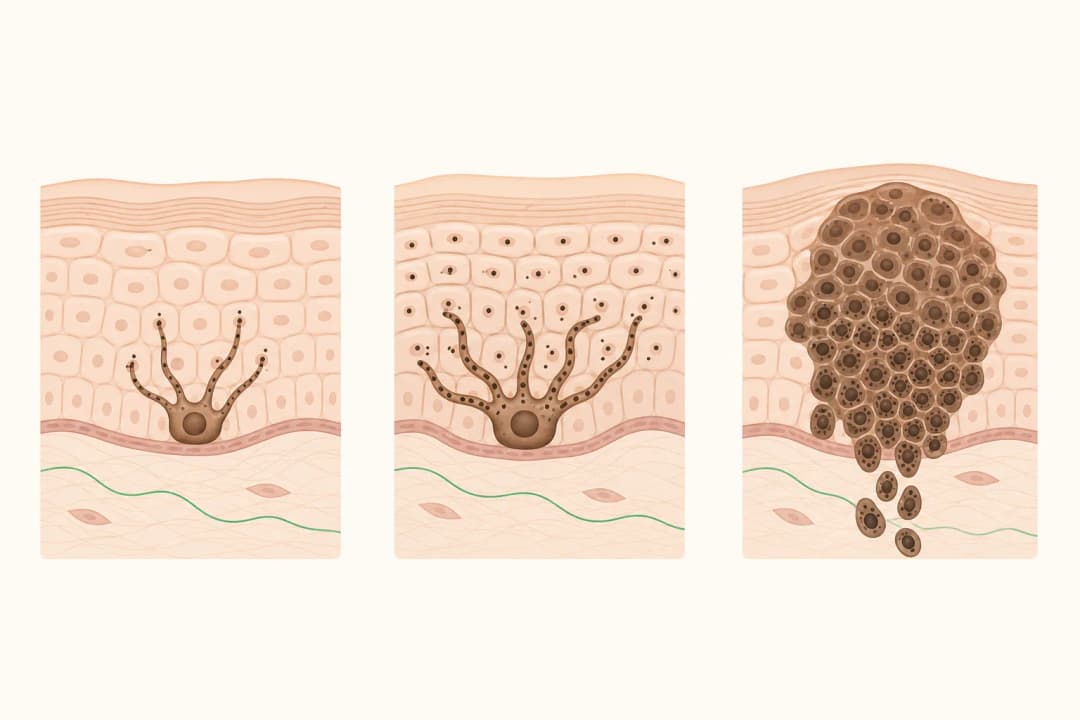
Stage zero melanoma is an early melanoma confined to the outer skin layer, where prompt assessment and complete removal are central to care.
This answers one question. It is not a diagnosis and does not replace an assessment by a licensed doctor.
At a glance
- Also called
- Melanoma in situ
- Location
- Outer skin layer
- Usual focus
- Complete removal and skin surveillance
The short answer
Stage zero melanoma, also called melanoma in situ, is abnormal pigment-forming cells confined to the epidermis, the skin's outer layer. It has not grown into deeper skin on the information implied by this stage label. A dermatologist confirms the diagnosis by examining a skin sample under a microscope. Early attention matters because untreated abnormal cells can extend deeper over time.
What the stage means
Staging describes how far melanoma has extended, not how a mole looks to you. Stage zero is different from invasive melanoma because the cells remain above the deeper layer that contains blood and lymph vessels. The diagnosis may follow a changing mole, an unusual dark patch or a biopsy of a lesion noticed during a skin examination. The wider melanoma picture is explained in Melanoma.
A stage zero diagnosis does not call for guessing whether every mark is concerning. It does call for a clear treatment plan and a careful look at the surrounding skin.
What to do next
Keep the pathology report and ask which edges of the sampled area were examined. Treatment commonly involves removing the melanoma and a small margin of nearby skin; this is often called Surgical Excision or Skin Cancer Surgery. The exact margin and closure depend on the lesion's location, size and microscopic features. Do not pick at a biopsy site, and protect healing skin as instructed.
Attend the planned skin checks. Follow-Up After Cancer Treatment can help organize surveillance, while regular self-checks make it easier to notice a new or changing mark. A Sentinel Lymph Node Biopsy is generally a discussion for selected invasive melanomas rather than a routine step for a lesion confined to the epidermis.
When to seek care
Arrange a dermatology review for a spot that changes in size, shape or colour, develops bleeding or crusting, or remains unlike your other marks. Seek prompt medical attention for spreading redness, increasing pain, pus or fever after a biopsy or removal. New headaches, weakness or other neurological symptoms need urgent assessment, but they are not how stage zero melanoma is defined.
Questions for your doctor
Ask: What did the pathology show? Were the edges clear? How much skin needs removal? When is the wound review? How often should my skin be examined? Which changes should prompt an earlier appointment?
Find care
General Clinics & Polyclinics in Abu Dhabi
That answer is general. If you want it applied to your own case, these are licensed general clinics & polyclinics listed in Abu Dhabi.
27 Ar Ruwwad St - Shakhbout City - MSH4 - Abu Dhabi - United Arab Emirates
Accepts: Daman, Thiqa, Cigna, MetLife +20 more
Al Ruwais, Al Dhafrah
Accepts: Daman, Thiqa, AXA, Cigna +16 more
Al Bahyah - Al Bahyah Old - Abu Dhabi - United Arab Emirates
Accepts: Daman, Thiqa, Cigna, Allianz Care +18 more
Abu Dhabi
Accepts: Daman, Thiqa, AXA, Cigna +27 more
Ordered by verification status and how complete each clinic's public record is, then alphabetically. This is a directory listing, not a ranking — Zavis does not rate or recommend providers.
A factual listing drawn from the DHA, DOH and MOHAP licence registers. It is not a referral, an endorsement, or advice that any of these providers is right for you.
Questions people ask
Is stage zero melanoma invasive?
No. By definition, the abnormal cells are confined to the epidermis rather than growing into deeper skin.
Is lymph-node surgery always needed?
No. It is not usually routine for melanoma confined to the epidermis; your specialist bases any staging procedure on the pathology.
Related
Related reading
Keep reading
Medical disclaimer. This page is general health information, not medical advice, and it cannot diagnose you. Always consult a licensed healthcare provider about your own symptoms and treatment. In an emergency in the UAE, call 998 for an ambulance.