
Melanoma stage 1: what to know
Short answer
Stage 1 melanoma is an early melanoma that is limited to the skin and assessed by its thickness and other pathology features.
This answers one question. It is not a diagnosis and does not replace an assessment by a licensed doctor.
At a glance
- Usually limited to
- The skin
- Key report details
- Thickness, ulceration, and margins
- Possible next step
- Wide local excision; sentinel node discussion in selected cases
What stage 1 means
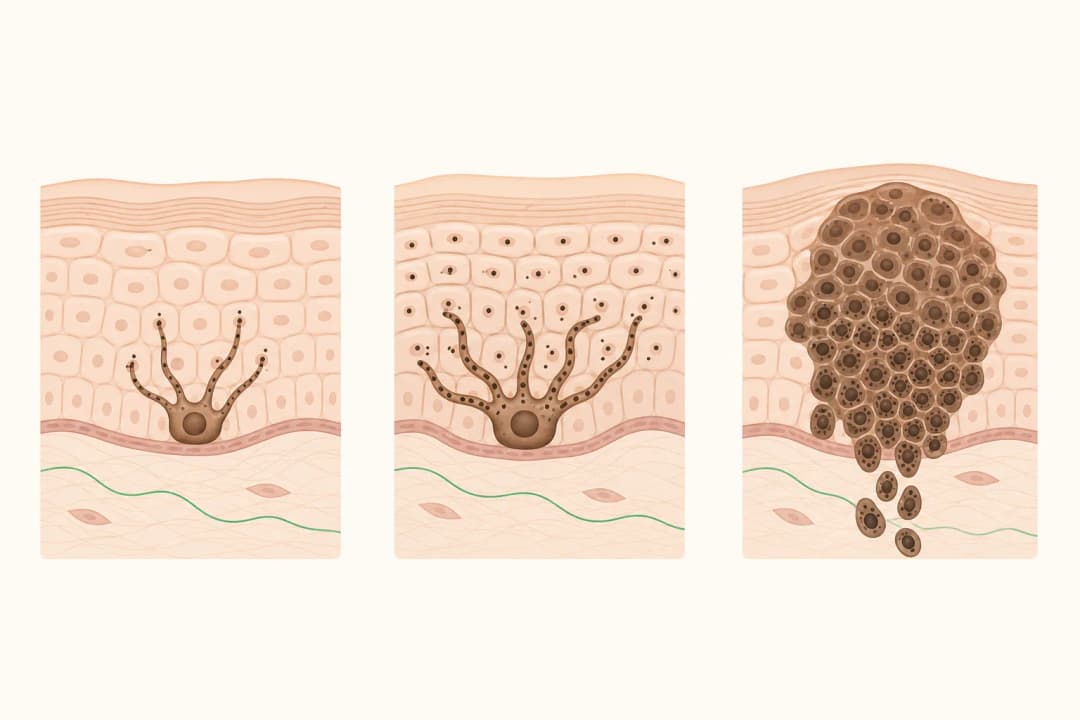
Staging brings together the melanoma’s depth in the skin, whether the surface is ulcerated, and whether examination has found spread to lymph nodes or distant organs. Stage 1 generally describes a tumour confined to the skin without evidence of spread. The pathology report helps your team distinguish an earlier stage 1A pattern from a stage 1B pattern, although the exact category depends on the findings recorded.
The stage is not a judgement about how you feel or how visible the mole was. A small-looking lesion can still need prompt specialist care, and a diagnosis does not establish what another changing mark represents. Learn more about [Melanoma] and how it is evaluated.
What to do next
Treatment commonly starts with [Surgical Excision] to remove the melanoma and a margin of nearby skin. The removed tissue is examined to confirm the diagnosis and margins. Depending on thickness and other features, your specialist may discuss a [Sentinel Lymph Node Biopsy]; it samples the first draining lymph node and is not required for every stage 1 melanoma.
Keep the wound-care instructions, arrange the pathology discussion, and ask how often your skin and lymph-node areas should be checked. Protect exposed skin from ultraviolet light and examine your skin in a consistent way so a new or changing lesion is noticed early. [Follow-Up After Cancer Treatment] can help explain surveillance planning.
When to seek care
Contact your treating team promptly if the surgical wound becomes increasingly red, swollen, hot, painful, or produces discharge, or if you develop fever. Seek assessment for a new or changing mole, a sore that does not heal, bleeding, or a firm lump near the original site or in the nearby lymph-node region. New persistent symptoms such as unexplained headaches, weakness, or vision changes need medical attention; they do not by themselves identify spread.
Questions for your doctor
Ask: What are the measured thickness and ulceration findings? Were the margins clear? Is sentinel node sampling appropriate for my pathology? How will the scar and nearby lymph nodes be checked? Which changes should prompt an earlier appointment?
Find care
General Clinics & Polyclinics in Abu Dhabi
That answer is general. If you want it applied to your own case, these are licensed general clinics & polyclinics listed in Abu Dhabi.
27 Ar Ruwwad St - Shakhbout City - MSH4 - Abu Dhabi - United Arab Emirates
Accepts: Daman, Thiqa, Cigna, MetLife +20 more
Al Ruwais, Al Dhafrah
Accepts: Daman, Thiqa, AXA, Cigna +16 more
Al Bahyah - Al Bahyah Old - Abu Dhabi - United Arab Emirates
Accepts: Daman, Thiqa, Cigna, Allianz Care +18 more
Abu Dhabi
Accepts: Daman, Thiqa, AXA, Cigna +27 more
Ordered by verification status and how complete each clinic's public record is, then alphabetically. This is a directory listing, not a ranking — Zavis does not rate or recommend providers.
A factual listing drawn from the DHA, DOH and MOHAP licence registers. It is not a referral, an endorsement, or advice that any of these providers is right for you.
Questions people ask
Is stage 1 melanoma serious?
It is a cancer diagnosis that needs specialist treatment and follow-up, but stage 1 indicates no identified spread beyond the skin at staging.
Does every stage 1 melanoma need a sentinel node biopsy?
No. The decision depends on the melanoma’s pathology features and your specialist’s assessment.
Related
Related reading
Keep reading
Medical disclaimer. This page is general health information, not medical advice, and it cannot diagnose you. Always consult a licensed healthcare provider about your own symptoms and treatment. In an emergency in the UAE, call 998 for an ambulance.