
What should you know about melanoma in situ surgery?
Short answer
Surgery for melanoma in situ removes the lesion with a planned surrounding margin, then pathology checks whether melanoma remains at the edges.
This answers one question. It is not a diagnosis and does not replace an assessment by a licensed doctor.
At a glance
- Main aim
- Remove the lesion and a planned border of nearby skin.
- After removal
- Pathology examines the tissue edges for remaining melanoma cells.
- Recovery
- Dressings, activity limits and stitch care depend on the wound and site.
The purpose of excision
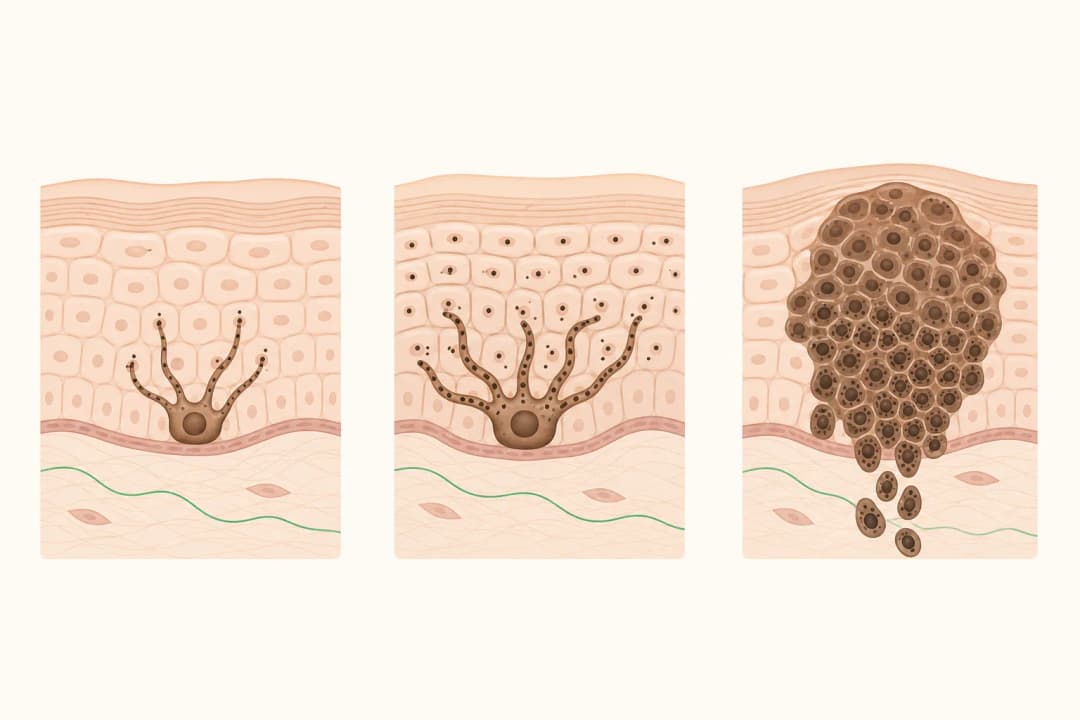
Because melanoma in situ is limited to the outer skin layer, the usual surgical aim is to remove the affected area and a border of nearby skin. The size and shape of the border depend on the site, the visible changes and the pathology findings. Local anaesthetic often numbs the area while the surgeon removes the tissue. The wound may be closed with stitches, left to heal gradually, or reconstructed when the site needs special care.
The removed tissue is examined to assess the margins. If cells reach an edge, your team may discuss another procedure. [Excisional Surgery](/treatments/surgical-dermatology/excisional-surgery/) explains the general approach.
Preparing and recovering
Tell the surgical team about medicines that affect bleeding, allergies, diabetes, immune conditions and previous problems with wound healing. Follow instructions about washing, dressings and activity. Keep the wound protected from rubbing and direct sun while it heals, and attend the appointment for stitch removal if one is arranged. Do not judge the final scar while the tissue is still swollen or pink; its appearance changes during healing. Keep the pathology and operative information for future visits.
Wound symptoms that need attention
Call the surgical team if pain, redness, warmth or swelling is increasing rather than settling, or if the wound opens, drains pus, develops a spreading rash, or continues bleeding after firm pressure. Fever with a worsening wound also needs prompt advice. Get urgent help for heavy bleeding, faintness, breathing difficulty or swelling affecting the mouth or throat.
Before agreeing to surgery
Ask where the incision will be, how the wound will be closed, what margin is planned, when the final pathology will be available, how movement or appearance may be affected, and who to contact after hours. Ask whether a plastic or reconstructive surgeon should be involved for a sensitive location.
Find care
General Clinics & Polyclinics in Abu Dhabi
That answer is general. If you want it applied to your own case, these are licensed general clinics & polyclinics listed in Abu Dhabi.
27 Ar Ruwwad St - Shakhbout City - MSH4 - Abu Dhabi - United Arab Emirates
Accepts: Daman, Thiqa, Cigna, MetLife +20 more
Al Ruwais, Al Dhafrah
Accepts: Daman, Thiqa, AXA, Cigna +16 more
Al Bahyah - Al Bahyah Old - Abu Dhabi - United Arab Emirates
Accepts: Daman, Thiqa, Cigna, Allianz Care +18 more
Abu Dhabi
Accepts: Daman, Thiqa, AXA, Cigna +27 more
Ordered by verification status and how complete each clinic's public record is, then alphabetically. This is a directory listing, not a ranking — Zavis does not rate or recommend providers.
A factual listing drawn from the DHA, DOH and MOHAP licence registers. It is not a referral, an endorsement, or advice that any of these providers is right for you.
Questions people ask
Will surgery always require a large wound?
The wound depends on the lesion and body site; the surgeon can explain closure options and likely scar placement before the procedure.
What if the margin is not clear?
Your team may recommend further removal so the affected area and an appropriate surrounding border are excised.
Related
Related reading
Keep reading
Medical disclaimer. This page is general health information, not medical advice, and it cannot diagnose you. Always consult a licensed healthcare provider about your own symptoms and treatment. In an emergency in the UAE, call 998 for an ambulance.