
What should you know about malignant melanoma pathology outlines?
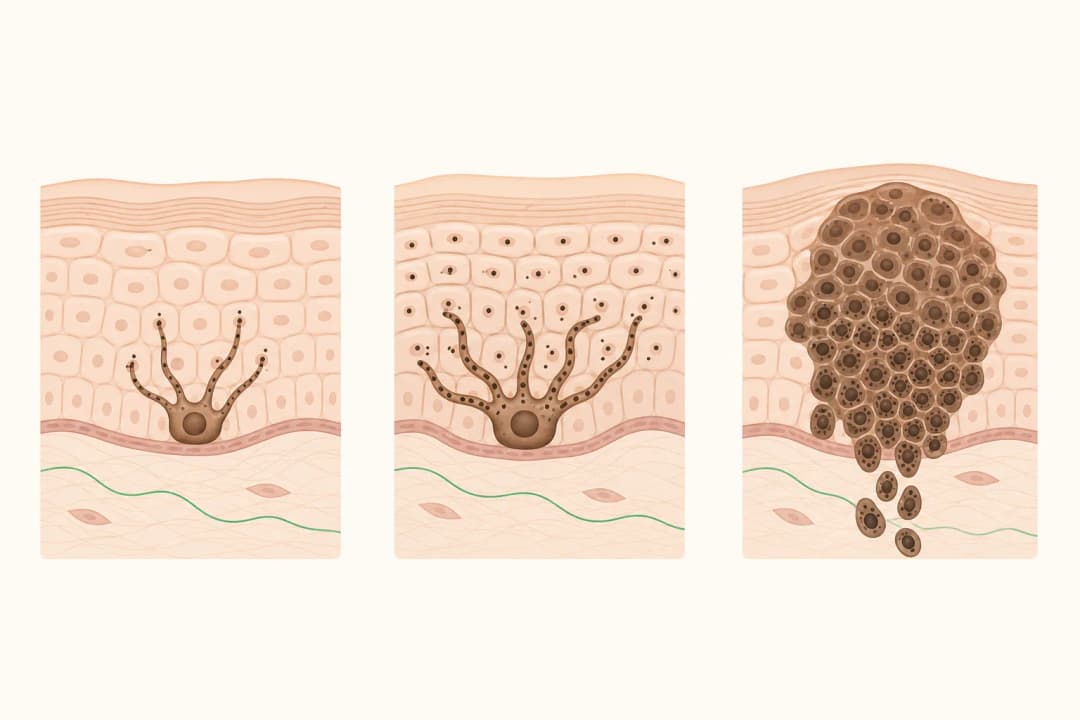
Short answer
Malignant melanoma pathology outlines describe the tissue findings that confirm melanoma and help doctors judge its depth, margins, spread risk and next treatment steps.
This answers one question. It is not a diagnosis and does not replace an assessment by a licensed doctor.
At a glance
- Confirms
- Whether melanoma is present in the examined tissue.
- Common measurements
- Tumour thickness, ulceration and specimen margins.
- Used with
- Examination, lymph-node assessment and imaging when indicated.
The short answer
A malignant melanoma pathology report translates what a pathologist sees in removed tissue into information for your care team. It confirms whether melanoma is present and records features such as tumour thickness, ulceration, margins and cell characteristics. The report is one part of staging and should be read with the examination and imaging findings.
How to read the report
The report may name the melanoma subtype, measure its thickness, state whether ulceration is present and describe mitotic activity or regression. Margins show whether melanoma reaches the edges of the specimen. A report may also say whether lymphatic invasion, microsatellites or lymph-node involvement was identified. Not every term appears on every report.
These findings do not by themselves predict exactly what will happen. Your specialist combines them with the tumour location, examination and any scans to decide whether further excision, lymph-node assessment, surveillance or systemic treatment is appropriate.
What to do with the result
Request a copy of the final report and ask the treating clinician to explain unfamiliar terms in plain language. Check whether the specimen is complete, whether the margins are clear and whether the measured thickness is stated. If the report is amended or sent for review, ask what changed and whether it alters the plan.
Keep pathology, operative and imaging reports together. A second pathology opinion may be considered when the diagnosis or treatment implications are uncertain, especially for an unusual specimen.
When to seek care
Contact your care team promptly if you do not understand a result, have not received a planned pathology report, or notice new swelling near the treated area. Seek urgent help for heavy wound bleeding, fever with increasing redness or pain, wound separation, sudden weakness, severe headache or new breathing difficulty. These symptoms need assessment regardless of the report wording.
Questions for your doctor
Ask which findings confirm melanoma, what the thickness and margin statements mean, whether lymph nodes or scans are needed, whether another excision is advised, and how the pathology affects follow-up.
Find care
General Clinics & Polyclinics in Abu Dhabi
That answer is general. If you want it applied to your own case, these are licensed general clinics & polyclinics listed in Abu Dhabi.
27 Ar Ruwwad St - Shakhbout City - MSH4 - Abu Dhabi - United Arab Emirates
Accepts: Daman, Thiqa, Cigna, MetLife +20 more
Al Ruwais, Al Dhafrah
Accepts: Daman, Thiqa, AXA, Cigna +16 more
Al Bahyah - Al Bahyah Old - Abu Dhabi - United Arab Emirates
Accepts: Daman, Thiqa, Cigna, Allianz Care +18 more
Abu Dhabi
Accepts: Daman, Thiqa, AXA, Cigna +27 more
Ordered by verification status and how complete each clinic's public record is, then alphabetically. This is a directory listing, not a ranking — Zavis does not rate or recommend providers.
A factual listing drawn from the DHA, DOH and MOHAP licence registers. It is not a referral, an endorsement, or advice that any of these providers is right for you.
Questions people ask
Does a pathology report alone provide the full stage?
Usually not. Staging combines pathology with examination and, when appropriate, lymph-node assessment or imaging.
What does a clear margin mean?
It means no melanoma was seen at the examined edge of the removed tissue. Your surgeon will explain whether the margin is sufficient for your site and result.
Related
Related reading
Keep reading
Medical disclaimer. This page is general health information, not medical advice, and it cannot diagnose you. Always consult a licensed healthcare provider about your own symptoms and treatment. In an emergency in the UAE, call 998 for an ambulance.