
How long does strength training rehabilitation take to work for patellar tendinitis?
Short answer
Strength training rehabilitation for patellar tendinitis often takes several weeks to begin improving symptoms and several months to rebuild useful strength and tolerance.
This answers one question. It is not a diagnosis and does not replace an assessment by a licensed doctor.
At a glance
- Typical pattern
- Gradual improvement over weeks, with strength and activity tolerance developing over months
- Track progress by
- Daily function, exercise tolerance, and how the knee feels the following morning
The short answer
Strength training rehabilitation for patellar tendinitis often takes several weeks to begin improving symptoms and several months to rebuild useful strength and tolerance. The pace depends on how irritable the tendon is, how long symptoms have been present, your starting strength, and whether training load is adjusted alongside exercises. A small reduction in pain during daily movement may come before you feel ready to run, jump, or return to sport.
What progress can look like
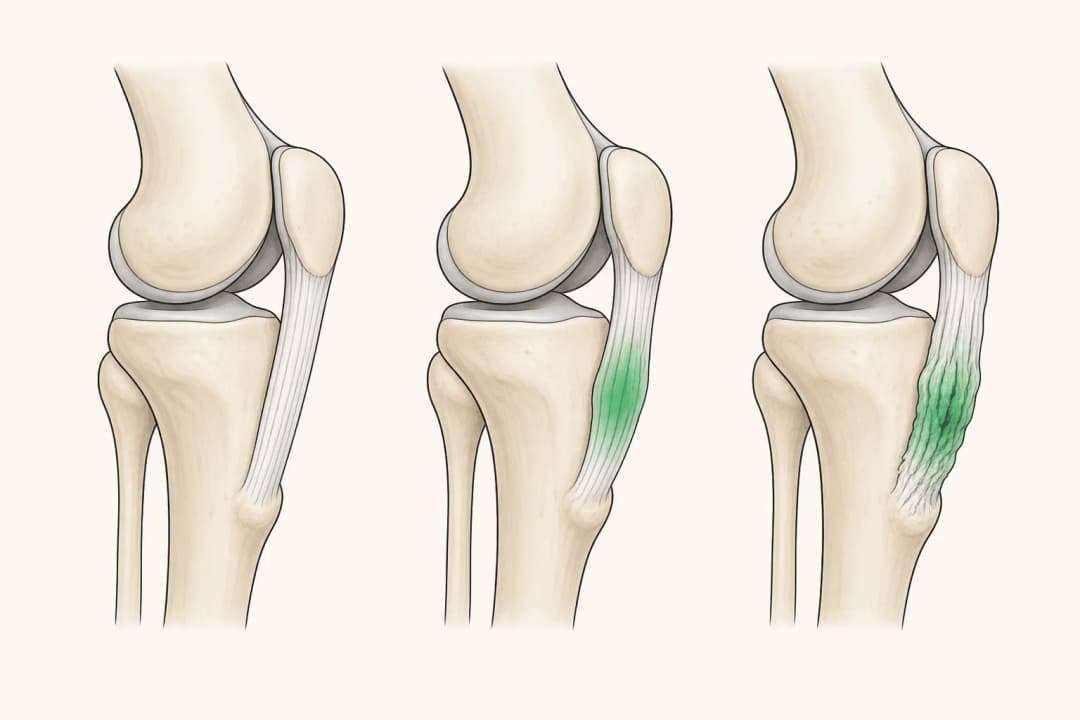
Patellar tendinitis, also called patellar tendinopathy or jumper's knee, affects the tendon connecting the kneecap to the shinbone. Rehabilitation aims to help that tendon and the surrounding leg muscles tolerate load again. Early sessions may focus on controlled contractions and slow movements. Later work may add heavier resistance, squats, step-downs, hopping, and sport-specific drills when your knee can manage them.
Progress is better judged by function than by one pain-free day. Useful signs include easier stairs, a steadier single-leg squat, less stiffness after rest, and a knee that settles back to its usual level by the next day. A flare after increasing resistance, repetitions, running, or jumping can mean the recent load was too much, not that rehabilitation has failed.
How to support recovery
Follow a progressive programme designed around your current capacity. Perform the prescribed exercises with controlled technique, record how your knee responds during the session and the following morning, and tell your physiotherapist if symptoms remain more intense than usual. Keep everyday movement within a tolerable range while temporarily reducing activities that repeatedly provoke sharp pain, such as deep jumping or sudden increases in running.
Avoid testing the tendon by repeatedly checking whether it can tolerate a full training session. Progress may involve changing resistance, range of motion, speed, or recovery time one factor at a time. If there is little functional improvement after a consistent period, or exercise becomes increasingly painful, arrange a reassessment so the diagnosis, technique, and loading plan can be reviewed.
When to seek care
Seek prompt medical assessment for a sudden pop, marked swelling, a visible change in the tendon or kneecap, inability to straighten the knee, or an inability to bear weight after an injury. Arrange a clinical review for worsening pain at rest, repeated giving-way, significant locking, fever, or redness and warmth around the knee. These features need assessment rather than a simple increase in strengthening work.
Questions for your doctor or physiotherapist
Ask which movements currently show that your tendon is ready for more load, how to modify running or jumping while you build strength, and what response the following morning should prompt a lighter session. You can also ask how progress will be measured, when a return-to-sport plan may start, and what other cause should be considered if your symptoms do not follow the expected pattern.
Find care
General Clinics & Polyclinics in Abu Dhabi
That answer is general. If you want it applied to your own case, these are licensed general clinics & polyclinics listed in Abu Dhabi.
27 Ar Ruwwad St - Shakhbout City - MSH4 - Abu Dhabi - United Arab Emirates
Accepts: Daman, Thiqa, Cigna, MetLife +20 more
Al Ruwais, Al Dhafrah
Accepts: Daman, Thiqa, AXA, Cigna +16 more
Al Bahyah - Al Bahyah Old - Abu Dhabi - United Arab Emirates
Accepts: Daman, Thiqa, Cigna, Allianz Care +18 more
Abu Dhabi
Accepts: Daman, Thiqa, AXA, Cigna +27 more
Ordered by verification status and how complete each clinic's public record is, then alphabetically. This is a directory listing, not a ranking — Zavis does not rate or recommend providers.
A factual listing drawn from the DHA, DOH and MOHAP licence registers. It is not a referral, an endorsement, or advice that any of these providers is right for you.
Questions people ask
Can I keep exercising during rehabilitation?
Often, yes, but the activity and intensity may need to be modified. Your rehabilitation plan should balance useful tendon loading with enough recovery to prevent repeated flare-ups.
What if my knee hurts more after strengthening?
Discuss the response with your physiotherapist. The resistance, repetitions, range, or exercise choice may need adjustment, especially if the increase lasts into the next day or affects walking and stairs.
When can I return to jumping or sport?
Return is usually progressed after you can perform the required strength and landing tasks with controlled movement and a stable symptom response. A clinician can set sport-specific checkpoints for you.
Related
Related reading
Keep reading
Medical disclaimer. This page is general health information, not medical advice, and it cannot diagnose you. Always consult a licensed healthcare provider about your own symptoms and treatment. In an emergency in the UAE, call 998 for an ambulance.