
How long does strength training rehabilitation take to work for gluteal tendinopathy?
Short answer
Strength training rehabilitation for gluteal tendinopathy may take several weeks to reduce irritability, while rebuilding hip strength for sport or stairs can take longer.
This answers one question. It is not a diagnosis and does not replace an assessment by a licensed doctor.
At a glance
- Common irritants
- Side-lying, hip compression, hills and single-leg loading may aggravate symptoms.
- Progress sign
- Daily tasks and exercise recover more comfortably by the following day.
What the timeline means
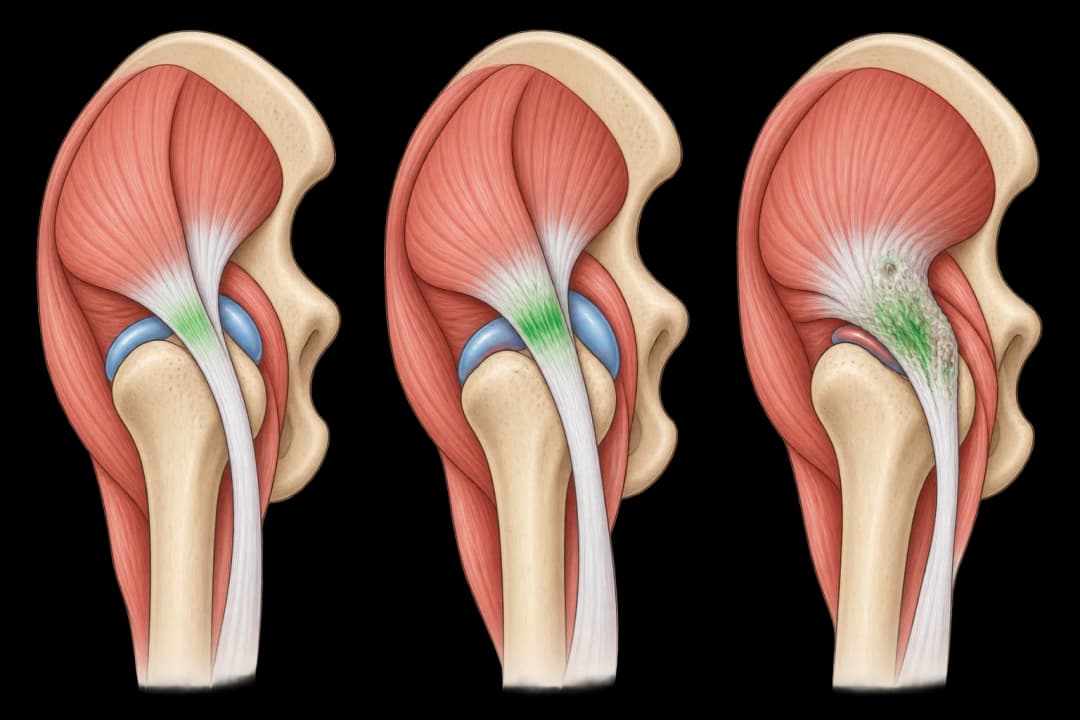
Gluteal tendinopathy involves the tendons of the hip-side muscles, often causing pain on the outer hip with lying on that side, stairs, hills or single-leg tasks. Rehabilitation usually starts by reducing positions that compress the tendon, then adds isometric and controlled strengthening before more demanding hip abduction, step and running work.
A tendon can remain sensitive even as capacity improves. Progress is clearer when you can sit, sleep, walk uphill or climb stairs with fewer symptoms and recover normally after exercise. The right pace depends on irritability, baseline strength, sleep and daily loading.
What you can do
Avoid leaning onto the painful hip, crossing the legs tightly or sleeping directly on that side if those positions reproduce pain. Use a pillow between the knees when side-lying if it helps. Complete the prescribed hip exercises with controlled alignment, and increase resistance or range only when the response remains manageable through the next day.
When to seek care
Arrange a clinical assessment for severe night pain, inability to walk, sudden weakness, major swelling, fever or pain after a fall. Seek review if pain spreads, your hip repeatedly gives way, or a graded programme produces worsening symptoms rather than improved function. Other hip or back conditions can mimic outer-hip tendon pain.
Questions for your doctor or physiotherapist
Ask which positions are compressing the tendon, how much walking or stair work is appropriate, and which strength test will guide progression. Ask when side-lying, hills and running can be reintroduced.
Find care
General Clinics & Polyclinics in Abu Dhabi
That answer is general. If you want it applied to your own case, these are licensed general clinics & polyclinics listed in Abu Dhabi.
27 Ar Ruwwad St - Shakhbout City - MSH4 - Abu Dhabi - United Arab Emirates
Accepts: Daman, Thiqa, Cigna, MetLife +20 more
Al Ruwais, Al Dhafrah
Accepts: Daman, Thiqa, AXA, Cigna +16 more
Al Bahyah - Al Bahyah Old - Abu Dhabi - United Arab Emirates
Accepts: Daman, Thiqa, Cigna, Allianz Care +18 more
Abu Dhabi
Accepts: Daman, Thiqa, AXA, Cigna +27 more
Ordered by verification status and how complete each clinic's public record is, then alphabetically. This is a directory listing, not a ranking — Zavis does not rate or recommend providers.
A factual listing drawn from the DHA, DOH and MOHAP licence registers. It is not a referral, an endorsement, or advice that any of these providers is right for you.
Questions people ask
Is pain during every exercise a sign of damage?
Not always, but a strong or lasting flare means the exercise dose, position or technique should be reviewed.
Can I keep walking with gluteal tendinopathy?
Often, but distance, hills and pace may need temporary adjustment to keep symptoms manageable.
Related
Related reading
Keep reading
Medical disclaimer. This page is general health information, not medical advice, and it cannot diagnose you. Always consult a licensed healthcare provider about your own symptoms and treatment. In an emergency in the UAE, call 998 for an ambulance.