
Exercises for trigger finger: what to know
Short answer
Exercises for trigger finger should keep the finger moving gently without forcing a painful catch or increasing tendon irritation.
This answers one question. It is not a diagnosis and does not replace an assessment by a licensed doctor.
At a glance
- Movement rule
- Gentle range only; do not force a catch
- Common aggravator
- Repeated forceful gripping
- Possible support
- A clinician-guided splint or treatment plan
The short answer
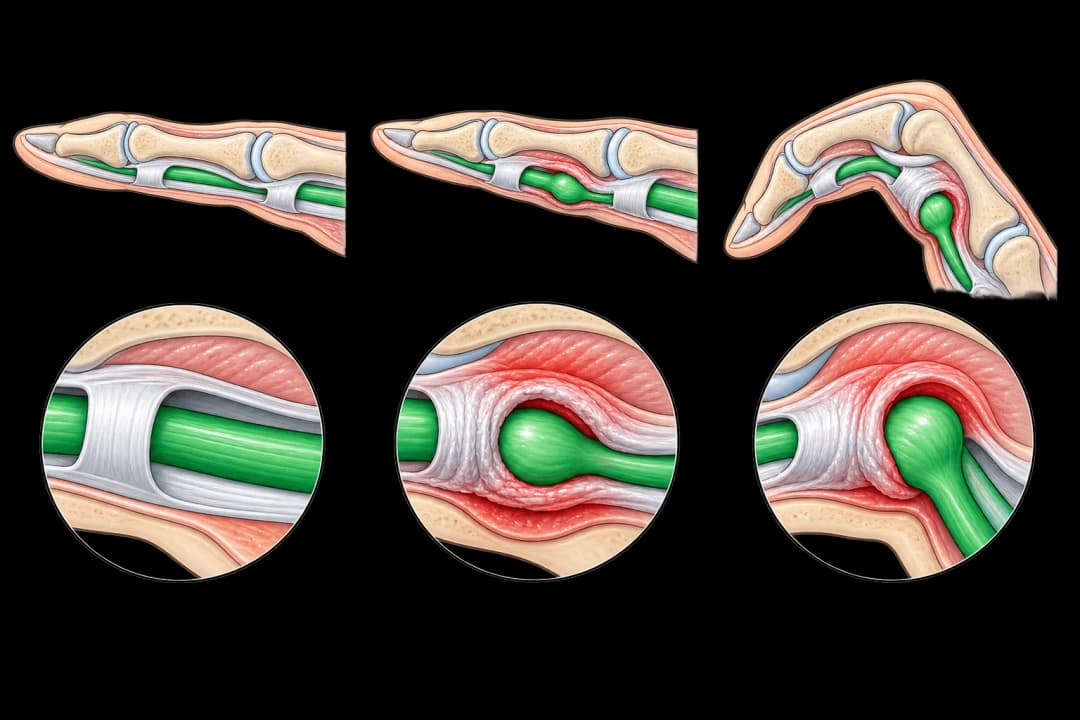
Exercises for trigger finger should keep the finger moving gently without forcing a painful catch or increasing tendon irritation. The problem involves a thickened or irritated tendon pathway, which can make bending and straightening feel stiff, sore, or jerky.
What movement can help
Gentle finger opening, supported bending and straightening, and comfortable tendon-gliding movements may preserve motion. Keep the wrist and other fingers relaxed, and use the opposite hand only for light support rather than forcing the affected finger through a lock. Finger Stiffness is common with this problem, especially after rest. Repeated gripping, tool use, and sustained flexion can keep irritating the tendon, so changing how you hold objects may matter as much as the exercises.
A careful daily approach
Move within a comfortable range and stop before a painful snap. Take breaks from forceful gripping, use larger handles where practical, and avoid repeatedly checking whether the finger will catch. A clinician may suggest Splinting, often to reduce triggering during rest or activity. If symptoms continue, treatment may include Cortisone Injection; persistent locking can require discussion of Trigger Finger Release. Do not massage firmly over a tender lump or force the finger straight.
When to seek care
Arrange an assessment when catching interferes with dressing, writing, work, or sleep, or when the finger stays locked in a bent position. Seek prompt care after an injury with sudden swelling, colour change, numbness, or inability to move the finger. Increasing pain despite reducing hand strain is also a reason to stop self-directed progression and get an examination.
Questions for your doctor
Which movements are safe for my finger? Should I wear a splint and when? What activities are aggravating the tendon? When would an injection be considered? If locking persists, what would recovery from release involve?
Find care
General Clinics & Polyclinics in Abu Dhabi
That answer is general. If you want it applied to your own case, these are licensed general clinics & polyclinics listed in Abu Dhabi.
27 Ar Ruwwad St - Shakhbout City - MSH4 - Abu Dhabi - United Arab Emirates
Accepts: Daman, Thiqa, Cigna, MetLife +20 more
Al Ruwais, Al Dhafrah
Accepts: Daman, Thiqa, AXA, Cigna +16 more
Al Bahyah - Al Bahyah Old - Abu Dhabi - United Arab Emirates
Accepts: Daman, Thiqa, Cigna, Allianz Care +18 more
Abu Dhabi
Accepts: Daman, Thiqa, AXA, Cigna +27 more
Ordered by verification status and how complete each clinic's public record is, then alphabetically. This is a directory listing, not a ranking — Zavis does not rate or recommend providers.
A factual listing drawn from the DHA, DOH and MOHAP licence registers. It is not a referral, an endorsement, or advice that any of these providers is right for you.
Questions people ask
Can exercises make trigger finger worse?
They can irritate it if they are forceful or repeated through pain, so use a comfortable range and reduce aggravating hand tasks.
When is a splint useful?
A splint may limit positions that trigger catching, especially during rest or activities identified by your clinician.
Related
Related reading
Keep reading
Medical disclaimer. This page is general health information, not medical advice, and it cannot diagnose you. Always consult a licensed healthcare provider about your own symptoms and treatment. In an emergency in the UAE, call 998 for an ambulance.