
Causes of Vulvar Melanoma
Short answer
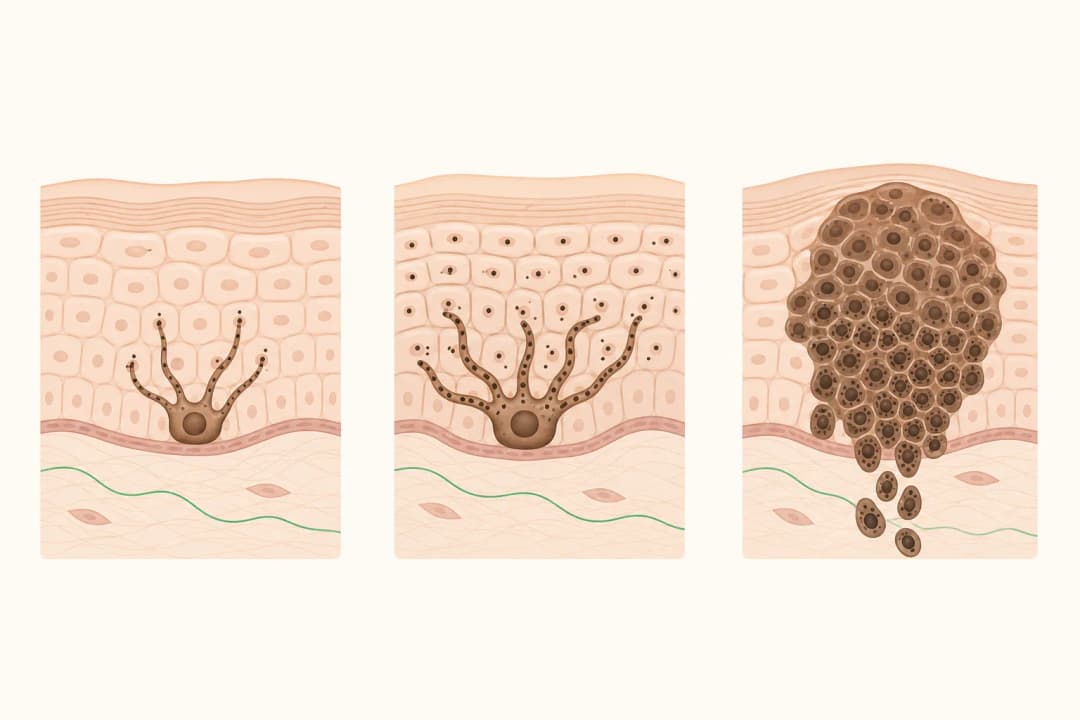
Vulvar melanoma develops when pigment-making cells in vulvar tissue acquire changes that allow uncontrolled growth; the exact cause is often unknown.
This answers one question. It is not a diagnosis and does not replace an assessment by a licensed doctor.
At a glance
- Cell involved
- Melanocytes, which make pigment
- Cause
- Often not identifiable
- Assessment
- Clinical examination and biopsy
What may contribute
Unlike many melanomas on sun-exposed skin, vulvar melanoma is not usually explained by sunlight alone. It begins in melanocytes, the cells that produce pigment, and can arise on vulvar skin or mucosal tissue. Older age, a personal history of melanoma, and changes in pigment cells may be relevant, but a person can develop it without an obvious risk factor. A dark patch, new pigmented spot, lump, bleeding area, or persistent itch can have several causes, so appearance alone cannot confirm melanoma.
What to do next
Arrange a dermatology or gynaecology assessment for a new or changing vulvar mark. The clinician may inspect the area closely and recommend a biopsy, in which a small tissue sample is examined to identify the cell type. If melanoma is confirmed, assessment may include checking nearby lymph nodes and planning removal with an appropriate margin. Learn about [Melanoma](/conditions/melanoma/) and [Surgical Excision](/treatments/surgical-dermatology/excisional-surgery/) before the appointment.
When to seek care
Seek prompt medical review for a vulvar lesion that is enlarging, developing uneven colour or edges, becoming raised, bleeding, crusting, or causing persistent itch or soreness. Seek urgent help for heavy bleeding, rapidly increasing swelling, severe pain, fever, or difficulty passing urine. These signs do not establish cancer, but they should not be watched indefinitely.
Questions for your doctor
Ask whether the change needs a biopsy, which specialist will perform it, when results should be available, and whether lymph-node assessment such as [Sentinel Lymph Node Biopsy](/treatments/diagnostics-and-staging/sentinel-lymph-node-biopsy/) is relevant. If treatment is needed, ask how [Skin Cancer Surgery](/treatments/surgical-dermatology/skin-cancer-surgery/) or [Immunotherapy](/treatments/systemic-therapy/immunotherapy/) fits your diagnosis.
Find care
General Clinics & Polyclinics in Abu Dhabi
That answer is general. If you want it applied to your own case, these are licensed general clinics & polyclinics listed in Abu Dhabi.
27 Ar Ruwwad St - Shakhbout City - MSH4 - Abu Dhabi - United Arab Emirates
Accepts: Daman, Thiqa, Cigna, MetLife +20 more
Al Ruwais, Al Dhafrah
Accepts: Daman, Thiqa, AXA, Cigna +16 more
Al Bahyah - Al Bahyah Old - Abu Dhabi - United Arab Emirates
Accepts: Daman, Thiqa, Cigna, Allianz Care +18 more
Abu Dhabi
Accepts: Daman, Thiqa, AXA, Cigna +27 more
Ordered by verification status and how complete each clinic's public record is, then alphabetically. This is a directory listing, not a ranking — Zavis does not rate or recommend providers.
A factual listing drawn from the DHA, DOH and MOHAP licence registers. It is not a referral, an endorsement, or advice that any of these providers is right for you.
Questions people ask
Is vulvar melanoma caused by poor hygiene?
No. Hygiene does not explain the cell changes that cause melanoma.
Can a vulvar mole become melanoma?
A changing pigmented lesion should be examined, because visual inspection cannot reliably distinguish a mole from melanoma.
Related
Related reading
Keep reading
Medical disclaimer. This page is general health information, not medical advice, and it cannot diagnose you. Always consult a licensed healthcare provider about your own symptoms and treatment. In an emergency in the UAE, call 998 for an ambulance.