
Why asthma is an obstructive lung disease
Short answer
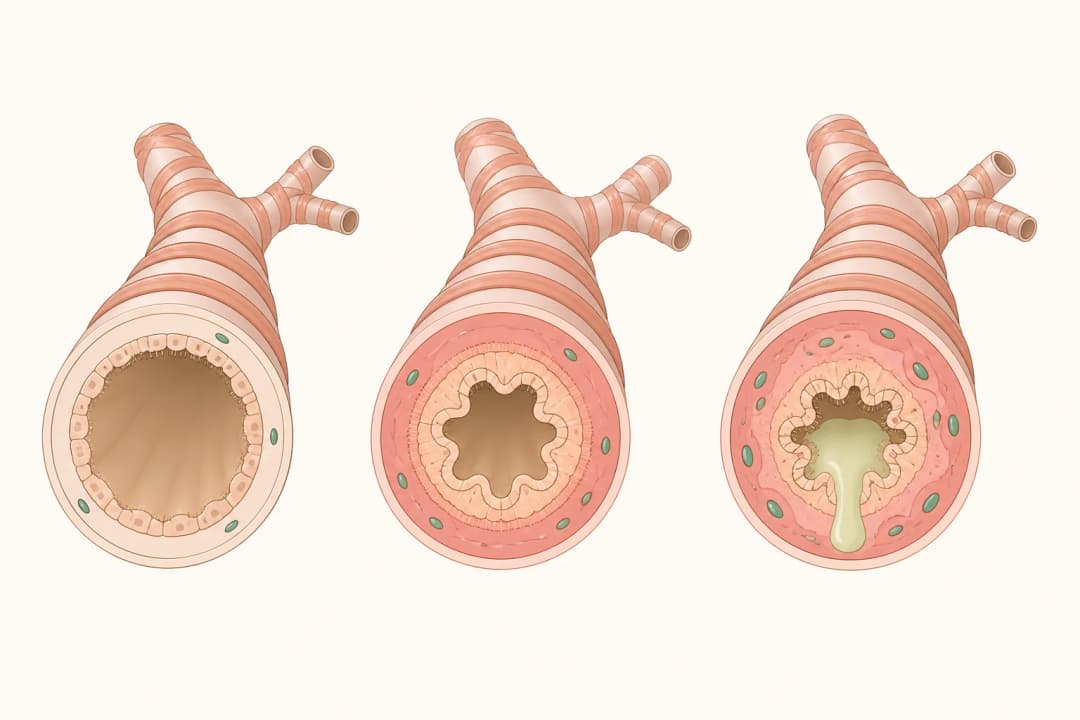
Asthma is an obstructive lung disease because inflamed, narrowed airways restrict airflow, especially during breathing out; unlike fixed obstruction, this limitation often varies and may improve with treatment.
This answers one question. It is not a diagnosis and does not replace an assessment by a licensed doctor.
At a glance
- Disease pattern
- Obstructive airflow limitation that often changes over time.
- Airway changes
- Muscle tightening, lining inflammation, and mucus narrow the bronchial tubes.
- Common checks
- Symptom history, spirometry, bronchodilator response, and peak-flow variation.
Obstruction in asthma
During asthma symptoms, muscles around the bronchial tubes tighten, the airway lining swells, and mucus can add further blockage. Air then meets more resistance as it leaves the lungs. Asthma can present with wheeze, cough, shortness of breath, or chest tightness, but symptoms can be absent between episodes.
The term obstructive describes the airflow pattern; it does not mean an object is physically lodged in the airway. Asthma differs from restrictive disorders, in which the lungs or chest have difficulty expanding to their expected volume.
How variable airflow is checked
A clinician combines the symptom pattern with breathing tests when suitable. Spirometry measures how much air you can force out and how quickly. Repeating it after a bronchodilator can show whether airflow improves. Peak-flow readings taken at different times may reveal variation that a single clinic test misses.
Keep a record of night waking, exercise limitation, triggers, and inhaler use. Take prescribed controller treatment regularly, check inhaler technique, and follow your written action plan. Normal breathing between episodes does not by itself exclude asthma, so arrange review if symptoms continue.
Acute airflow obstruction
Seek urgent help when breathing becomes rapidly harder, the prescribed reliever gives little or short-lived benefit, you struggle to walk or speak, the chest pulls inward between the ribs, or you become exhausted, confused, blue, or grey around the lips. These signs reflect severity of airflow limitation and require prompt treatment.
Questions about testing
Ask what your spirometry or peak-flow pattern shows, whether testing should be repeated when you have symptoms, and which changes in your readings activate the steps in your asthma plan. Discuss other explanations if the pattern is not typical or treatment has not improved control.
Find care
General Clinics & Polyclinics in Abu Dhabi
That answer is general. If you want it applied to your own case, these are licensed general clinics & polyclinics listed in Abu Dhabi.
27 Ar Ruwwad St - Shakhbout City - MSH4 - Abu Dhabi - United Arab Emirates
Accepts: Daman, Thiqa, Cigna, MetLife +20 more
Al Ruwais, Al Dhafrah
Accepts: Daman, Thiqa, AXA, Cigna +16 more
Al Bahyah - Al Bahyah Old - Abu Dhabi - United Arab Emirates
Accepts: Daman, Thiqa, Cigna, Allianz Care +18 more
Abu Dhabi
Accepts: Daman, Thiqa, AXA, Cigna +27 more
Ordered by verification status and how complete each clinic's public record is, then alphabetically. This is a directory listing, not a ranking — Zavis does not rate or recommend providers.
A factual listing drawn from the DHA, DOH and MOHAP licence registers. It is not a referral, an endorsement, or advice that any of these providers is right for you.
Questions people ask
Does obstructive mean something is stuck in my lung?
No. In asthma, obstruction refers to reduced airflow through narrowed bronchial tubes rather than a foreign object blocking the lung.
Can an asthma breathing test be normal?
Yes. Airflow limitation can vary, so testing between symptomatic periods may be normal. A clinician may repeat spirometry or use peak-flow monitoring alongside your history.
Is asthma the same as other obstructive lung diseases?
No. Conditions can share an obstructive test pattern but differ in cause, course, and response to treatment. Asthma is characterised by variable symptoms and airflow limitation.
Related
Related reading
Keep reading
Medical disclaimer. This page is general health information, not medical advice, and it cannot diagnose you. Always consult a licensed healthcare provider about your own symptoms and treatment. In an emergency in the UAE, call 998 for an ambulance.