
How alopecia areata involves the immune system
Short answer
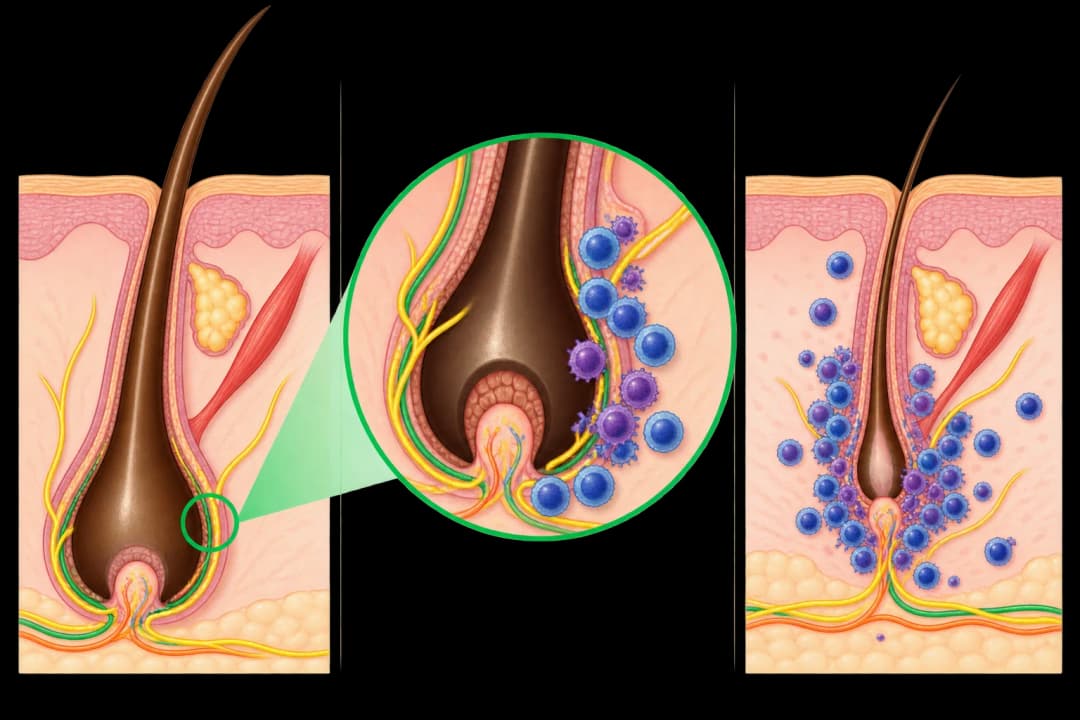
Alopecia areata is an autoimmune condition in which immune activity targets hair follicles and interrupts normal hair growth.
This answers one question. It is not a diagnosis and does not replace an assessment by a licensed doctor.
At a glance
- Condition type
- Alopecia areata is autoimmune rather than infectious.
- Hair follicle
- The follicle usually remains present despite interrupted growth.
- Treatment focus
- Some treatments aim to reduce inflammation or alter immune signalling.
The immune connection
The follicles usually remain in the skin rather than being destroyed. This helps explain why hair can resume growing when inflammation around a follicle settles, although the timing and completeness of regrowth cannot be predicted for an individual.
What autoimmune means in this condition
The immune system normally identifies threats and coordinates defence. In alopecia areata, that response is misdirected toward structures involved in hair production. The result often presents as smooth bald patches, while the surface skin may look otherwise normal. Brows, lashes, beard hair, nails, or other body hair can also be involved.
This does not mean the entire immune system is weak, and alopecia areata is not an infection that can spread between people. Stress may coincide with an episode for some individuals, but blaming a single event overlooks the condition's complex immune tendency.
How immune-directed care is chosen
A dermatologist first checks that the pattern fits alopecia areata and considers how active and extensive it is. Limited patches may be observed or treated locally. More extensive loss may lead to discussion of medicines that affect immune signals, with the choice shaped by the areas affected, other health conditions, and monitoring needs.
Continue ordinary hygiene and gentle hair care; you do not need to isolate or disinfect personal items because the condition is not contagious. Record changes in patches and mention new nail changes, eyebrow or eyelash loss, rashes, joint symptoms, or known immune-related diagnoses during the consultation.
When to get assessed
A new or rapidly changing bald patch deserves medical assessment, particularly when multiple regions or facial hair are involved. Pain, prominent redness, thick scale, crusting, discharge, or scar-like skin should be checked promptly because those features can signal a different scalp disorder or infection.
Questions about immune treatment
Consider asking which findings show active inflammation, whether local or broader treatment matches your pattern, and what monitoring a proposed medicine requires. Ask how existing illnesses, vaccines, infections, pregnancy plans, or other medicines could influence the treatment choice.
Find care
General Clinics & Polyclinics in Abu Dhabi
That answer is general. If you want it applied to your own case, these are licensed general clinics & polyclinics listed in Abu Dhabi.
27 Ar Ruwwad St - Shakhbout City - MSH4 - Abu Dhabi - United Arab Emirates
Accepts: Daman, Thiqa, Cigna, MetLife +20 more
Al Ruwais, Al Dhafrah
Accepts: Daman, Thiqa, AXA, Cigna +16 more
Al Bahyah - Al Bahyah Old - Abu Dhabi - United Arab Emirates
Accepts: Daman, Thiqa, Cigna, Allianz Care +18 more
Abu Dhabi
Accepts: Daman, Thiqa, AXA, Cigna +27 more
Ordered by verification status and how complete each clinic's public record is, then alphabetically. This is a directory listing, not a ranking — Zavis does not rate or recommend providers.
A factual listing drawn from the DHA, DOH and MOHAP licence registers. It is not a referral, an endorsement, or advice that any of these providers is right for you.
Questions people ask
Does alopecia areata mean my immune system is weak?
No. It reflects a misdirected immune response around hair follicles, not a general inability to fight infection.
Can I pass alopecia areata to another person?
No. It is not caused by a contagious organism and does not spread through touch, towels, or hair tools.
Why can hair grow back if the condition is autoimmune?
The follicles commonly remain capable of making hair, so growth can restart when immune activity around them decreases.
Related
Related reading
Keep reading
Medical disclaimer. This page is general health information, not medical advice, and it cannot diagnose you. Always consult a licensed healthcare provider about your own symptoms and treatment. In an emergency in the UAE, call 998 for an ambulance.