

3 checks Dubai patients should make after the NDLEA-NDEA drug-trafficking pact
Patients with controlled medicines should expect tighter document checks. Here is what to prepare before travel or pharmacy pickup in the UAE.
How Zavis verifies this coverage
Editorial standards, source rules, methodology, and review provenance are public.
For patients in Dubai, the 26 September 2026 agreement between Nigeria's National Drug Law Enforcement Agency and the UAE's National Drug Enforcement Authority means one practical thing: controlled medicines need cleaner paperwork at airports, clinics and pharmacies.
The Guardian Nigeria reported that NDLEA intercepted 354.7kg of illicit drugs, including cocaine, cannabis, tramadol, Rohypnol, ecstasy and khat, in consignments bound for the UAE between 2021 and 2026. That enforcement record does not change a Dubai patient's valid prescription. It does raise the chance that medicines with narcotic or psychotropic status will face document checks, especially when they arrive through baggage, courier shipments or cross-border supply chains.
What Dubai patients should do before travelling
Dubai patients should first check whether their medicine appears on the Emirates Drug Establishment personal import permit service or its controlled and semi-controlled medicines list. The service says prior electronic approval for travellers is optional, but it also states that narcotic and psychotropic medicines should be carried with a prescription or medical report, and the quantity should not exceed the patient's need for a maximum of three months.
The same EDE service lists a completion time of 1 working day and a fee of AED 0. For a Dubai resident using long-term medicines for pain, anxiety, ADHD, sleep or epilepsy, that is the lowest-cost risk control before a flight. Carry the medicine in original packaging. Keep the prescription recent. EDE says the prescription should be issued within the last three months, while a medical report should be issued within the last year.
- Check the scientific name, brand name, dose and dosage form against the EDE list.
- Carry a passport copy, prescription and medical report when the medicine is controlled.
- Use the EDE portal before travel if the medicine is narcotic or psychotropic.
- For airport transit without leaving the airport, EDE says approval is not required.
What changes at the pharmacy counter
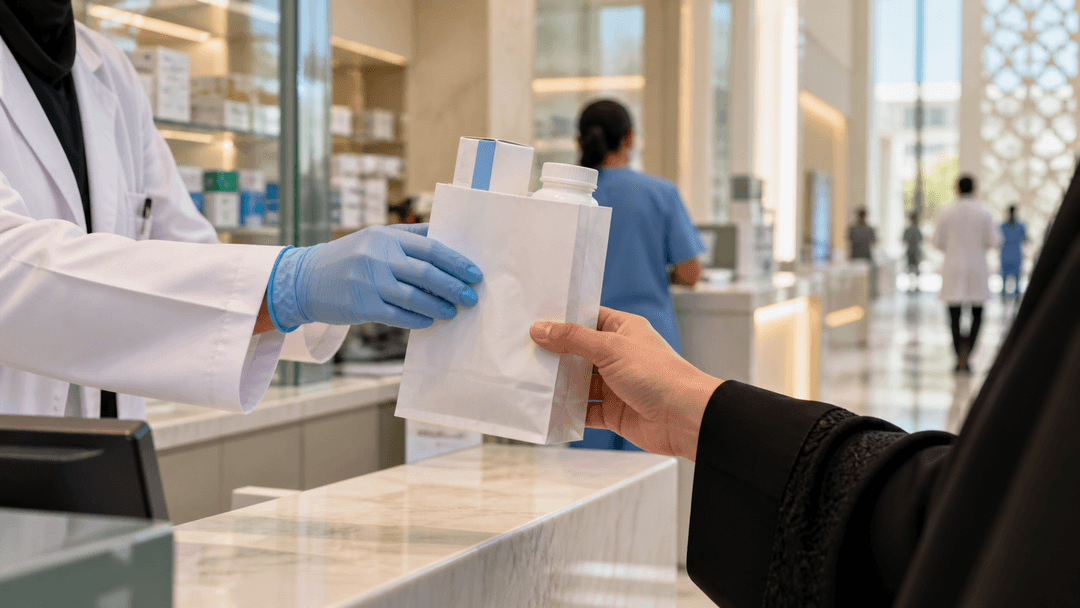
Inside Dubai, the relevant healthcare regulator is the Dubai Health Authority (DHA). A licensed Dubai pharmacy can dispense controlled medicines only against the correct prescription route and within UAE rules. Patients should expect Emirates ID checks, prescription validation and limits on repeats for controlled medicines. A regular refill should start with the treating doctor, because pharmacies cannot solve a missing or expired controlled-medicine prescription at the counter.
In Abu Dhabi and Al Ain, the relevant health regulator is the Department of Health Abu Dhabi (DOH). In Sharjah, Ajman, Ras Al Khaimah, Fujairah and Umm Al Quwain, healthcare services sit under the Ministry of Health and Prevention (MOHAP), while medicines regulation is handled federally through EDE. The patient action is the same across the UAE: confirm the medicine status before travel, keep the prescription current and use licensed pharmacies.
Patients should not rely on social media price claims for controlled medicines. If the medicine is legally available in the UAE, ask a licensed pharmacy to check the registered product and price through official product systems or its wholesaler. For insured patients, the payable amount depends on the policy. Members of Daman, Thiqa or Sukoon plans should check whether the medicine needs prior approval, whether the prescriber is in network and whether the pharmacy is in network before the refill date.
Why this matters for patients
The enforcement story is about trafficking, but patients feel it through delay risk. A traveller with a valid prescription can still lose time at customs if the medicine name, dose, quantity or diagnosis is unclear. A Dubai resident can also lose a refill window if a controlled-medicine prescription has expired or if the specialist appointment is booked after the current supply runs out.
The patient checklist is simple. Start 7 to 10 days before travel or before a controlled-medicine refill. Ask the doctor for the scientific name, dose, diagnosis and treatment duration in writing. Check the EDE controlled list. Confirm the pharmacy has stock. Ask the insurer about prior approval before paying cash.
For a licensed pharmacy near home or work, search the UAE Open Healthcare Directory, which lists 3,898 pharmacy providers across the UAE and lets patients filter licensed providers by city, including Dubai, Abu Dhabi, Sharjah and the northern emirates.
Zavis Intelligence
Healthcare Industry Desk
Contributing to UAE healthcare industry coverage
Related coverage



FAQ
What is happening in UAE healthcare industry?
Patients with controlled medicines should expect tighter document checks. Here is what to prepare before travel or pharmacy pickup in the UAE.