
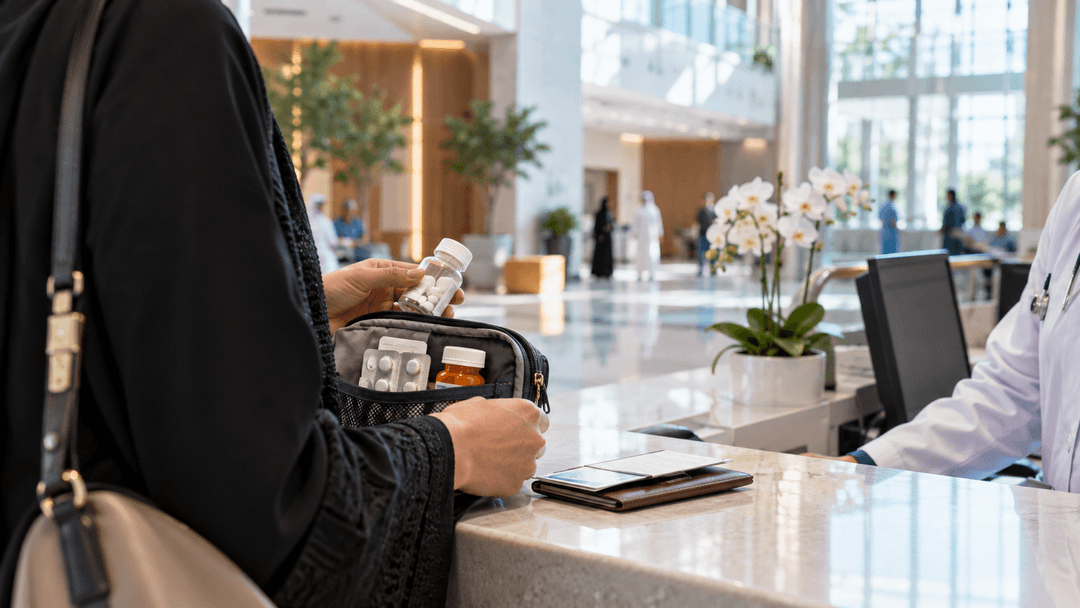
UAE-Nigeria drug pact puts controlled medicines on patients' travel checklist
The UAE-Nigeria pact changes little at the pharmacy counter. It makes documentation more important for patients carrying controlled medicines into Dubai.
How Zavis verifies this coverage
Editorial standards, source rules, methodology, and review provenance are public.
Patients in Dubai should treat the 26 September 2026 UAE-Nigeria drug enforcement pact as a reminder to check medicines before travel, because legal prescriptions can still trigger questions at customs if they are narcotic or psychotropic products.
The highest-stakes readers are patients who use ADHD, pain, anxiety, sleep or psychiatric medicines, pharmacy operators serving international patients, and medical directors writing repeat prescriptions. The pact reported by The Guardian Nigeria concerns trafficking enforcement, not routine prescribing. Its practical effect is that cross-border scrutiny is likely to be tighter on high-risk routes and courier consignments, while licensed UAE pharmacy dispensing remains governed by the Dubai Health Authority (DHA), Department of Health Abu Dhabi (DOH Abu Dhabi) and Ministry of Health and Prevention (MOHAP) rules.
What patients should check before flying to Dubai
The patient issue is documentation. The UAE's official guidance says travellers carrying narcotic or psychotropic medicines should use the Emirates Drug Establishment personal medicine import service, and carry a prescription and medical report where the medicine is listed as narcotic or psychotropic. The service page says the medical document should be issued within the last three months and recognised or stamped by the healthcare facility following the patient.
For a Dubai visitor, the safest operating rule is simple: check the medicine name before travel, keep it in its original packaging, carry only a personal-use quantity, and keep the prescription with the same patient name as the passport. If the medicine is controlled, apply through the Emirates Drug Establishment or MOHAP-linked service before arrival rather than arguing the case at the airport.
- Search the active ingredient, not only the brand name, because brand names differ by country.
- Carry a prescription that states dose, duration, patient name, doctor name and issue date.
- Keep a medical report for narcotic or psychotropic medicines where the official service requires it.
- Ask the prescribing doctor for an English version before departure if the original is in another language.
What changes at the pharmacy counter
For residents already inside Dubai, the pact does not create a new patient pathway for refills. Controlled and semi-controlled medicines remain subject to UAE prescribing and dispensing controls. DHA circulars have required Dubai physicians and pharmacists dealing with narcotic, controlled and semi-controlled medicines to use the unified controlled prescriptions platform since 19 May 2019.
That matters for patients because a foreign prescription may support travel documentation, but it usually will not replace a UAE clinical assessment for a local refill. A patient who arrives with a one-month supply of an ADHD stimulant, opioid pain medicine or benzodiazepine should book a licensed UAE doctor before the supply runs out. The doctor can decide whether the medicine is clinically appropriate and whether a UAE-controlled prescription can be issued.
Pharmacy prices vary by product, insurance network and whether the medicine is registered in the UAE. Patients should not rely on informal social media price quotes for controlled medicines. A practical check is to ask a DHA-licensed pharmacy for the cash price and then ask the insurer, such as Daman, Thiqa or Sukoon where applicable, whether the medicine needs prior approval, a specialist diagnosis or a chronic medication file.
Why the Nigeria route matters for patients
The enforcement pact is relevant because the Nigeria-UAE route has named seizure data. NDLEA chairman Brig.-Gen. Mohamed Buba Marwa (retd.) said NDLEA intercepted about 354.7kg of illicit drugs destined for the UAE between 2021 and 2026, including cocaine, cannabis, tramadol, Rohypnol, ecstasy and khat. The agency also reported 47 arrests linked to those seizures.
Marwa said the agreement would deepen intelligence-sharing and joint enforcement operations along the Nigeria-UAE corridor. — Brig.-Gen. Mohamed Buba Marwa (retd.), NDLEA chairman and chief executive officer
For patients, the risk is confusion between illegal supply chains and legitimate therapy. Tramadol and some sedatives can be prescribed medicines in one country and controlled medicines in the UAE. Khat is illegal in the UAE. A traveller who carries such products without the required paperwork can face delay, confiscation or legal review, even when the patient intended personal medical use.
Abu Dhabi and Al Ain patients should follow DOH Abu Dhabi facility pathways for local care, while patients in Sharjah, Ajman, Ras Al Khaimah, Fujairah and Umm Al Quwain should expect MOHAP-linked providers and pharmacies to apply federal medicine controls. The common rule across emirates is that controlled medicines need licensed prescribers, compliant pharmacy dispensing and clear patient documentation.
The practical close for Dubai patients is to move early. Check the medicine list before travel, keep documents dated within the official time window, and arrange a UAE appointment before a foreign supply runs out. For licensed pharmacy options, use the UAE Open Healthcare Directory, which lists 1,680 DHA-licensed pharmacy providers in Dubai.
Zavis Intelligence
Healthcare Industry Desk
Contributing to UAE healthcare industry coverage
Related coverage




FAQ
What is happening in UAE healthcare industry?
The UAE-Nigeria pact changes little at the pharmacy counter. It makes documentation more important for patients carrying controlled medicines into Dubai.