
Knee Pain vs Knee Swelling
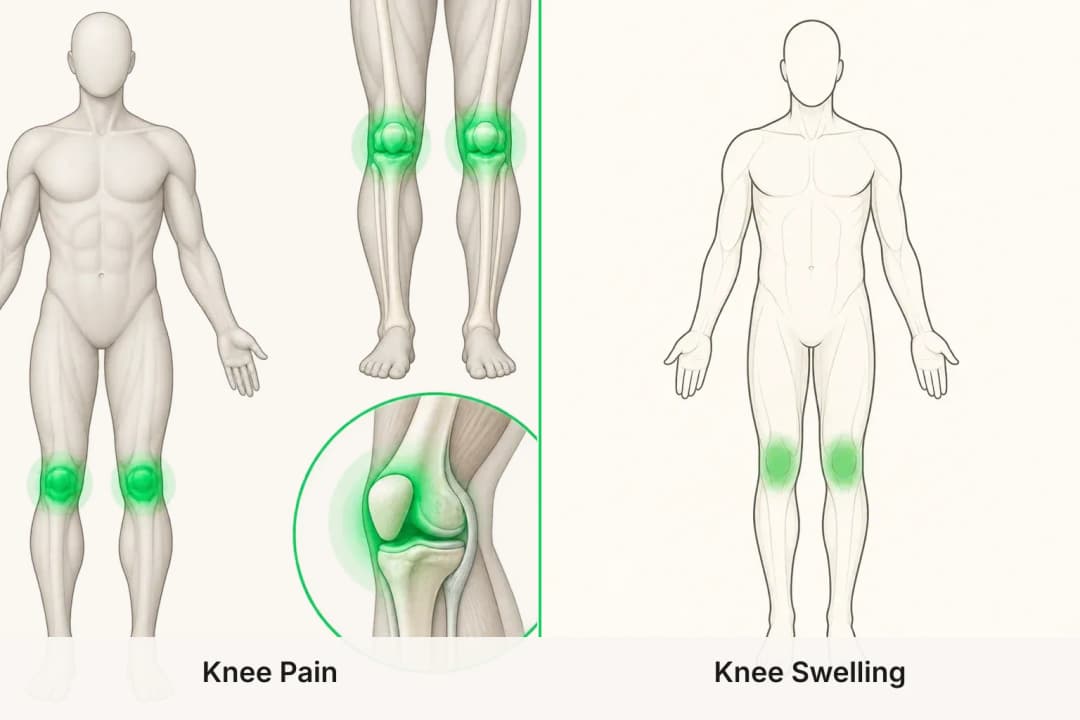
At a glance
- Knee pain
- An unpleasant sensation whose location and triggers provide useful clues.
- Knee swelling
- Increased fullness or size that may limit bending and make the knee feel tight.
- Prompt assessment
- Consider it for severe pain, major injury, fever, locking or inability to bear weight.
Find care
General Clinics & Polyclinics in Abu Dhabi
Licensed general clinics & polyclinics listed in Abu Dhabi. Appearing here means a provider holds a UAE licence in this category — not that it offers knee pain vs knee swelling, which is worth confirming with the clinic before you book.
27 Ar Ruwwad St - Shakhbout City - MSH4 - Abu Dhabi - United Arab Emirates
Accepts: Daman, Thiqa, Cigna, MetLife +20 more
Al Ruwais, Al Dhafrah
Accepts: Daman, Thiqa, AXA, Cigna +16 more
Al Bahyah - Al Bahyah Old - Abu Dhabi - United Arab Emirates
Accepts: Daman, Thiqa, Cigna, Allianz Care +18 more
Abu Dhabi
Accepts: Daman, Thiqa, AXA, Cigna +27 more
The New EMI State Tower - 3rd Floor 303 Kan’ad Street - Hamdan Bin Mohammed St - Al Danah - Zone 1 - Abu Dhabi - United Arab Emirates
Accepts: Daman, Thiqa, Cigna, MetLife +22 more
Taj Resorts RV-1, Al Nasser Properties - Mafraq-2 - Mafraq Industrial Area - Abu Dhabi - United Arab Emirates
Accepts: Daman, Thiqa, AXA, Cigna +14 more
Ordered by verification status and how complete each clinic's public record is, then alphabetically. This is a directory listing, not a ranking — Zavis does not rate or recommend providers.
A factual listing drawn from the DHA, DOH and MOHAP licence registers. It is not a referral, an endorsement, or advice that any of these providers is right for you.
Pain and swelling are different clues
Pain tells you that a body structure is being irritated, strained or sensitised. Swelling tells you that fluid or tissue volume has increased around or inside the knee. Either can occur alone, and both can follow an injury or inflammatory problem. Describing which came first, what movement changes it and whether the knee locks or gives way helps narrow the possibilities.
When pain is the leading symptom
Use the pain pathway when discomfort is the main limitation and the knee looks close to its usual size. Note whether pain is at the front, inside, outside or back of the knee, and whether it follows stairs, twisting, running, sitting or rest. Pain that persists, repeatedly returns or changes how you walk deserves assessment even without visible swelling.
When swelling is the leading symptom
Use the swelling pathway when the knee looks larger, feels tight or cannot bend as far as usual. Swelling soon after a significant twist or impact, swelling that appears without a clear cause, or recurrent fluid build-up should be evaluated. Compare both knees in similar positions, but do not repeatedly press a painful area to test it.
Warning signs that change the plan
Pain and swelling can accompany ligament, cartilage, bone, tendon or joint problems, so the visible symptom alone is not enough to identify the cause. Seek prompt care for severe pain, a deformed knee, inability to bear weight, a hot red knee with fever, a locked joint, sudden calf swelling, or new numbness or weakness. Avoid returning to impact activity while these signs are unresolved.
When the knee symptoms are unclear
Some people describe stiffness, clicking, instability or a sense that the knee will give way without clear pain or swelling. Symptoms may also come from the hip, lower back or nearby soft tissues. A clinician can examine the knee and connected areas, check strength and movement, and decide whether imaging or another form of evaluation is needed.
What guides the next step
A recommendation depends on onset, injury mechanism, age, activity demands, previous knee problems and the effect on walking or daily tasks. Examination may include joint-line tenderness, stability, range of motion and signs of fluid. Mild symptoms that are steadily improving may be managed with guided activity changes, while worsening symptoms or major loss of function call for earlier review.
Questions people ask
Can knee pain happen without swelling?
Yes. Pain can arise from irritated or overloaded tissues without obvious fluid or size change, especially early or with some activity-related problems.
Does knee swelling always cause pain?
No. Some swelling is mainly noticed as tightness or reduced bending. New, persistent or recurrent swelling should still be assessed to identify its source.
Related
Related reading
Keep reading
Medical disclaimer. This page is general health information, not medical advice, and it cannot diagnose you. Always consult a licensed healthcare provider about your own symptoms and treatment. In an emergency in the UAE, call 998 for an ambulance.