
Brachytherapy vs Radiotherapy: How Are They Different?
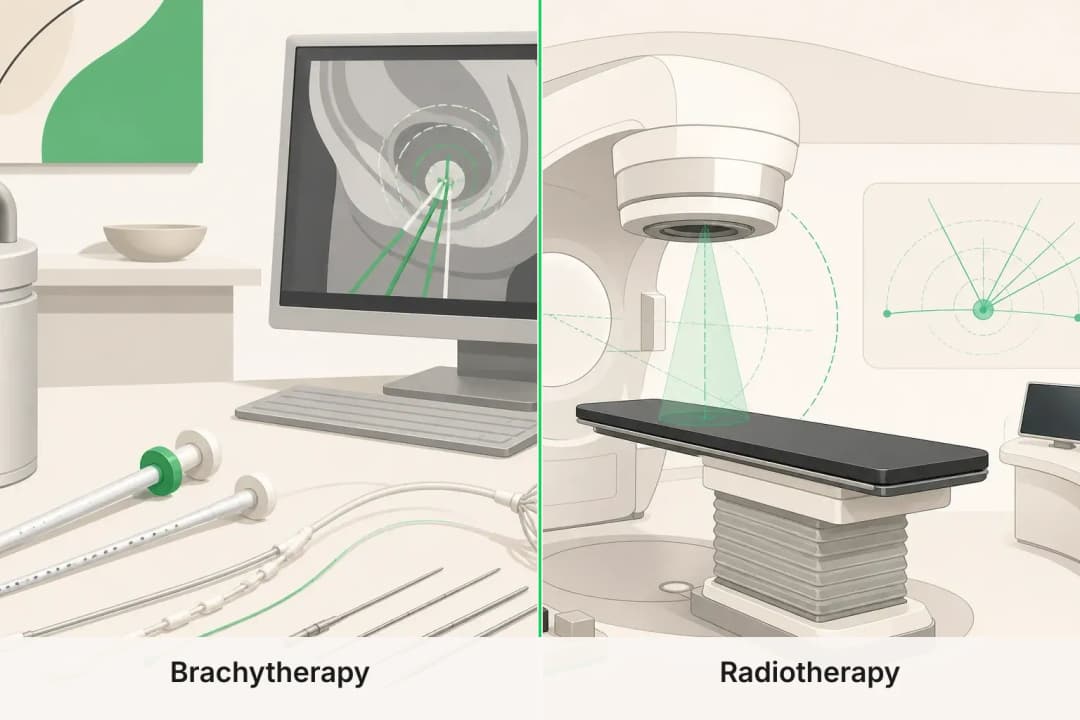
At a glance
- Brachytherapy
- Radiation delivered from a source placed in or beside the target.
- Radiotherapy
- Radiation delivered by a machine outside the body.
- Choice
- The plan depends on the target, nearby organs, previous treatment, and overall health.
Brachytherapy and radiotherapy at a glance
Brachytherapy places a radiation source inside or next to the treatment area, while radiotherapy directs radiation from a machine outside the body.
Both approaches are planned to target cancer cells while limiting exposure to nearby healthy tissue, but the suitable approach depends on the tumour's location, size, shape, and treatment goal. Some treatment plans use one approach, while others combine methods with surgery, medicines, or another form of radiation. The names describe delivery methods rather than a simple ranking.
When brachytherapy may be considered
Brachytherapy may be considered when the tumour can be reached safely with a catheter, applicator, needle, or implant. Bringing the source close to the target can allow the team to shape the dose around a small treatment area. The technique is used for selected cancers and may be given temporarily or through an implant that remains in place, depending on the plan.
Your team may discuss this option when a clearly defined target is near organs that need protection, or when focused treatment is part of the overall plan. The placement procedure, anaesthesia needs, and number of visits vary by treatment site.
When radiotherapy may be considered
Radiotherapy may be considered when an external beam can cover the target and any surrounding area the team needs to treat. It can be planned for a tumour that cannot be reached by an applicator or for an area requiring treatment from several directions. The machine does not need to enter the body, although you must remain in the planned position during delivery.
A course can involve repeated appointments, with the schedule set by the radiation oncologist. Radiotherapy may be used before or after surgery, alongside other treatment, or as the main local treatment, depending on the diagnosis and goal.
Side effects and practical considerations
Both approaches can irritate normal tissue near the treatment area. Possible effects depend on the body region and may include tiredness, skin or lining irritation, swelling, discomfort, or changes in nearby organ function. Brachytherapy also has procedure-related considerations such as bleeding, infection, or soreness at the placement site. External radiotherapy may cause skin changes or symptoms in tissues included in the treatment field.
Tell the team about new or worsening symptoms, medicines, implanted devices, and any concerns about anaesthesia or positioning. They can explain which effects are expected for your treatment site and which need prompt contact.
When neither option is the right first step
Neither method may be suitable as the first treatment when the target cannot be reached safely, when a wider treatment approach is needed, or when the main goal is better addressed by surgery, cancer medicines, monitoring, or symptom care. A plan can also change if imaging shows that the tumour's position or extent differs from the initial assessment.
A different option does not mean that treatment has stopped. The oncology team may recommend another local or whole-body treatment, or combine approaches after reviewing pathology, scans, previous treatment, and your general health.
How clinicians make the recommendation
The team weighs the cancer type, exact location, size and shape of the target, nearby organs, prior radiation, and the purpose of treatment. They also consider whether the area can be reached for source placement, how well you can maintain the required position, and whether a procedure or repeated visits fit your health needs.
Useful questions include: What area will be treated? Why is this delivery method suited to my scan and pathology? Will treatment be temporary or repeated? What preparation, anaesthesia, appointments, and recovery should I expect? Which symptoms should prompt a call? Asking for the expected goal and alternatives can make the decision clearer.
Questions people ask
Can brachytherapy and radiotherapy be used together?
They can be combined in selected treatment plans when the oncology team believes different delivery methods will address different parts of the treatment goal.
Does brachytherapy always require a procedure?
It requires placement of an applicator, catheter, needle, or implant, and the preparation and anaesthesia depend on the treatment area and plan.
How do I know which option is suitable?
Your team uses scans, pathology, the target's position, nearby organs, previous treatment, and your health to recommend an approach.
Related
Related reading
Keep reading
Cancer care in the UAE
Hospitals & Medical Centers in Abu Dhabi
Most UAE cancer care is delivered inside hospital services rather than by standalone oncology clinics, so these are licensed hospitals & medical centers listed in Abu Dhabi. Confirm the specific cancer service exists before you travel, and know that asking for a second opinion is routine.
Ahalia Hospital Musaffah Building - Musaffah - Musaffah Industrial - Abu Dhabi - United Arab Emirates
Accepts: Daman, Thiqa, AXA, Cigna +26 more
Al Ruwais Industrial City - Abu Dhabi - United Arab Emirates
Accepts: Daman, Thiqa, AXA, Cigna +30 more
Abu Dhabi, Abu Dhabi
Accepts: Daman, Thiqa, AXA, Cigna +30 more
Second opinions are routine in cancer care and asking for one does not affect your treatment. How to arrange a second opinion in the UAE.
Ordered by verification status and how complete each clinic's public record is, then alphabetically. This is a directory listing, not a ranking — Zavis does not rate or recommend providers.
A factual listing drawn from the DHA, DOH and MOHAP licence registers. It is not a referral, an endorsement, or advice that any of these providers is right for you.
Medical disclaimer. This page is general health information, not medical advice, and it cannot diagnose you. Always consult a licensed healthcare provider about your own symptoms and treatment. In an emergency in the UAE, call 998 for an ambulance.