
Why is a pedicle screw used in spinal fusion?
Short answer
A pedicle screw is used in spinal fusion to anchor nearby vertebrae and help keep them aligned while the bones heal together.
This answers one question. It is not a diagnosis and does not replace an assessment by a licensed doctor.
At a glance
- Main purpose
- Anchors vertebrae to rods for stability
- Fusion material
- Bone graft supports bone bridging
What the screw does
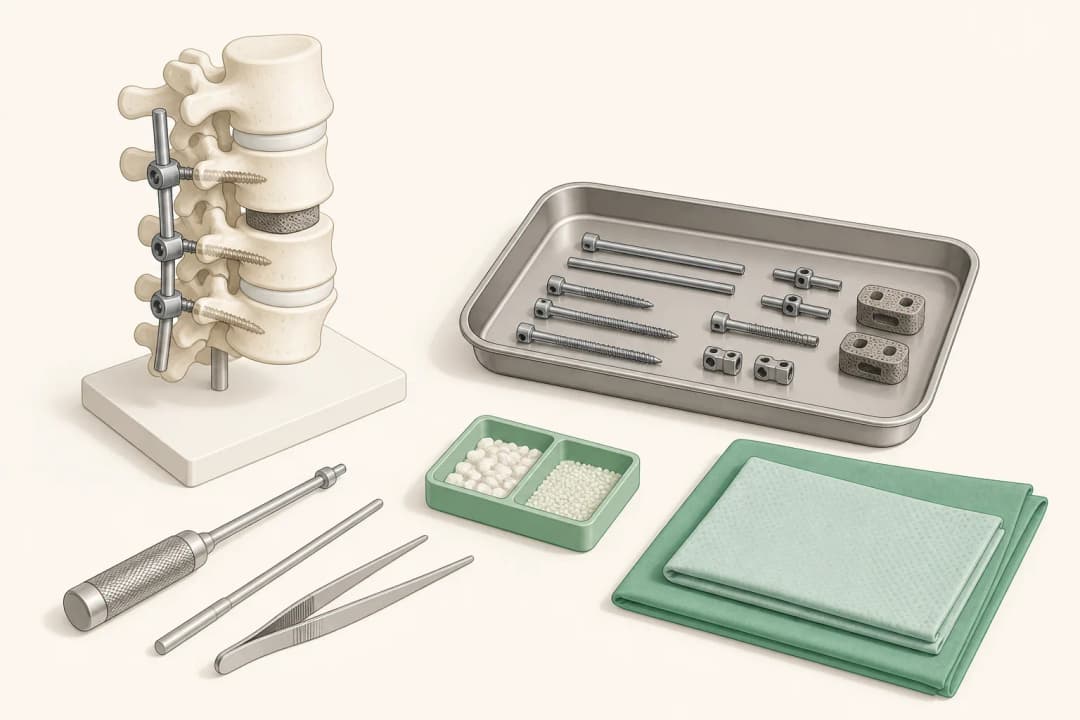
The screw is placed through the bony pedicle, a strong bridge at the back of a vertebra. It connects to a rod, allowing the surgeon to stabilise the selected spinal levels. This framework can limit unwanted movement and support the correction or positioning planned during surgery. The screw is not intended to replace the bone graft; the graft is what allows the vertebrae to grow together over time.
The number and location of screws depend on the spinal region, the reason for fusion, bone quality and the surgeon’s plan. Imaging and careful technique help the surgical team choose a safe trajectory.
How to prepare and recover
Before surgery, ask which levels will be fused and whether screws and rods are part of the construct. Afterward, follow movement, wound-care and lifting instructions. Keep follow-up appointments so healing and hardware position can be assessed. New pain does not automatically mean a screw has moved; report changes so they can be examined rather than guessing from symptoms.
When to seek care
Contact your surgical team promptly for worsening weakness, new numbness, loss of bladder or bowel control, fever, drainage from the incision, or pain that suddenly becomes severe. Seek emergency help for rapidly progressing weakness or difficulty breathing.
Questions for your doctor
Ask what the screws are stabilising, how long activity restrictions may last, which symptoms are expected after surgery, and how fusion will be checked. You can also read about [Pedicle Screw](/materials/pedicle-screw/) and [Spinal Fusion](/treatments/spine-care/spinal-fusion/).
Find care
General Clinics & Polyclinics in Abu Dhabi
That answer is general. If you want it applied to your own case, these are licensed general clinics & polyclinics listed in Abu Dhabi.
27 Ar Ruwwad St - Shakhbout City - MSH4 - Abu Dhabi - United Arab Emirates
Accepts: Daman, Thiqa, Cigna, MetLife +20 more
Al Ruwais, Al Dhafrah
Accepts: Daman, Thiqa, AXA, Cigna +16 more
Al Bahyah - Al Bahyah Old - Abu Dhabi - United Arab Emirates
Accepts: Daman, Thiqa, Cigna, Allianz Care +18 more
Abu Dhabi
Accepts: Daman, Thiqa, AXA, Cigna +27 more
Ordered by verification status and how complete each clinic's public record is, then alphabetically. This is a directory listing, not a ranking — Zavis does not rate or recommend providers.
A factual listing drawn from the DHA, DOH and MOHAP licence registers. It is not a referral, an endorsement, or advice that any of these providers is right for you.
Questions people ask
Does the screw make the bones fuse?
No. The screw and rod construct provides stability; bone graft and the body’s healing process create the fusion.
Can a pedicle screw cause symptoms?
Persistent or new pain, weakness, or numbness needs clinical assessment because several causes are possible.
Related
Related reading
Keep reading
Medical disclaimer. This page is general health information, not medical advice, and it cannot diagnose you. Always consult a licensed healthcare provider about your own symptoms and treatment. In an emergency in the UAE, call 998 for an ambulance.