
What Is the First Treatment for Trigger Finger?
Short answer
The first treatment tried for trigger finger is often activity modification and a splint, with a cortisone injection considered when symptoms persist.
This answers one question. It is not a diagnosis and does not replace an assessment by a licensed doctor.
At a glance
- Typical early focus
- Reduce gripping and limit tendon catching
- Support option
- A clinician-fitted splint
What trigger finger involves
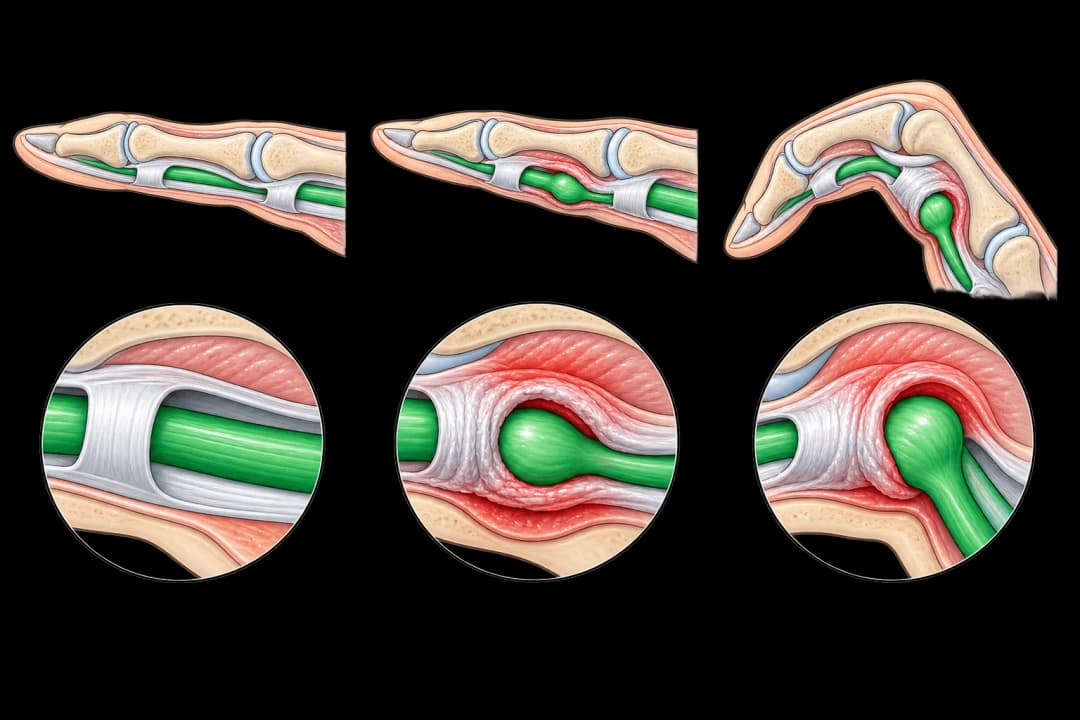
Trigger finger, also called stenosing tenosynovitis, occurs when a finger tendon does not glide smoothly through its surrounding pulley. This can cause stiffness, clicking, catching, or a finger that briefly locks, often near the base of the affected digit. Resting repetitive gripping may reduce irritation. A splint can hold the finger in a position that limits painful catching, commonly during sleep or tasks that provoke symptoms.
How initial care is used
A clinician may recommend a period of reduced gripping, gentle movement within comfort, and a fitted splint. Do not force a locked finger straight or repeatedly snap it through the catch. If symptoms continue, a cortisone injection may reduce inflammation around the tendon. Persistent locking, substantial loss of movement, or recurrence may lead to discussion of trigger finger release after examination.
When to seek care
Arrange medical assessment if the finger remains locked, pain interferes with sleep or ordinary tasks, or swelling and stiffness are worsening. Seek prompt help after an injury if the finger is visibly deformed, numb, unusually pale, or impossible to move. Fever, spreading redness, or drainage needs urgent assessment because it may point to infection rather than routine triggering.
Questions for your doctor
Ask which movements to limit, when to wear the splint, whether an injection suits your symptoms, and what improvement should be expected. If release is discussed, ask how movement exercises and hand use will be managed afterward.
Find care
General Clinics & Polyclinics in Abu Dhabi
That answer is general. If you want it applied to your own case, these are licensed general clinics & polyclinics listed in Abu Dhabi.
27 Ar Ruwwad St - Shakhbout City - MSH4 - Abu Dhabi - United Arab Emirates
Accepts: Daman, Thiqa, Cigna, MetLife +20 more
Al Ruwais, Al Dhafrah
Accepts: Daman, Thiqa, AXA, Cigna +16 more
Al Bahyah - Al Bahyah Old - Abu Dhabi - United Arab Emirates
Accepts: Daman, Thiqa, Cigna, Allianz Care +18 more
Abu Dhabi
Accepts: Daman, Thiqa, AXA, Cigna +27 more
Ordered by verification status and how complete each clinic's public record is, then alphabetically. This is a directory listing, not a ranking — Zavis does not rate or recommend providers.
A factual listing drawn from the DHA, DOH and MOHAP licence registers. It is not a referral, an endorsement, or advice that any of these providers is right for you.
Questions people ask
Does every person with trigger finger need surgery?
No. Many people first try activity changes, splinting, or an injection; release is considered when symptoms remain troublesome or the finger stays locked.
Should I pull a locked finger straight?
No. Forcing it can increase irritation; use the clinician's instructions and arrange an assessment.
Related
Related reading
Keep reading
Medical disclaimer. This page is general health information, not medical advice, and it cannot diagnose you. Always consult a licensed healthcare provider about your own symptoms and treatment. In an emergency in the UAE, call 998 for an ambulance.