
What Happens If Rotator Cuff Tendinitis Is Not Treated?
Short answer
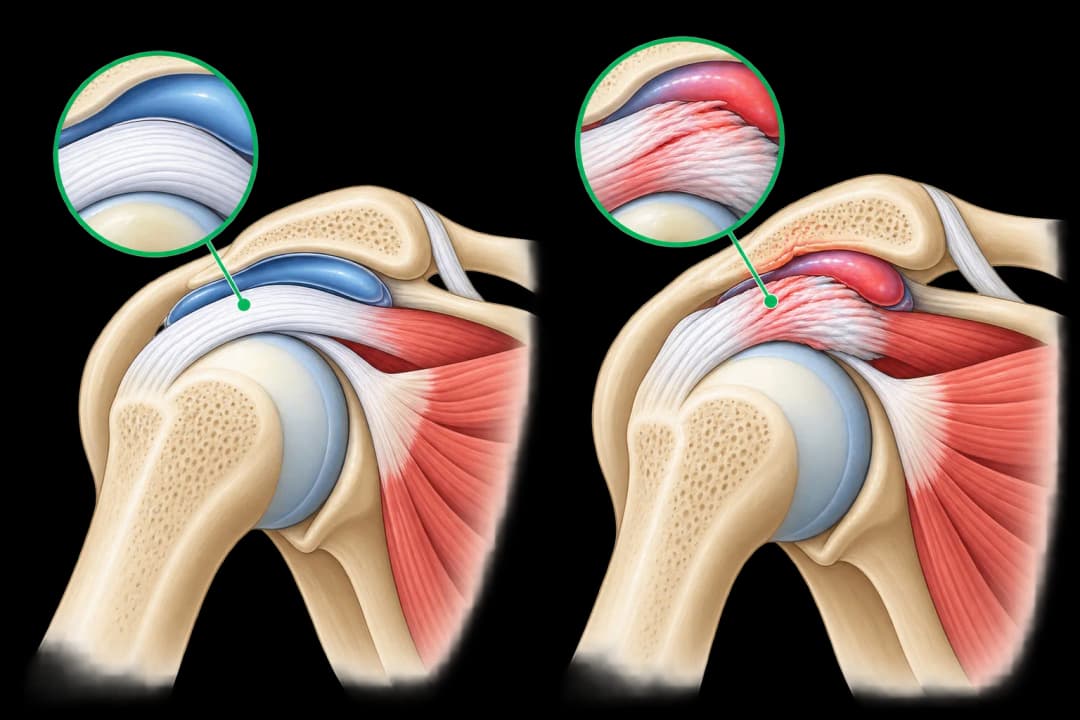
If rotator cuff tendinitis is not treated, pain may persist, shoulder movement may become restricted and weakness can develop.
This answers one question. It is not a diagnosis and does not replace an assessment by a licensed doctor.
At a glance
- Typical problem
- Painful tendon loading can lead to reduced use and shoulder stiffness.
- Rehabilitation aim
- Restore comfortable movement, strength and tolerance for daily tasks.
Why symptoms can continue
The rotator cuff tendons help move and steady the shoulder. Repeated overhead activity, heavy lifting or poor recovery can keep an irritated tendon under load. This may cause shoulder pain and pain when lifting the arm, especially during reaching, dressing or sleeping on that side. Avoiding movement altogether can reduce shoulder mobility and contribute to stiffness. Persistent tendon problems may also alter shoulder mechanics and make ordinary tasks feel demanding. Tendinitis does not automatically mean a tear, but ongoing or worsening symptoms deserve assessment so other causes are not missed.
Practical treatment options
A clinician or physiotherapist can assess strength, movement, neck contribution and the activities that provoke symptoms. Treatment often begins with adjusting aggravating loads, then gradually rebuilding shoulder capacity through exercise therapy or physiotherapy. Pain relief may be discussed, and a cortisone injection or shockwave therapy may be considered in selected situations. Progress should be based on function and response rather than pushing through sharp pain. Follow-up is useful when symptoms are not improving or weakness is increasing.
When to seek care
Arrange an assessment for shoulder pain that persists, repeatedly returns or prevents sleep, work or dressing. Seek prompt care after an injury followed by sudden weakness or inability to lift the arm. Urgent assessment is needed for severe pain with fever, a visibly deformed shoulder, new numbness or an arm that becomes cold or discoloured.
Questions for your doctor
Is the tendon irritated, torn or affected by another shoulder problem? Which activities should I modify? What exercise level is appropriate now? When would an injection or shockwave therapy be considered? How can we prevent stiffness while symptoms settle?
Find care
General Clinics & Polyclinics in Abu Dhabi
That answer is general. If you want it applied to your own case, these are licensed general clinics & polyclinics listed in Abu Dhabi.
27 Ar Ruwwad St - Shakhbout City - MSH4 - Abu Dhabi - United Arab Emirates
Accepts: Daman, Thiqa, Cigna, MetLife +20 more
Al Ruwais, Al Dhafrah
Accepts: Daman, Thiqa, AXA, Cigna +16 more
Al Bahyah - Al Bahyah Old - Abu Dhabi - United Arab Emirates
Accepts: Daman, Thiqa, Cigna, Allianz Care +18 more
Abu Dhabi
Accepts: Daman, Thiqa, AXA, Cigna +27 more
Ordered by verification status and how complete each clinic's public record is, then alphabetically. This is a directory listing, not a ranking — Zavis does not rate or recommend providers.
A factual listing drawn from the DHA, DOH and MOHAP licence registers. It is not a referral, an endorsement, or advice that any of these providers is right for you.
Questions people ask
Can rotator cuff tendinitis turn into a frozen shoulder?
Pain-related guarding and reduced movement can contribute to stiffness; persistent restriction should be assessed.
Should I stop using the shoulder completely?
Usually the goal is to reduce aggravating loads while keeping suitable, comfortable movement.
Related
Related reading
Keep reading
Medical disclaimer. This page is general health information, not medical advice, and it cannot diagnose you. Always consult a licensed healthcare provider about your own symptoms and treatment. In an emergency in the UAE, call 998 for an ambulance.