
What does IPL photofacial treat?
Short answer
An IPL photofacial treats selected sun-related pigmentation, freckles, redness, visible small vessels, and uneven skin tone.
This answers one question. It is not a diagnosis and does not replace an assessment by a licensed doctor.
At a glance
- Targets
- Pigment, redness, and selected visible vessels
- Key preparation
- Skin assessment and careful sun protection
What the light targets
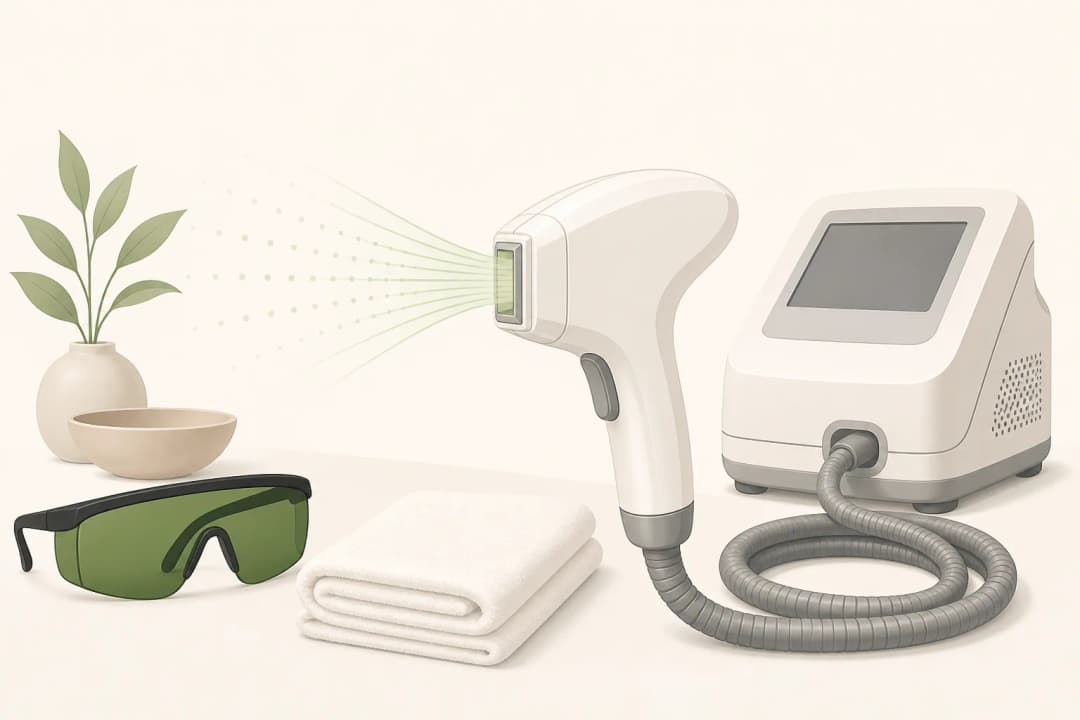
Intense pulsed light uses a range of wavelengths rather than one single laser beam. Depending on the filter and settings, energy can be absorbed by excess pigment or by blood within visible vessels. It may be discussed for freckles, hyperpigmentation, sun-damaged skin, post-inflammatory erythema, rosacea-related redness, and spider veins. Results depend on the diagnosis, skin tone, depth of the target, and whether the trigger continues. IPL is not suitable for every dark spot, so an unexplained or changing lesion needs diagnosis first.
Before and after an IPL session
A qualified clinician should assess your skin, recent sun exposure, medicines, tanning products, and tendency to develop pigment changes. Protect the treated area from sunlight and follow the clinic’s instructions about skincare. Mild warmth, redness, or darkening of pigment spots can occur while the skin settles. Do not pick or scrub treated areas. Compare options with [IPL Photofacial](/treatments/laser-and-energy/ipl-photofacial/) and [Picosecond Laser Treatment](/treatments/laser-and-energy/picosecond-laser-treatment/).
When to seek care
Contact the clinic for blistering, increasing pain, marked swelling, crusting, or redness that continues to spread. Seek assessment for a pigmented spot that changes in shape, colour, or bleeding, because cosmetic light treatment should not delay examination of a possible skin cancer. Report any persistent light or dark patch after healing.
Questions for your doctor
Ask which target is being treated, whether your skin tone and recent sun exposure change the plan, what eye protection is required, and how pigment changes will be managed. Ask whether a diagnosis is needed before treating a single dark or changing spot.
Find care
General Clinics & Polyclinics in Abu Dhabi
That answer is general. If you want it applied to your own case, these are licensed general clinics & polyclinics listed in Abu Dhabi.
27 Ar Ruwwad St - Shakhbout City - MSH4 - Abu Dhabi - United Arab Emirates
Accepts: Daman, Thiqa, Cigna, MetLife +20 more
Al Ruwais, Al Dhafrah
Accepts: Daman, Thiqa, AXA, Cigna +16 more
Al Bahyah - Al Bahyah Old - Abu Dhabi - United Arab Emirates
Accepts: Daman, Thiqa, Cigna, Allianz Care +18 more
Abu Dhabi
Accepts: Daman, Thiqa, AXA, Cigna +27 more
Ordered by verification status and how complete each clinic's public record is, then alphabetically. This is a directory listing, not a ranking — Zavis does not rate or recommend providers.
A factual listing drawn from the DHA, DOH and MOHAP licence registers. It is not a referral, an endorsement, or advice that any of these providers is right for you.
Questions people ask
Is IPL the same as a laser?
No. IPL delivers a broad range of filtered light, while a laser uses a more specific wavelength.
Can IPL treat every dark mark?
No. Dark marks have different causes, and some require examination or a different treatment.
Related
Related reading
Keep reading
Medical disclaimer. This page is general health information, not medical advice, and it cannot diagnose you. Always consult a licensed healthcare provider about your own symptoms and treatment. In an emergency in the UAE, call 998 for an ambulance.