
What Causes Melanoma?
Short answer
Melanoma develops when pigment-producing skin cells acquire abnormal growth changes, with ultraviolet exposure and atypical moles contributing to risk.
This answers one question. It is not a diagnosis and does not replace an assessment by a licensed doctor.
At a glance
- Cell involved
- Melanocytes, the cells that make skin pigment.
- Contributing exposure
- Ultraviolet radiation from sunlight or tanning devices.
- Mole-related factor
- An atypical mole can indicate increased susceptibility.
What this means
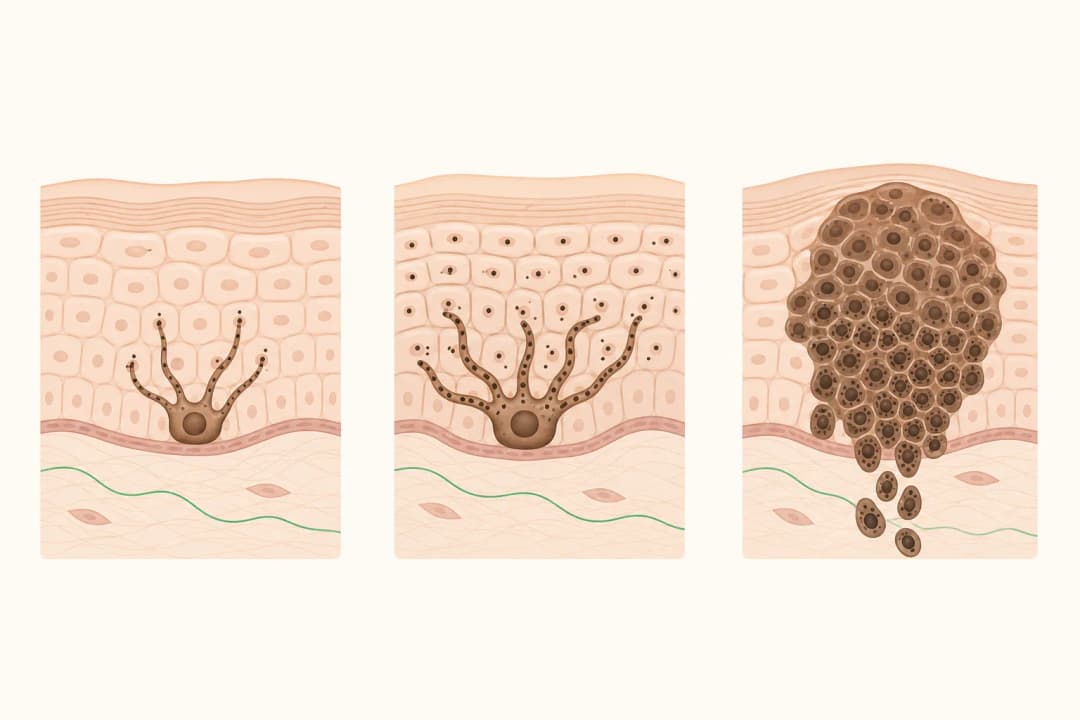
Melanocytes make the pigment that gives skin and moles their colour. Melanoma begins when these cells develop changes that allow abnormal growth and persistence. Ultraviolet radiation from sunlight or tanning devices can damage skin-cell DNA and contributes to this process. An atypical mole can be a marker of increased susceptibility, although melanoma can also arise in previously normal-looking skin. Family history, a tendency to develop many moles, and repeated sun exposure can all be relevant when a clinician assesses the whole picture.
What you can do
Check your skin regularly in consistent lighting, including the scalp, soles, palms, between toes, and under nails. Notice a mole or spot that changes in size, shape, colour, border, or sensation, and arrange an examination rather than trying to diagnose it from a photograph. Reduce ultraviolet exposure with shade, protective clothing, sunglasses, and broad-spectrum sunscreen. Do not use tanning devices, and ask about a personalised skin-check plan if you have atypical moles or a close family history.
When to seek care
Book a prompt skin assessment for a changing mole, a new dark or unusual spot, a lesion that bleeds or fails to heal, or a mark that becomes persistently itchy or tender. Urgent assessment is appropriate for rapid change, repeated bleeding, or an ulcerated lesion. These signs do not establish melanoma, but they should not be ignored.
Questions for your doctor
Ask whether the spot needs dermoscopic examination or removal for laboratory analysis, how your mole pattern affects follow-up, and which areas are easiest to miss during self-checks. Ask for practical sun-protection advice suited to your daily routine.
Find care
General Clinics & Polyclinics in Abu Dhabi
That answer is general. If you want it applied to your own case, these are licensed general clinics & polyclinics listed in Abu Dhabi.
27 Ar Ruwwad St - Shakhbout City - MSH4 - Abu Dhabi - United Arab Emirates
Accepts: Daman, Thiqa, Cigna, MetLife +20 more
Al Ruwais, Al Dhafrah
Accepts: Daman, Thiqa, AXA, Cigna +16 more
Al Bahyah - Al Bahyah Old - Abu Dhabi - United Arab Emirates
Accepts: Daman, Thiqa, Cigna, Allianz Care +18 more
Abu Dhabi
Accepts: Daman, Thiqa, AXA, Cigna +27 more
Ordered by verification status and how complete each clinic's public record is, then alphabetically. This is a directory listing, not a ranking — Zavis does not rate or recommend providers.
A factual listing drawn from the DHA, DOH and MOHAP licence registers. It is not a referral, an endorsement, or advice that any of these providers is right for you.
Questions people ask
Does melanoma always start in an existing mole?
No. Melanoma can develop in an atypical mole or in previously normal-looking skin, so new and changing spots both deserve attention.
Can sunscreen prevent every melanoma?
Sun protection reduces ultraviolet exposure but cannot remove every cause or guarantee prevention, so skin awareness and appropriate examinations still matter.
Related
Related reading
Keep reading
Medical disclaimer. This page is general health information, not medical advice, and it cannot diagnose you. Always consult a licensed healthcare provider about your own symptoms and treatment. In an emergency in the UAE, call 998 for an ambulance.