
What are the treatment options for rotator cuff tendinitis?
Short answer
Treatment for rotator cuff tendinitis may include activity modification, physiotherapy, exercise therapy, injection or shockwave therapy for selected cases.
This answers one question. It is not a diagnosis and does not replace an assessment by a licensed doctor.
At a glance
- Treatment goal
- Restore shoulder capacity without repeatedly aggravating the tendon
- Useful measure
- Track overhead tolerance, sleep and next-day response to exercise
What the treatment is targeting
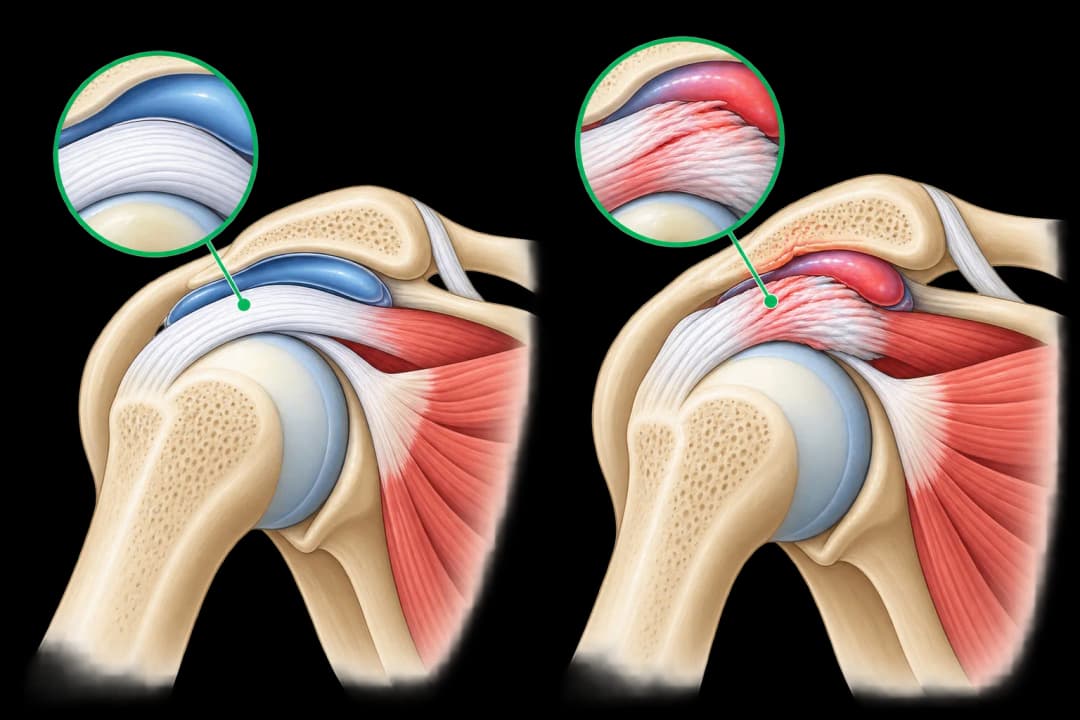
Rotator cuff tendinitis involves an irritated or overloaded tendon around the shoulder. Pain may be stronger with reaching overhead, reaching behind the back or lying on that side. The aim is to calm the aggravating load, keep the shoulder moving and improve the tendon’s ability to handle everyday and sporting demands.
Physiotherapy looks at shoulder-blade control, posture, range of motion and strength. Exercise therapy commonly progresses from comfortable mobility to isometric and resisted work. A cortisone injection may be considered when pain blocks rehabilitation, while shockwave therapy may be discussed for persistent tendon pain after assessment.
Practical next steps
Reduce painful overhead repetitions and heavy lifting temporarily, while continuing gentle movement within a comfortable range. Do not repeatedly test the painful arc. A clinician can tailor [Physiotherapy](/treatments/physiotherapy-and-rehabilitation/physiotherapy/) and [Exercise Therapy](/treatments/physiotherapy-and-rehabilitation/exercise-therapy/) to your work, sleep and sport.
Ask whether [Cortisone Injection](/treatments/non-surgical-orthopedics/cortisone-injection/) or [Shockwave Therapy](/treatments/physiotherapy-and-rehabilitation/shockwave-therapy/) is appropriate if progress is limited. Avoid increasing exercise intensity and volume at the same time; change one demand gradually and monitor how the shoulder responds later that day and the next morning.
When to seek care
Seek assessment if pain persists, repeatedly returns, limits sleep or causes loss of strength despite sensible activity changes. Get prompt care after a sudden injury with inability to lift the arm, or for a cold, numb, visibly deformed or rapidly swollen shoulder or arm.
Questions for your doctor
Ask whether the problem is tendinitis, tendinopathy or a tear, which movements to modify, and how to progress strengthening. If an injection or shockwave treatment is suggested, ask about its purpose, expected short-term effects and how it fits with rehabilitation.
Find care
General Clinics & Polyclinics in Abu Dhabi
That answer is general. If you want it applied to your own case, these are licensed general clinics & polyclinics listed in Abu Dhabi.
27 Ar Ruwwad St - Shakhbout City - MSH4 - Abu Dhabi - United Arab Emirates
Accepts: Daman, Thiqa, Cigna, MetLife +20 more
Al Ruwais, Al Dhafrah
Accepts: Daman, Thiqa, AXA, Cigna +16 more
Al Bahyah - Al Bahyah Old - Abu Dhabi - United Arab Emirates
Accepts: Daman, Thiqa, Cigna, Allianz Care +18 more
Abu Dhabi
Accepts: Daman, Thiqa, AXA, Cigna +27 more
Ordered by verification status and how complete each clinic's public record is, then alphabetically. This is a directory listing, not a ranking — Zavis does not rate or recommend providers.
A factual listing drawn from the DHA, DOH and MOHAP licence registers. It is not a referral, an endorsement, or advice that any of these providers is right for you.
Questions people ask
Should I rest my shoulder completely?
Complete rest can make the shoulder stiffer; most plans use relative rest with comfortable movement and graded loading.
When is physiotherapy useful?
Physiotherapy is useful when you need a tailored progression for movement, shoulder-blade control and strengthening.
Related
Related reading
Keep reading
Medical disclaimer. This page is general health information, not medical advice, and it cannot diagnose you. Always consult a licensed healthcare provider about your own symptoms and treatment. In an emergency in the UAE, call 998 for an ambulance.