
What should you know about vitiligo and melanoma?
Short answer
Vitiligo causes areas of lost pigment, while melanoma is a separate skin cancer that can arise in pigmented or non-pigmented skin.
This answers one question. It is not a diagnosis and does not replace an assessment by a licensed doctor.
At a glance
- Key distinction
- Vitiligo is pigment loss; melanoma is a cancer of pigment-producing cells.
- Watch for
- A new or changing lesion, including one that is not dark.
Understanding the difference
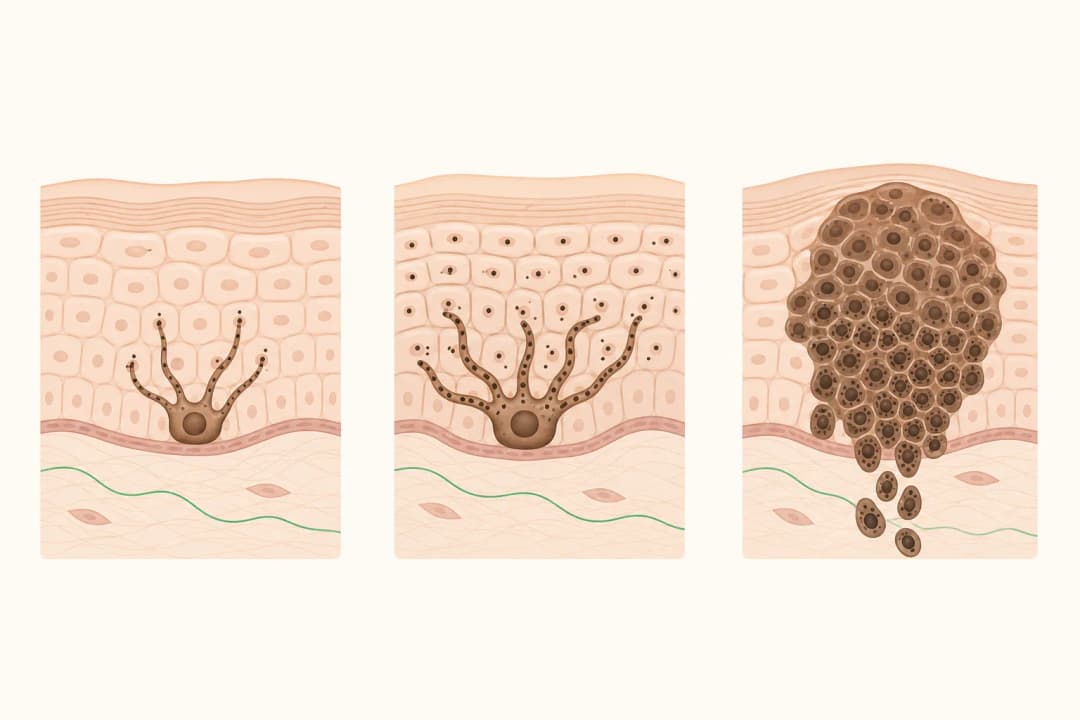
Vitiligo is an autoimmune condition in which pigment-producing cells are damaged, creating lighter patches. Melanoma begins in pigment-producing cells and may look like a changing mole, a new dark spot, or an unusual pink or skin-coloured lesion. Vitiligo does not turn every light patch into cancer, and a melanoma is not identified by colour alone. Loss of pigment around a mole can occur for several reasons, so examination is needed rather than self-diagnosis. A dermatologist may inspect the whole skin surface and decide whether a biopsy is appropriate.
How to monitor your skin
Use sun protection on depigmented and normally pigmented skin, and check for new or changing lesions in good light. Record changes in size, shape, colour, border, bleeding, or symptoms, without repeatedly picking or rubbing the area. If melanoma is suspected, care may include Skin Cancer Surgery, Surgical Excision, or Sentinel Lymph Node Biopsy depending on the examination and staging. Do not delay review while trying to treat a patch as vitiligo.
When to seek care
Book a prompt dermatology appointment for a new lesion or a mole that changes, bleeds, crusts, becomes painful, or develops an irregular border. Seek urgent medical help for severe symptoms linked to advanced cancer, such as new neurological problems. Confirmed melanoma requires specialist planning; treatments may include Immunotherapy and structured Follow-Up After Cancer Treatment.
Questions to bring
Ask whether the appearance fits vitiligo, whether the lesion needs dermoscopy or biopsy, and how to protect depigmented skin. If melanoma is diagnosed, ask about its stage, the reason for each procedure, treatment choices, and how follow-up will be organised.
Find care
General Clinics & Polyclinics in Abu Dhabi
That answer is general. If you want it applied to your own case, these are licensed general clinics & polyclinics listed in Abu Dhabi.
27 Ar Ruwwad St - Shakhbout City - MSH4 - Abu Dhabi - United Arab Emirates
Accepts: Daman, Thiqa, Cigna, MetLife +20 more
Al Ruwais, Al Dhafrah
Accepts: Daman, Thiqa, AXA, Cigna +16 more
Al Bahyah - Al Bahyah Old - Abu Dhabi - United Arab Emirates
Accepts: Daman, Thiqa, Cigna, Allianz Care +18 more
Abu Dhabi
Accepts: Daman, Thiqa, AXA, Cigna +27 more
Ordered by verification status and how complete each clinic's public record is, then alphabetically. This is a directory listing, not a ranking — Zavis does not rate or recommend providers.
A factual listing drawn from the DHA, DOH and MOHAP licence registers. It is not a referral, an endorsement, or advice that any of these providers is right for you.
Questions people ask
Does vitiligo mean a person has melanoma?
No. Vitiligo and melanoma are different conditions, although any changing lesion still deserves a skin examination.
Can melanoma be skin-coloured?
Yes. Melanoma can be non-pigmented, so change in a lesion matters more than colour alone.
Related
Related reading
Keep reading
Medical disclaimer. This page is general health information, not medical advice, and it cannot diagnose you. Always consult a licensed healthcare provider about your own symptoms and treatment. In an emergency in the UAE, call 998 for an ambulance.