
Superficial spreading melanoma prognosis
Short answer
Prognosis for superficial spreading melanoma depends mainly on tumour depth, ulceration, lymph-node involvement, spread, and response to treatment.
This answers one question. It is not a diagnosis and does not replace an assessment by a licensed doctor.
At a glance
- Key pathology factor
- Breslow thickness, interpreted with the rest of the report
- Outlook update
- The assessment can change as staging and treatment response become clearer
How clinicians assess outlook
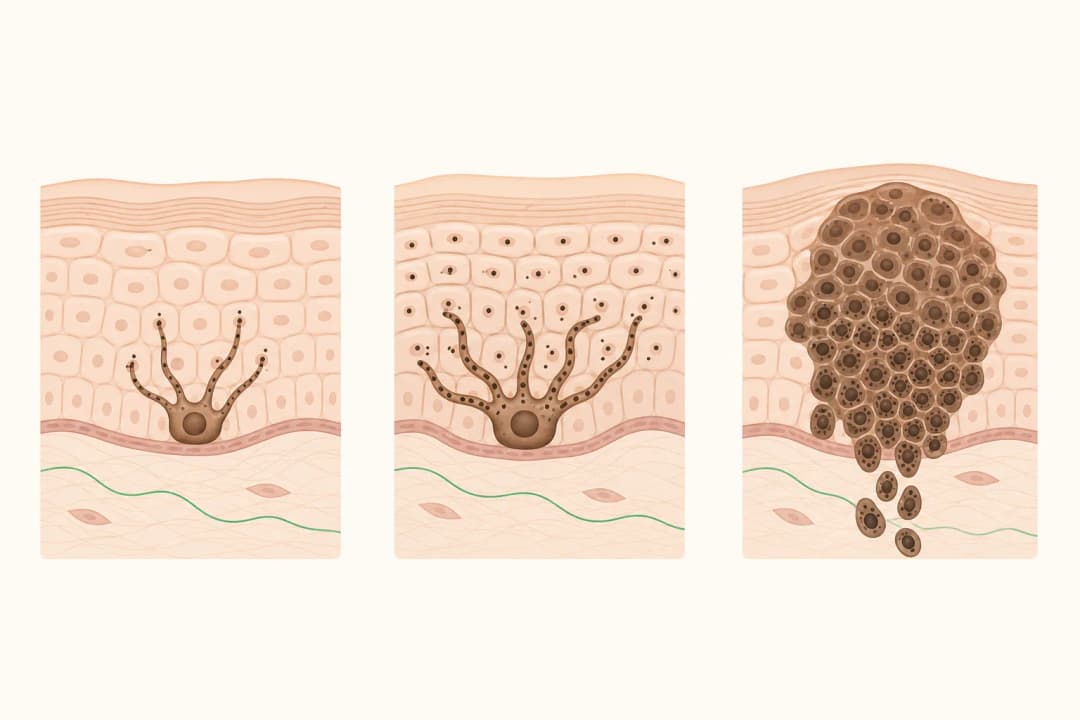
Superficial spreading melanoma can remain in the upper skin for a period before invading deeper tissue. A thinner tumour without ulceration generally gives clinicians a different starting point from a thicker or ulcerated tumour, but only your complete pathology and staging can describe your situation. The status of nearby lymph nodes and any distant spread also changes the care pathway. Brain metastases are one example of distant spread, but symptoms or a subtype name alone cannot establish that it has occurred.
Prognosis is a clinical estimate, not a promise about one person. It can be revised when surgery, imaging, lymph-node testing, or treatment provides new information. Your age, general health, tumour biology, and how the disease responds to therapy may also matter.
Ways to move the assessment forward
Ask for a clear explanation of the pathology stage and whether the primary lesion was fully removed. Depending on the findings, your team may discuss wider excision, sentinel lymph node biopsy, imaging, or systemic treatment. Keep appointments, bring your report and medication list, and examine your skin and lymph-node areas as advised. Follow-up after cancer treatment helps detect changes early and gives you a place to discuss anxiety, scars, and sun protection. Read more about Melanoma and Follow-Up After Cancer Treatment.
When to seek care promptly
Report a new lump near the treated area, a changing spot, persistent unexplained pain, or ongoing swelling to your cancer team. Seek urgent help for severe breathlessness, sudden weakness, confusion, seizure, or a rapidly worsening severe headache. These symptoms have many possible causes, but prompt assessment matters after a melanoma diagnosis.
Questions for your doctor
What is my stage and which finding contributes most to it? Was ulceration present? Were lymph nodes assessed? Do I need additional surgery or imaging? How will you monitor for recurrence, and which symptoms should trigger a call?
Find care
General Clinics & Polyclinics in Abu Dhabi
That answer is general. If you want it applied to your own case, these are licensed general clinics & polyclinics listed in Abu Dhabi.
27 Ar Ruwwad St - Shakhbout City - MSH4 - Abu Dhabi - United Arab Emirates
Accepts: Daman, Thiqa, Cigna, MetLife +20 more
Al Ruwais, Al Dhafrah
Accepts: Daman, Thiqa, AXA, Cigna +16 more
Al Bahyah - Al Bahyah Old - Abu Dhabi - United Arab Emirates
Accepts: Daman, Thiqa, Cigna, Allianz Care +18 more
Abu Dhabi
Accepts: Daman, Thiqa, AXA, Cigna +27 more
Ordered by verification status and how complete each clinic's public record is, then alphabetically. This is a directory listing, not a ranking — Zavis does not rate or recommend providers.
A factual listing drawn from the DHA, DOH and MOHAP licence registers. It is not a referral, an endorsement, or advice that any of these providers is right for you.
Questions people ask
Can a pathology subtype predict my exact future?
No. The subtype is one part of the diagnosis; depth, ulceration, nodes, spread, biology, and treatment response are also considered.
Does follow-up still matter after surgery?
Yes. Follow-up checks the scar, surrounding skin, lymph nodes, and any concerns that arise during recovery.
Related
Related reading
Keep reading
Medical disclaimer. This page is general health information, not medical advice, and it cannot diagnose you. Always consult a licensed healthcare provider about your own symptoms and treatment. In an emergency in the UAE, call 998 for an ambulance.