
What should you know about sacral chondrosarcoma?
Short answer
Sacral chondrosarcoma is a cartilage-forming tumour in the sacrum that requires specialist imaging, biopsy planning, and carefully coordinated treatment.
This answers one question. It is not a diagnosis and does not replace an assessment by a licensed doctor.
At a glance
- Location
- Sacrum at the base of the spine
- Tumour origin
- Cartilage-forming cells
- Key assessment
- Imaging and specialist-planned tissue diagnosis
Understanding the tumour and its location
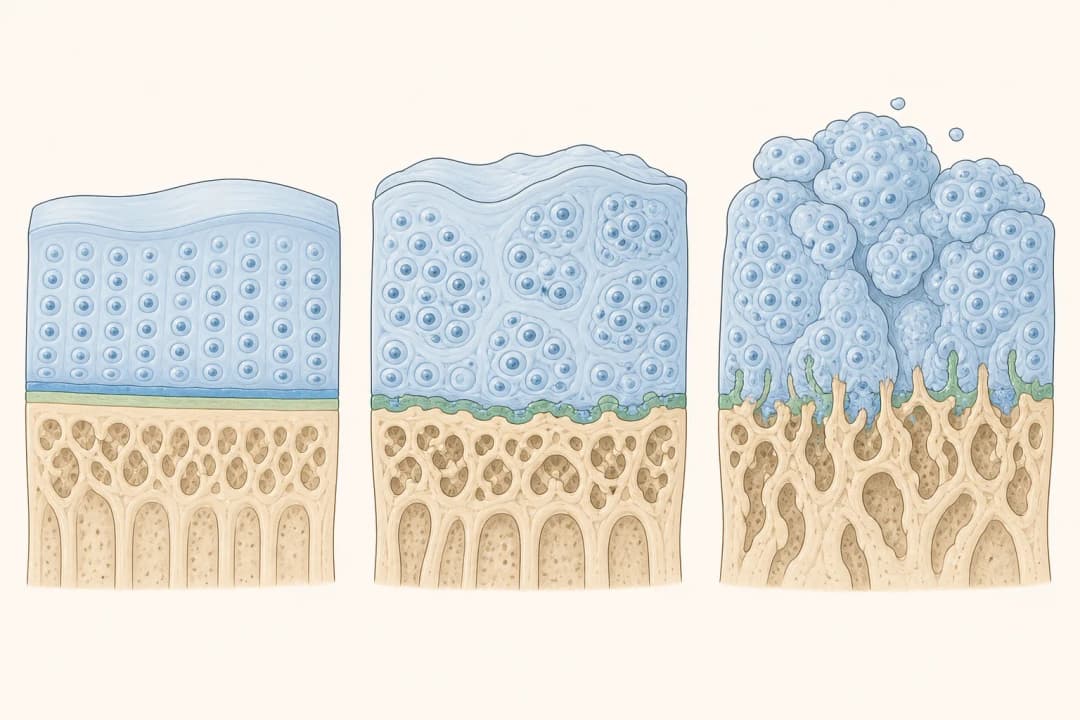
The sacrum is the broad bone at the base of the spine between the hip bones. A chondrosarcoma develops from cartilage-producing cells and may grow near nerves that control sensation, leg movement, and bladder or bowel function. Symptoms can include deep lower-back or buttock pain, a lump, altered sensation, weakness, or changes in bladder or bowel control.
MRI and other scans help show the tumour's size, position, and relationship to nearby structures. A biopsy may be planned by the specialist team so the sample path does not interfere with later surgery. The pathology result helps identify the tumour type and grade.
Treatment planning
Ask for care from a team experienced with bone and pelvic tumours. Treatment decisions consider the tumour's location, extent, grade, symptoms, and the nerves or organs nearby. Tumour removal surgery may be discussed when the team believes the growth can be removed while balancing movement, sensation, and bladder or bowel function.
Proton therapy may be considered as a form of radiation treatment in selected situations, especially when the team is planning how to treat the tumour while limiting radiation exposure to nearby healthy tissues. Your specialists will explain the intended benefit and possible effects.
When to seek care
Seek urgent medical help for new loss of bladder or bowel control, inability to pass urine, rapidly worsening leg weakness, numbness around the inner thighs, or severe uncontrolled pain. Contact your team promptly if a sacral lump grows, pain changes substantially, or walking becomes more difficult.
Questions for your doctor
Ask which scans are needed, where the biopsy should be performed, whether surgery is feasible, and how treatment could affect walking, sensation, and bladder or bowel function. Ask whether proton therapy is relevant and how follow-up will be arranged.
Questions people ask
Can sacral chondrosarcoma affect nerves?
Yes. Because the sacrum is close to nerves for the legs, bladder, and bowel, the tumour or its treatment may affect these functions.
Why does biopsy planning matter?
The biopsy route can influence later surgery, so it is usually planned with the specialist team that will coordinate treatment.
Related
Related reading
Keep reading
Cancer care in the UAE
Hospitals & Medical Centers in Abu Dhabi
Most UAE cancer care is delivered inside hospital services rather than by standalone oncology clinics, so these are licensed hospitals & medical centers listed in Abu Dhabi. Confirm the specific cancer service exists before you travel, and know that asking for a second opinion is routine.
Ahalia Hospital Musaffah Building - Musaffah - Musaffah Industrial - Abu Dhabi - United Arab Emirates
Accepts: Daman, Thiqa, AXA, Cigna +26 more
Al Ruwais Industrial City - Abu Dhabi - United Arab Emirates
Accepts: Daman, Thiqa, AXA, Cigna +30 more
Abu Dhabi, Abu Dhabi
Accepts: Daman, Thiqa, AXA, Cigna +30 more
Second opinions are routine in cancer care and asking for one does not affect your treatment. How to arrange a second opinion in the UAE.
Ordered by verification status and how complete each clinic's public record is, then alphabetically. This is a directory listing, not a ranking — Zavis does not rate or recommend providers.
A factual listing drawn from the DHA, DOH and MOHAP licence registers. It is not a referral, an endorsement, or advice that any of these providers is right for you.
Medical disclaimer. This page is general health information, not medical advice, and it cannot diagnose you. Always consult a licensed healthcare provider about your own symptoms and treatment. In an emergency in the UAE, call 998 for an ambulance.