
Melanoma staging explained
Short answer
Melanoma staging combines the primary tumour’s pathology with evidence about lymph nodes and distant spread to guide treatment planning.
This answers one question. It is not a diagnosis and does not replace an assessment by a licensed doctor.
At a glance
- Main inputs
- Tumour features, lymph nodes, and distant findings
- Stage can change
- After surgery or additional testing
- Purpose
- To organise care planning
How staging is built
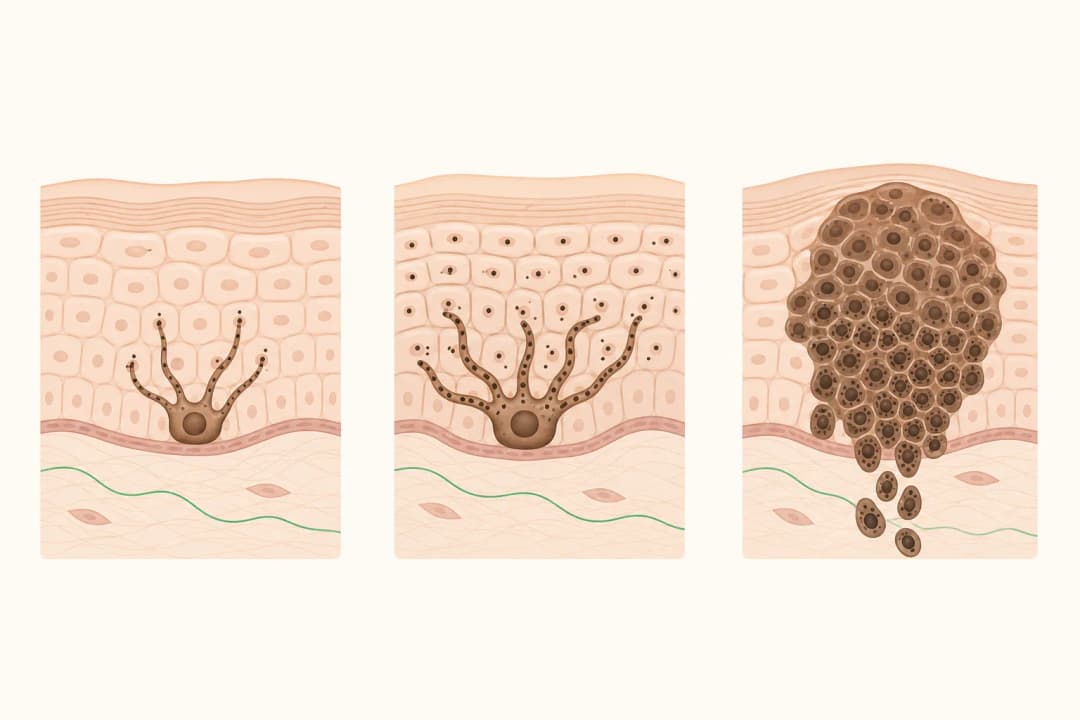
Your team considers the tumour’s thickness, ulceration, and whether melanoma cells are found in nearby lymph nodes. They may also use examination, imaging, or other tests when symptoms or pathology make them relevant. The result is grouped into stages that describe disease limited to the skin, disease involving regional nodes or nearby skin, or disease found in distant organs.
A stage is based on available clinical and pathology information; it can be refined after excision or node testing. It does not predict one person’s experience with certainty. The [Melanoma] overview gives broader context, while [Sentinel Lymph Node Biopsy] explains one way regional spread may be assessed.
How to prepare for the staging discussion
Bring the pathology report and write down unfamiliar terms such as Breslow thickness, ulceration, margins, or sentinel node. Ask which tests are necessary for your particular findings and which are not. Treatment may include [Surgical Excision] for the primary lesion; more advanced findings can lead to discussions about [Immunotherapy] or other specialist options.
Keep copies of scan and pathology results, attend planned appointments, and check the skin and lymph-node areas your clinician identifies. Staging is a process of organising evidence, not a substitute for examining a new symptom.
When to seek care
Seek prompt advice for a rapidly changing or bleeding lesion, a non-healing sore, or a new firm lump near the melanoma or in a nearby lymph-node area. During treatment or staging, report persistent headaches, new weakness, breathing difficulty, unexplained pain, or marked changes in general health. These symptoms have many possible causes, but timely assessment helps your team decide whether further evaluation is needed.
Questions for your doctor
Ask which stage applies now and whether it is clinical or based on surgical pathology. What do thickness, ulceration, margins, and node findings mean in my report? Do I need imaging or sentinel node sampling? How will the stage affect surgery, treatment choices, and follow-up?
Find care
General Clinics & Polyclinics in Abu Dhabi
That answer is general. If you want it applied to your own case, these are licensed general clinics & polyclinics listed in Abu Dhabi.
27 Ar Ruwwad St - Shakhbout City - MSH4 - Abu Dhabi - United Arab Emirates
Accepts: Daman, Thiqa, Cigna, MetLife +20 more
Al Ruwais, Al Dhafrah
Accepts: Daman, Thiqa, AXA, Cigna +16 more
Al Bahyah - Al Bahyah Old - Abu Dhabi - United Arab Emirates
Accepts: Daman, Thiqa, Cigna, Allianz Care +18 more
Abu Dhabi
Accepts: Daman, Thiqa, AXA, Cigna +27 more
Ordered by verification status and how complete each clinic's public record is, then alphabetically. This is a directory listing, not a ranking — Zavis does not rate or recommend providers.
A factual listing drawn from the DHA, DOH and MOHAP licence registers. It is not a referral, an endorsement, or advice that any of these providers is right for you.
Questions people ask
Can melanoma staging be completed from a photograph?
No. A photograph may support assessment, but staging depends on examination, pathology, and selected tests.
Does a higher stage always mean symptoms are worse?
No. Stage describes where melanoma is found and its features; symptoms vary between people.
Related
Related reading
Keep reading
Medical disclaimer. This page is general health information, not medical advice, and it cannot diagnose you. Always consult a licensed healthcare provider about your own symptoms and treatment. In an emergency in the UAE, call 998 for an ambulance.