
What should you know about melanoma satellite lesions?
Short answer
Melanoma satellite lesions are separate deposits near a primary melanoma and require prompt specialist assessment.
This answers one question. It is not a diagnosis and does not replace an assessment by a licensed doctor.
At a glance
- Location
- Near the original melanoma, separated by normal-looking skin.
- Why it matters
- It may change staging and treatment planning.
- Assessment
- Clinical review, pathology, and selected imaging.
What a satellite lesion is
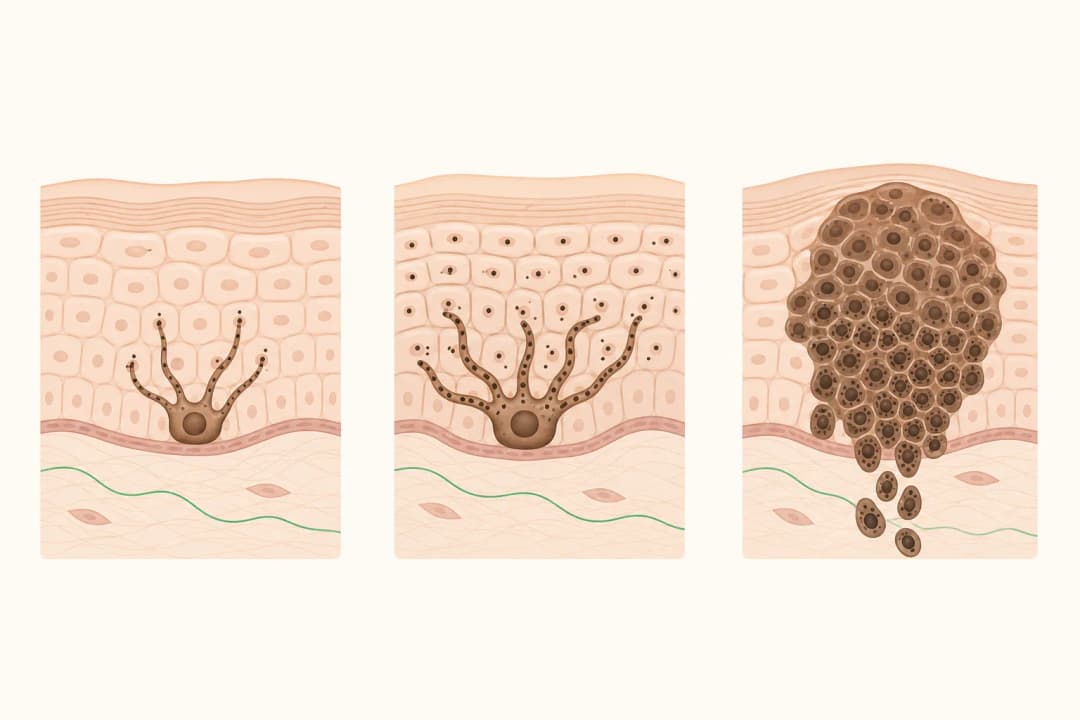
A satellite lesion is a melanoma deposit in the skin or nearby tissue close to the original tumour, with normal-looking skin between the spots. It is different from a single mole that has changed and different from a scar caused by treatment. A clinician may also distinguish satellite disease from an in-transit deposit, which is farther along lymphatic drainage.
The finding can affect staging because it suggests melanoma cells have moved beyond the primary focus. It does not, by itself, show where else the cancer may be present. Examination, biopsy, and selected imaging help the team decide whether nearby lymph nodes or distant organs need assessment.
What to do next
Contact the specialist managing the melanoma without delaying an appointment. Avoid squeezing, shaving over, or repeatedly touching the area. Photograph the spots in consistent lighting and record new symptoms such as tenderness, bleeding, swelling, or rapid growth.
The plan may involve surgical excision or skin cancer surgery, a sentinel lymph node biopsy, and discussion of systemic treatment such as immunotherapy. Decisions depend on pathology, the number and position of lesions, lymph-node findings, and imaging.
When to seek care
Seek same-day advice for rapid enlargement, heavy bleeding, spreading redness with fever, or severe pain. New weakness, confusion, seizures, breathing difficulty, or a severe headache needs urgent assessment because melanoma can involve distant sites, including the brain.
Questions for your doctor
Ask whether the spots need biopsy, how they affect the stage, whether lymph-node evaluation or imaging is needed, and which treatment sequence is recommended. Clarify how to monitor the area and when follow-up after cancer treatment should occur.
Find care
General Clinics & Polyclinics in Abu Dhabi
That answer is general. If you want it applied to your own case, these are licensed general clinics & polyclinics listed in Abu Dhabi.
27 Ar Ruwwad St - Shakhbout City - MSH4 - Abu Dhabi - United Arab Emirates
Accepts: Daman, Thiqa, Cigna, MetLife +20 more
Al Ruwais, Al Dhafrah
Accepts: Daman, Thiqa, AXA, Cigna +16 more
Al Bahyah - Al Bahyah Old - Abu Dhabi - United Arab Emirates
Accepts: Daman, Thiqa, Cigna, Allianz Care +18 more
Abu Dhabi
Accepts: Daman, Thiqa, AXA, Cigna +27 more
Ordered by verification status and how complete each clinic's public record is, then alphabetically. This is a directory listing, not a ranking — Zavis does not rate or recommend providers.
A factual listing drawn from the DHA, DOH and MOHAP licence registers. It is not a referral, an endorsement, or advice that any of these providers is right for you.
Questions people ask
Is every new spot near melanoma a satellite lesion?
No. A new spot may have another explanation, so examination and sometimes biopsy are needed.
Can satellite lesions be removed?
Some can be removed surgically, but the overall plan depends on staging and the wider melanoma assessment.
Related
Related reading
Keep reading
Medical disclaimer. This page is general health information, not medical advice, and it cannot diagnose you. Always consult a licensed healthcare provider about your own symptoms and treatment. In an emergency in the UAE, call 998 for an ambulance.