
What should you know about melanoma on a knee?
Short answer
Melanoma on a knee should be checked promptly when a spot changes or develops irregular colour, bleeding, crusting, or a persistent sore.
This answers one question. It is not a diagnosis and does not replace an assessment by a licensed doctor.
At a glance
- Common irritation
- Friction and minor injury can alter knee skin
- Definitive test
- Biopsy with pathology review
- Treatment concern
- Healing across a moving joint
How melanoma may appear on the knee
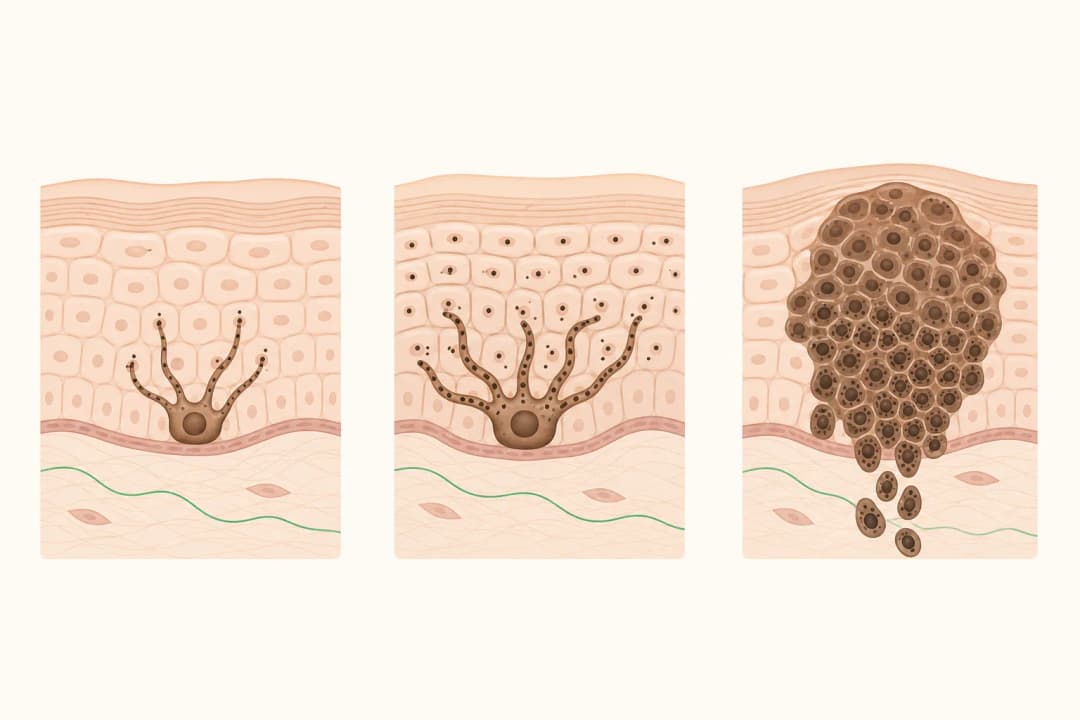
Melanoma is a cancer of pigment-producing cells. On or near the knee it can look like a new dark patch, a changing mole, an uneven bump, or a lesion that catches on clothing and repeatedly bleeds. It may have an irregular outline, more than one shade, altered texture, itching, or a sore surface.
The knee is also prone to friction, shaving cuts, insect bites, and bruises, which can make a harmless mark look concerning. A clinician may use dermoscopy and take a biopsy to distinguish these causes. Pathology, rather than location or colour alone, determines the diagnosis and next steps.
What you can do
Arrange a skin assessment if the mark is new, evolving, or unlike your other moles. Photograph it and note any bleeding, discomfort, or change in its outline. Avoid rubbing, scratching, or using wart remover and other home products, since these can irritate the area and obscure its appearance.
When melanoma is confirmed, treatment often involves planned removal. Your clinician may explain Surgical Excision, Skin Cancer Surgery, or Tumour Removal Surgery, along with wound care around a moving joint. A Sentinel Lymph Node Biopsy may be discussed when it could add useful staging information.
When not to wait
Seek prompt care for a knee lesion that is enlarging, changing quickly, persistently bleeding, ulcerated, or surrounded by increasing warmth and redness. Urgent assessment is needed for fever with a worsening wound, sudden leg swelling, severe pain, new weakness, confusion, or breathing trouble. These symptoms require attention even if the skin mark seems small.
Questions to take along
Ask whether friction or an old injury could explain the appearance, whether biopsy is needed, and how the result will be shared. Ask about the expected scar, movement during healing, margins, lymph-node assessment, and the schedule for checking the treated area and the rest of your skin.
Find care
General Clinics & Polyclinics in Abu Dhabi
That answer is general. If you want it applied to your own case, these are licensed general clinics & polyclinics listed in Abu Dhabi.
27 Ar Ruwwad St - Shakhbout City - MSH4 - Abu Dhabi - United Arab Emirates
Accepts: Daman, Thiqa, Cigna, MetLife +20 more
Al Ruwais, Al Dhafrah
Accepts: Daman, Thiqa, AXA, Cigna +16 more
Al Bahyah - Al Bahyah Old - Abu Dhabi - United Arab Emirates
Accepts: Daman, Thiqa, Cigna, Allianz Care +18 more
Abu Dhabi
Accepts: Daman, Thiqa, AXA, Cigna +27 more
Ordered by verification status and how complete each clinic's public record is, then alphabetically. This is a directory listing, not a ranking — Zavis does not rate or recommend providers.
A factual listing drawn from the DHA, DOH and MOHAP licence registers. It is not a referral, an endorsement, or advice that any of these providers is right for you.
Questions people ask
Can a knee injury cause a dark mark?
Yes. Bruising and healing injuries can darken skin, but a mark that persists or changes should still be assessed.
Will treatment affect knee movement?
The procedure and wound location influence recovery, so ask the treating clinician how to protect movement while healing.
Related
Related reading
Keep reading
Medical disclaimer. This page is general health information, not medical advice, and it cannot diagnose you. Always consult a licensed healthcare provider about your own symptoms and treatment. In an emergency in the UAE, call 998 for an ambulance.