
What should you know about melanoma oct?
Short answer
Melanoma awareness means knowing that a changing pigmented mark deserves clinical assessment, while treatment is chosen after examination and pathology clarify the diagnosis.
This answers one question. It is not a diagnosis and does not replace an assessment by a licensed doctor.
At a glance
- Watch for
- Change, bleeding, crusting, or a non-healing sore.
- Assessment
- History, examination, and sometimes biopsy.
- Protection
- Shade, clothing, and sunscreen help reduce exposure.
What a concerning mark can show
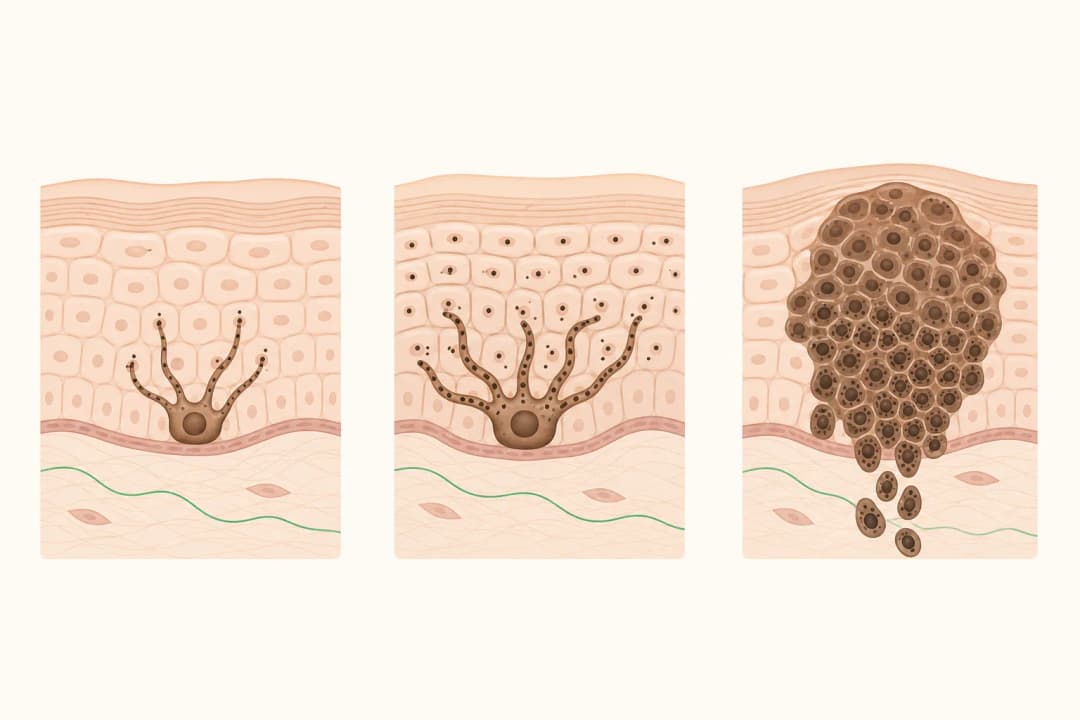
Melanoma may show change in size, shape, colour, or surface. It can itch, bleed, crust, or become sore, although some melanomas cause little discomfort. Lesions may occur on the face, trunk, limbs, scalp, palms, soles, or around a nail. A clinician considers the whole pattern and your history rather than relying on one visual rule. Many changing marks have non-cancerous explanations, so examination is the route to a useful answer.
A sensible checking routine
Look at your skin in good light, using a mirror or help for the scalp and back. Keep a dated photograph of a mark that needs observation, but do not postpone an appointment if it continues to change. Use shade, protective clothing, and sunscreen, and avoid tanning devices. At assessment, a clinician may examine the lesion with magnification and recommend surgical excision or another biopsy when the appearance warrants tissue diagnosis.
When timing matters
Book a prompt review for a new or changing pigmented mark, pigment under a nail, a sore that does not heal, or repeated bleeding from a lesion. Seek urgent care for bleeding that cannot be controlled, sudden severe symptoms, or signs of infection after a biopsy. A concerning mark does not by itself establish melanoma, but it should be assessed rather than managed with home creams or cosmetic cover.
What to ask
Ask whether the lesion can be monitored safely, what biopsy method is proposed, how results will be communicated, and what the report means. If melanoma is found, ask whether the margins are clear, whether lymph-node assessment is needed, and how follow-up will be organised.
Find care
General Clinics & Polyclinics in Abu Dhabi
That answer is general. If you want it applied to your own case, these are licensed general clinics & polyclinics listed in Abu Dhabi.
27 Ar Ruwwad St - Shakhbout City - MSH4 - Abu Dhabi - United Arab Emirates
Accepts: Daman, Thiqa, Cigna, MetLife +20 more
Al Ruwais, Al Dhafrah
Accepts: Daman, Thiqa, AXA, Cigna +16 more
Al Bahyah - Al Bahyah Old - Abu Dhabi - United Arab Emirates
Accepts: Daman, Thiqa, Cigna, Allianz Care +18 more
Abu Dhabi
Accepts: Daman, Thiqa, AXA, Cigna +27 more
Ordered by verification status and how complete each clinic's public record is, then alphabetically. This is a directory listing, not a ranking — Zavis does not rate or recommend providers.
A factual listing drawn from the DHA, DOH and MOHAP licence registers. It is not a referral, an endorsement, or advice that any of these providers is right for you.
Questions people ask
Can melanoma be painless?
Yes. Some melanomas cause no discomfort, which is why visual change still deserves attention.
Should I treat a suspicious mark at home?
No. Cosmetic products cannot diagnose or treat melanoma; arrange clinical assessment.
Related
Related reading
Keep reading
Medical disclaimer. This page is general health information, not medical advice, and it cannot diagnose you. Always consult a licensed healthcare provider about your own symptoms and treatment. In an emergency in the UAE, call 998 for an ambulance.