
What should you know about melanoma lesions?
Short answer
A melanoma lesion is a cancerous growth of pigment-producing skin cells that may change in colour, shape, border, size, or sensation and needs clinical assessment.
This answers one question. It is not a diagnosis and does not replace an assessment by a licensed doctor.
At a glance
- Possible clue
- A new or changing spot that differs from nearby moles
- Diagnosis
- Clinical assessment followed by biopsy when indicated
- Do not do
- Avoid picking, shaving, or treating a suspicious lesion at home
How lesions can differ
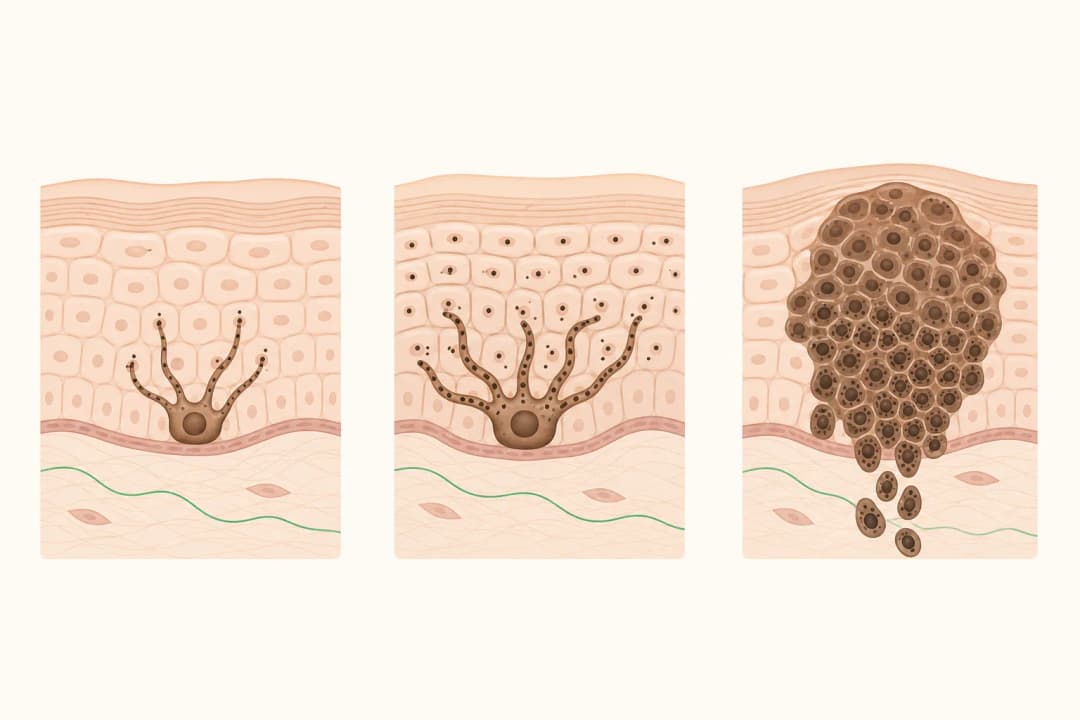
Melanoma can appear as a new spot or as a change within an existing mole. Some lesions are dark, while others contain tan, red, blue, white, or very little pigment. One side may not match the other, the edge may look notched, or several shades may sit together. A lesion can itch, bleed, crust, or become sore, but it can also cause no sensation.
These features are clues rather than a diagnosis. A dermatologist may compare the lesion with the rest of your skin, use magnification, and remove part or all of it for laboratory analysis. The report determines whether melanoma is present and how deeply it has entered the skin.
Practical next steps
Check your skin in good light, including the scalp, soles, nails, and areas covered by clothing. Keep a record of a spot that looks different from your other moles, and arrange an appointment rather than repeatedly examining it without help. Do not pick, shave, or apply home treatments to a suspicious lesion. Confirmed melanoma may be managed with Surgical Excision or another form of Skin Cancer Surgery; the choice depends on the pathology report and body location.
When to seek care
Arrange prompt dermatology review for a spot that is evolving, stands out from your other moles, or repeatedly bleeds or crusts. Seek urgent help for heavy bleeding that will not stop with firm pressure, a rapidly spreading local infection, or new severe symptoms such as confusion, weakness, or a seizure. Those symptoms need immediate assessment and are not proof that a skin lesion has spread.
Questions for your doctor
What features make this lesion concerning? Should it be photographed, monitored, or biopsied? Will the whole lesion be removed? When will the pathology result be available? If melanoma is confirmed, do I need further surgery, staging, or surveillance?
Find care
General Clinics & Polyclinics in Abu Dhabi
That answer is general. If you want it applied to your own case, these are licensed general clinics & polyclinics listed in Abu Dhabi.
27 Ar Ruwwad St - Shakhbout City - MSH4 - Abu Dhabi - United Arab Emirates
Accepts: Daman, Thiqa, Cigna, MetLife +20 more
Al Ruwais, Al Dhafrah
Accepts: Daman, Thiqa, AXA, Cigna +16 more
Al Bahyah - Al Bahyah Old - Abu Dhabi - United Arab Emirates
Accepts: Daman, Thiqa, Cigna, Allianz Care +18 more
Abu Dhabi
Accepts: Daman, Thiqa, AXA, Cigna +27 more
Ordered by verification status and how complete each clinic's public record is, then alphabetically. This is a directory listing, not a ranking — Zavis does not rate or recommend providers.
A factual listing drawn from the DHA, DOH and MOHAP licence registers. It is not a referral, an endorsement, or advice that any of these providers is right for you.
Questions people ask
Can melanoma look like a normal mole?
Yes. Some melanomas resemble ordinary moles, which is why change and comparison with surrounding skin matter.
Does an itchy lesion always mean melanoma?
No. Itching has many causes; persistent change or bleeding warrants assessment rather than self-diagnosis.
Related
Related reading
Keep reading
Medical disclaimer. This page is general health information, not medical advice, and it cannot diagnose you. Always consult a licensed healthcare provider about your own symptoms and treatment. In an emergency in the UAE, call 998 for an ambulance.