
Melanoma in situ: lentigo maligna type
Short answer
Melanoma in situ lentigo maligna type is an early melanoma that spreads within the outer skin layer, often as a slowly enlarging uneven patch on sun-exposed skin.
This answers one question. It is not a diagnosis and does not replace an assessment by a licensed doctor.
At a glance
- Typical setting
- Chronically sun-exposed skin, often the face, scalp, or neck
- Appearance
- A flat patch with uneven colour or an irregular border that changes gradually
What lentigo maligna type means
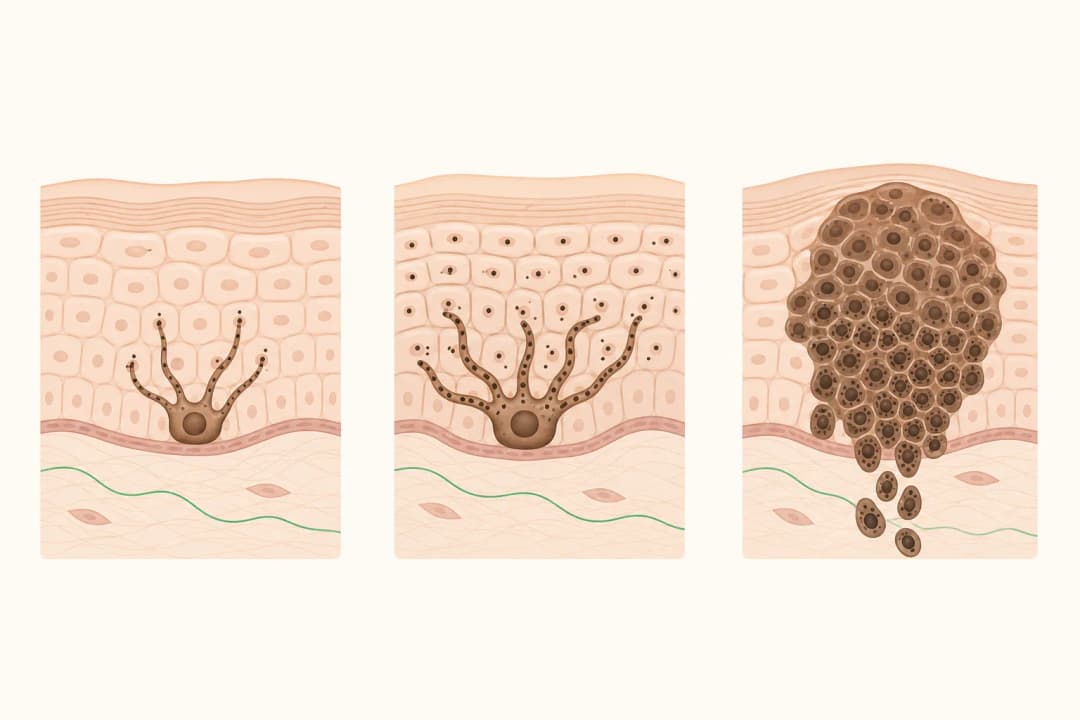
Lentigo maligna is a form of melanoma in situ that commonly develops on chronically sun-exposed skin, such as the face, scalp, or neck. It may begin as a flat tan, brown, or black patch and gradually develop uneven colour, an irregular outline, or small darker areas. The patch can be broad and subtle, so its edge may be difficult to distinguish from surrounding sun-damaged skin.
The diagnosis is made from a skin examination and a biopsy reviewed by a pathologist. The report helps show whether the sampled area is in situ and whether the edges contain abnormal cells. A different diagnosis remains possible until tissue has been assessed.
How it is managed
Arrange specialist care so the full visible area and its margins can be assessed. Treatment aims to remove all melanoma in situ while considering the location and the amount of healthy skin that can be preserved. Your clinician may discuss surgical excision or other skin cancer surgery and may recommend further tissue assessment if the edges are involved. Sentinel lymph node biopsy is not routine for every in-situ lesion; its relevance depends on the final findings. Read about Melanoma and Follow-Up After Cancer Treatment for context.
When to seek care
Seek prompt assessment for a flat patch on sun-exposed skin that enlarges, changes shade, develops an uneven border, or contains a new darker focus. After treatment, report a recurring stain at the scar, a new nearby patch, bleeding, or a sore that does not heal. Get urgent wound advice for persistent bleeding, rapidly increasing swelling, fever, or spreading redness after a procedure.
Questions for your doctor
Ask how the diagnosis was confirmed, how far the patch extends, and whether the biopsy margins are clear. Ask which removal method fits the location, whether further tissue sampling is needed, and how the scar and surrounding skin will be monitored. Ask what sun-protection measures are realistic for your daily routine.
Find care
General Clinics & Polyclinics in Abu Dhabi
That answer is general. If you want it applied to your own case, these are licensed general clinics & polyclinics listed in Abu Dhabi.
27 Ar Ruwwad St - Shakhbout City - MSH4 - Abu Dhabi - United Arab Emirates
Accepts: Daman, Thiqa, Cigna, MetLife +20 more
Al Ruwais, Al Dhafrah
Accepts: Daman, Thiqa, AXA, Cigna +16 more
Al Bahyah - Al Bahyah Old - Abu Dhabi - United Arab Emirates
Accepts: Daman, Thiqa, Cigna, Allianz Care +18 more
Abu Dhabi
Accepts: Daman, Thiqa, AXA, Cigna +27 more
Ordered by verification status and how complete each clinic's public record is, then alphabetically. This is a directory listing, not a ranking — Zavis does not rate or recommend providers.
A factual listing drawn from the DHA, DOH and MOHAP licence registers. It is not a referral, an endorsement, or advice that any of these providers is right for you.
Questions people ask
Is lentigo maligna type always raised?
No. It is often a flat patch, although colour and texture can vary as the lesion changes.
Why can treatment require careful margin assessment?
The visible pigment may have subtle extensions within sun-damaged skin, so the clinician must assess the edges carefully.
Related
Related reading
Keep reading
Medical disclaimer. This page is general health information, not medical advice, and it cannot diagnose you. Always consult a licensed healthcare provider about your own symptoms and treatment. In an emergency in the UAE, call 998 for an ambulance.