
What should you know about melanoma in grey horses?
Short answer
Melanoma in grey horses is a veterinary condition involving dark skin nodules that should be examined and monitored.
This answers one question. It is not a diagnosis and does not replace an assessment by a licensed doctor.
At a glance
- Patient
- Grey horse
- Typical finding
- Dark subcutaneous nodule
- Important checks
- Growth, ulceration, bleeding, and obstruction
Why grey horses need attention
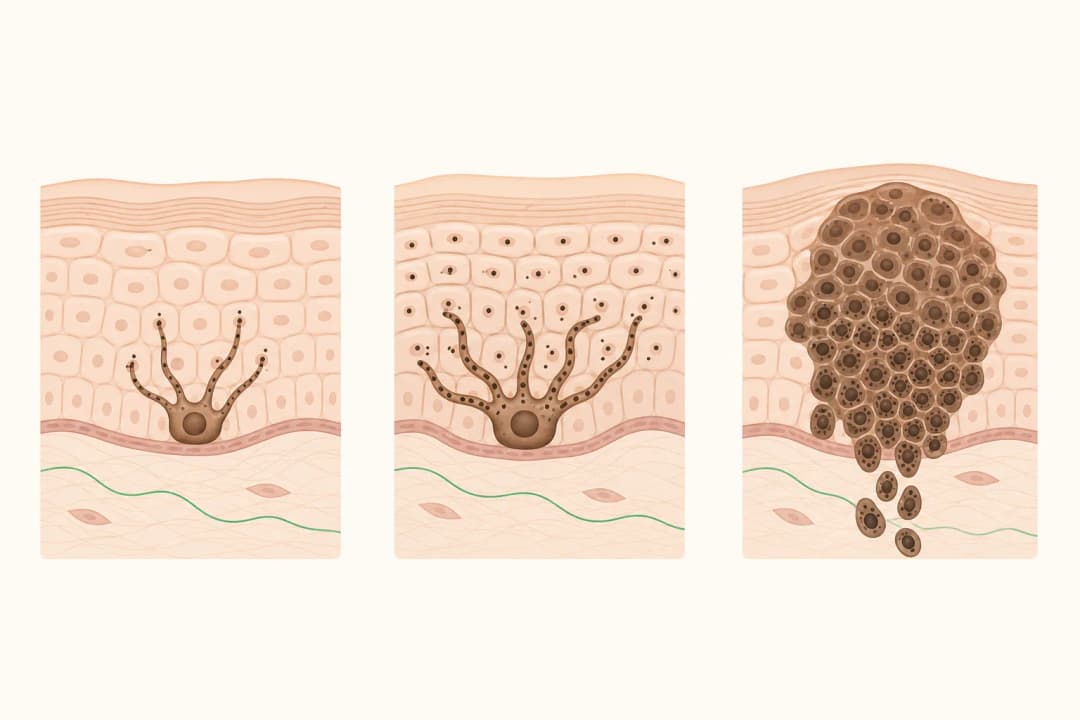
Grey horses commonly develop areas of dark pigment and may form firm nodules beneath the skin. Lesions are often noticed around the dock and anus, under the tail, beneath the mane, or near the eyelids, although other sites can be involved. A nodule may remain quiet for a long time, then enlarge, ulcerate, bleed, become infected, or interfere with defecation, grooming, vision, or movement. Not every dark lump is melanoma, and a veterinarian may need to examine, measure, sample, or image it.
The care plan depends on the number, size, location, growth pattern, and effect on the horse. Removing a lesion can be difficult when it lies close to the anus, tail, eye, or another structure where normal tissue is limited.
How to respond
Ask your equine veterinarian to assess any new lump, a lump that changes, or a mass that rubs, cracks, or discharges. Keep a simple record of its location and appearance, and do not squeeze, cut, or apply caustic products. The veterinarian may recommend observation with scheduled measurements, biopsy, surgical excision, or tumour removal surgery. If several lesions exist or a mass cannot be removed safely, referral to an equine surgical or oncology service may help plan care.
When to call urgently
Arrange urgent veterinary care for heavy bleeding, foul discharge, rapidly worsening swelling, fever, severe pain, difficulty passing manure, inability to see, or sudden weakness. A mass that blocks the anus, damages the eye, or causes repeated straining should not wait for a routine check. After a diagnosis, new coughing, breathing trouble, marked weight loss, or neurological changes need prompt review because serious disease may have spread.
Questions for your veterinarian
Ask whether the lesion can be monitored safely, how it will be measured, and whether sampling could change the plan. Discuss surgical access, wound care, pain relief, effects on tail or bowel function, and signs of infection. Ask how often the horse should be rechecked and whether other nodules need mapping.
Find care
General Clinics & Polyclinics in Abu Dhabi
That answer is general. If you want it applied to your own case, these are licensed general clinics & polyclinics listed in Abu Dhabi.
27 Ar Ruwwad St - Shakhbout City - MSH4 - Abu Dhabi - United Arab Emirates
Accepts: Daman, Thiqa, Cigna, MetLife +20 more
Al Ruwais, Al Dhafrah
Accepts: Daman, Thiqa, AXA, Cigna +16 more
Al Bahyah - Al Bahyah Old - Abu Dhabi - United Arab Emirates
Accepts: Daman, Thiqa, Cigna, Allianz Care +18 more
Abu Dhabi
Accepts: Daman, Thiqa, AXA, Cigna +27 more
Ordered by verification status and how complete each clinic's public record is, then alphabetically. This is a directory listing, not a ranking — Zavis does not rate or recommend providers.
A factual listing drawn from the DHA, DOH and MOHAP licence registers. It is not a referral, an endorsement, or advice that any of these providers is right for you.
Questions people ask
Does every dark lump on a grey horse mean melanoma?
No. Pigment, cysts, infection, and other masses can look similar; an equine veterinarian should assess any changing or troublesome lump.
Can a grey horse's melanoma be removed?
Some lesions can be removed, while others are monitored or managed by a specialist because location and size affect surgical safety.
Related
Related reading
Keep reading
Medical disclaimer. This page is general health information, not medical advice, and it cannot diagnose you. Always consult a licensed healthcare provider about your own symptoms and treatment. In an emergency in the UAE, call 998 for an ambulance.