
What should you know about melanoma horses?
Short answer
What should you know about melanoma horses? Horses do not transmit melanoma to people through ordinary contact, while a changing human skin lesion should be assessed separately.
This answers one question. It is not a diagnosis and does not replace an assessment by a licensed doctor.
At a glance
- Transmission
- Ordinary contact with a horse does not transmit melanoma
- Human lesion
- Assessment depends on its own appearance and change
- Animal lump
- A veterinarian should examine it
Separating animal and human concerns
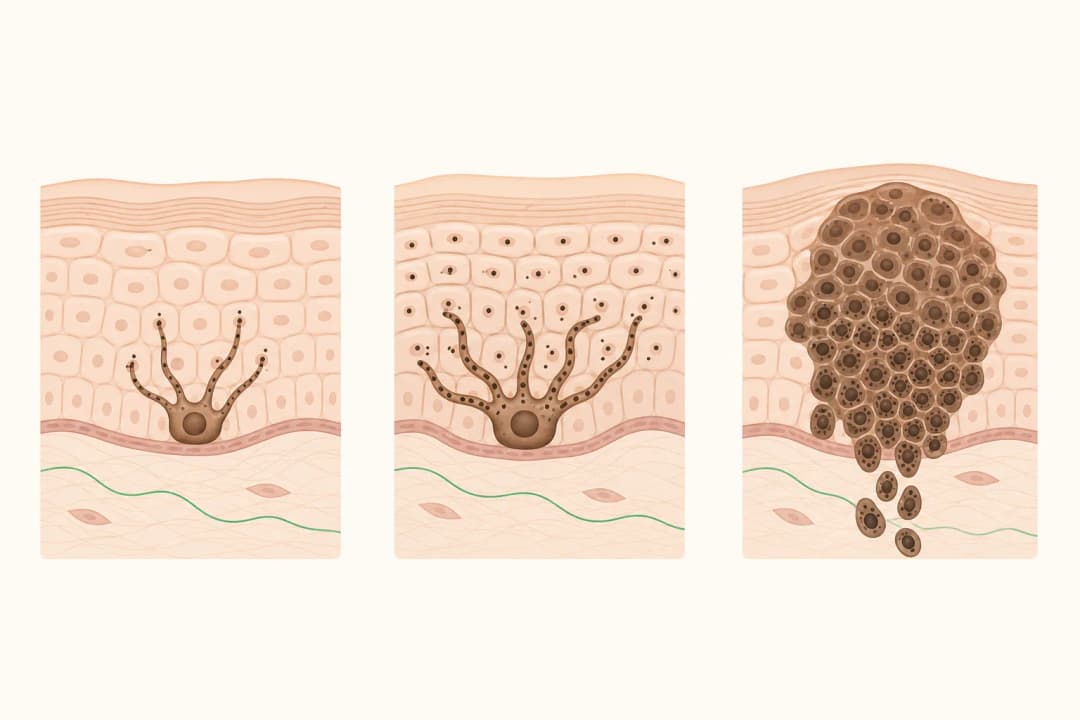
Melanoma is a tumour of pigment-producing cells. It occurs in people and can also occur in animals, including horses, but an animal's diagnosis is not passed to a person by touching, grooming, riding, or sharing a stable. A lump or dark patch on a horse is a veterinary concern; it should be examined by a veterinarian rather than compared with a human mole.
For a person, a new or changing mark may have many causes, from an ordinary mole to irritation or another skin condition. A clinician uses examination and, when needed, biopsy to identify it.
What you can do
If your concern is a horse, arrange a veterinary examination and avoid squeezing or cutting the lump. If your concern is your own skin, photograph the area for personal comparison, avoid picking it, and book a dermatology or medical assessment. Tell the clinician about change, bleeding, crusting, itching, or injury. A confirmed human melanoma may be managed with Surgical Excision, Skin Cancer Surgery, staging tests, or Immunotherapy.
When to seek care
Seek prompt medical review for a human lesion that grows, becomes uneven in colour or border, bleeds, crusts, or does not heal. Seek urgent help for heavy bleeding, rapidly spreading redness, severe pain, or fever. Seek veterinary advice for a horse with a growing, ulcerated, bleeding, or bothersome lump. Contact with a horse alone is not a reason for emergency care.
Questions for your doctor
Ask what features make your lesion concerning, whether a biopsy is needed, how the sample will be handled, and what follow-up is recommended. If the concern began with an animal's lump, explain exactly what you observed and keep the human and veterinary assessments separate.
Find care
General Clinics & Polyclinics in Abu Dhabi
That answer is general. If you want it applied to your own case, these are licensed general clinics & polyclinics listed in Abu Dhabi.
27 Ar Ruwwad St - Shakhbout City - MSH4 - Abu Dhabi - United Arab Emirates
Accepts: Daman, Thiqa, Cigna, MetLife +20 more
Al Ruwais, Al Dhafrah
Accepts: Daman, Thiqa, AXA, Cigna +16 more
Al Bahyah - Al Bahyah Old - Abu Dhabi - United Arab Emirates
Accepts: Daman, Thiqa, Cigna, Allianz Care +18 more
Abu Dhabi
Accepts: Daman, Thiqa, AXA, Cigna +27 more
Ordered by verification status and how complete each clinic's public record is, then alphabetically. This is a directory listing, not a ranking — Zavis does not rate or recommend providers.
A factual listing drawn from the DHA, DOH and MOHAP licence registers. It is not a referral, an endorsement, or advice that any of these providers is right for you.
Questions people ask
Can I catch melanoma from a horse?
No. Melanoma is not spread to people through routine contact with horses.
What should I do about a changing mole?
Arrange a medical or dermatology examination; a biopsy may be needed to identify the cause.
Related
Related reading
Keep reading
Medical disclaimer. This page is general health information, not medical advice, and it cannot diagnose you. Always consult a licensed healthcare provider about your own symptoms and treatment. In an emergency in the UAE, call 998 for an ambulance.