
What should you know about malignant melanoma on neck?
Short answer
Malignant melanoma on the neck is a skin cancer that needs prompt examination, biopsy and treatment planning based on its depth, margins and possible lymph-node involvement.
This answers one question. It is not a diagnosis and does not replace an assessment by a licensed doctor.
At a glance
- Typical clue
- A new or changing mark with differences in colour, border, shape or surface.
- Confirmation
- Clinical examination and tissue pathology.
- Treatment planning
- Depth, margins and lymph-node findings guide decisions.
The short answer
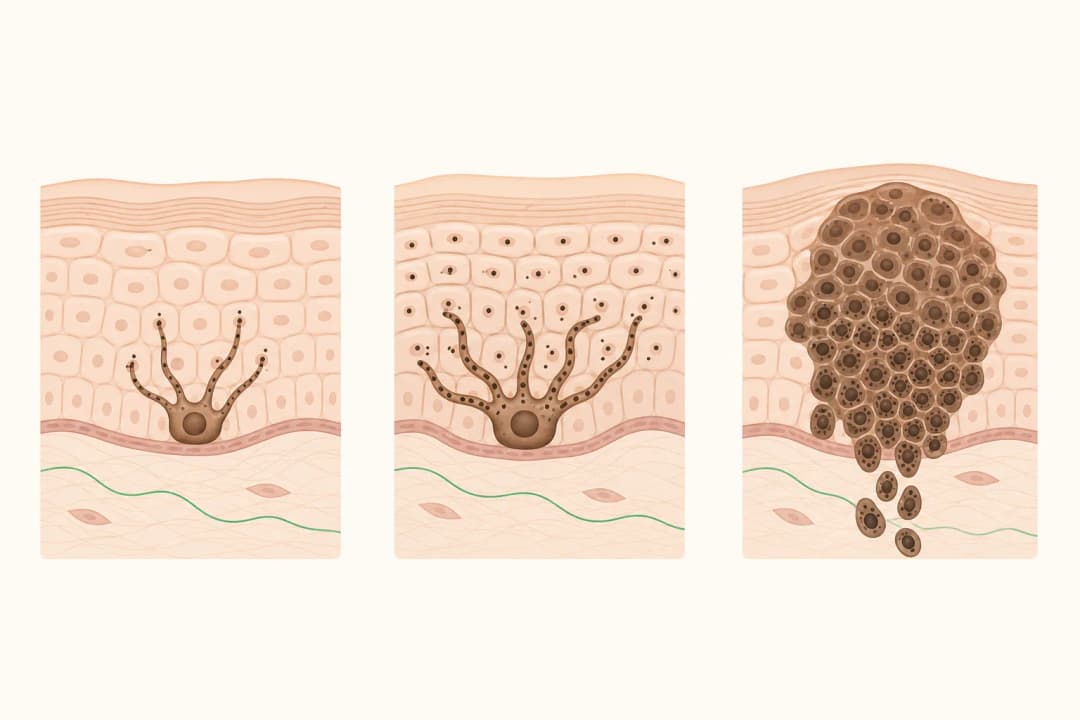
Malignant melanoma on the neck is a melanoma arising in neck skin. It may begin in an existing mole or appear as a new mark, with changes in colour, border, size, surface or sensation. A visual check cannot confirm the diagnosis; a clinician may use dermoscopy and biopsy.
What the diagnosis means
The neck receives regular sun exposure, but melanoma can develop in skin that is not constantly exposed. Pathology describes the tumour and whether the removed edges are clear. The team may examine lymph nodes in the neck or nearby region and use imaging if the findings warrant it.
For a localised lesion, surgical excision is commonly discussed, with the aim of removing the melanoma and an appropriate surrounding margin. More advanced disease may require lymph-node procedures, medicines such as immunotherapy or coordinated oncology care.
What to do next
Arrange a prompt skin examination for any neck mark that is new, changing, bleeding, crusting, itching or unlike your other moles. Photographing the area can help show change, but it should not replace an examination. Do not shave, pick or burn the lesion, and bring previous dermatology records to the appointment.
After treatment, check the scar and surrounding skin as advised. Ask how to examine your neck, scalp and lymph-node areas and when your next review is due.
When to seek care
Seek prompt assessment when a neck lesion changes quickly, develops several colours, has an irregular edge, repeatedly bleeds or forms a sore. Contact urgent care for uncontrolled bleeding, rapidly spreading redness with fever, or sudden breathing or swallowing difficulty. Those urgent symptoms may have causes unrelated to melanoma, but need immediate attention.
Questions for your doctor
Ask whether a biopsy is needed, what the pathology measures, whether the neck lymph nodes need assessment, how much tissue surgery may remove, and how you should monitor the scar and remaining skin.
Find care
General Clinics & Polyclinics in Abu Dhabi
That answer is general. If you want it applied to your own case, these are licensed general clinics & polyclinics listed in Abu Dhabi.
27 Ar Ruwwad St - Shakhbout City - MSH4 - Abu Dhabi - United Arab Emirates
Accepts: Daman, Thiqa, Cigna, MetLife +20 more
Al Ruwais, Al Dhafrah
Accepts: Daman, Thiqa, AXA, Cigna +16 more
Al Bahyah - Al Bahyah Old - Abu Dhabi - United Arab Emirates
Accepts: Daman, Thiqa, Cigna, Allianz Care +18 more
Abu Dhabi
Accepts: Daman, Thiqa, AXA, Cigna +27 more
Ordered by verification status and how complete each clinic's public record is, then alphabetically. This is a directory listing, not a ranking — Zavis does not rate or recommend providers.
A factual listing drawn from the DHA, DOH and MOHAP licence registers. It is not a referral, an endorsement, or advice that any of these providers is right for you.
Questions people ask
Can a neck mole change without being melanoma?
Yes. Benign moles can alter with irritation or other skin conditions, but a new or changing lesion should be checked rather than diagnosed at home.
Why might the neck lymph nodes be examined?
Lymph nodes drain nearby skin. Their examination can help the team decide whether further staging or treatment is appropriate.
Related
Related reading
Keep reading
Medical disclaimer. This page is general health information, not medical advice, and it cannot diagnose you. Always consult a licensed healthcare provider about your own symptoms and treatment. In an emergency in the UAE, call 998 for an ambulance.