
What should you know about malignant chondrosarcoma?
Short answer
Malignant chondrosarcoma is a cartilage-forming cancer that can develop in bone or soft tissue, and treatment depends on its location, size, grade and relationship to nearby structures.
This answers one question. It is not a diagnosis and does not replace an assessment by a licensed doctor.
At a glance
- Cell type
- Cartilage-forming cancer cells
- Treatment planning
- Tumour site, grade, size and nearby structures
What the diagnosis means
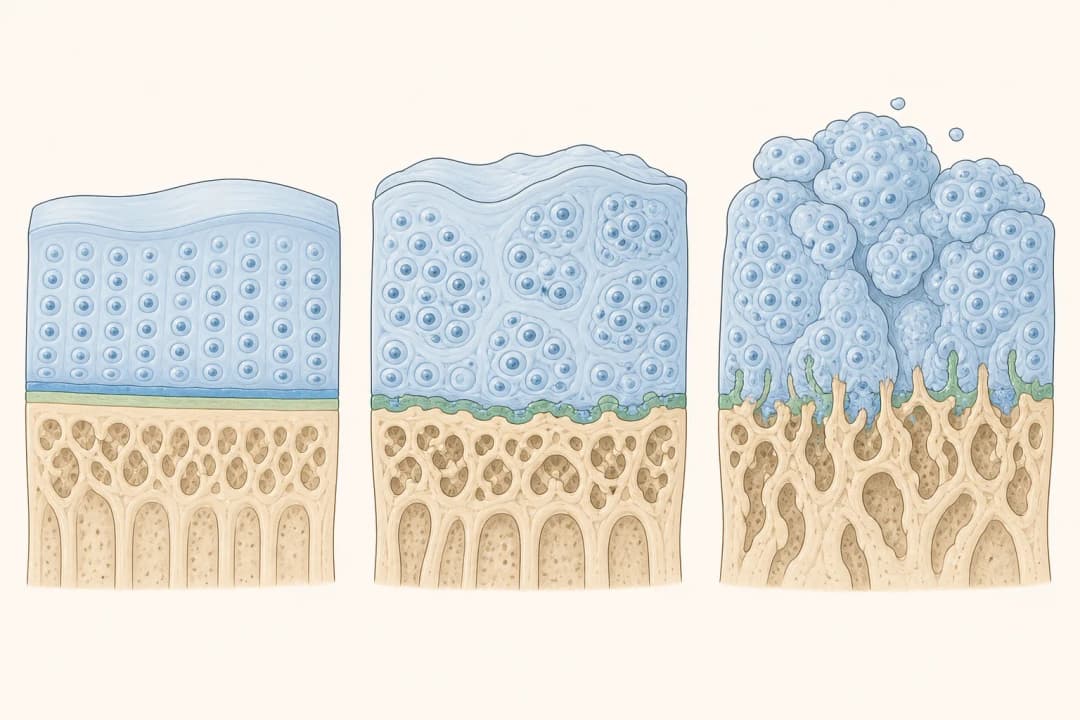
Chondrosarcoma may arise in the pelvis, ribs, shoulder, limbs or other bones, and some tumours begin in soft tissue. It can cause a slowly enlarging lump, persistent pain or reduced movement, although the symptoms vary with the site. A scan shows the shape and position of the tumour; a carefully planned biopsy examines its cells and grade.
The grade describes how the cells look and behave under the microscope. Imaging of the primary area and other parts of the body helps the team plan treatment and follow-up. Because these tumours can be close to nerves, blood vessels or organs, specialist planning matters.
Preparing for treatment
Ask to be assessed by a sarcoma team before a biopsy or operation. Surgery is often the main treatment when the tumour can be removed, with the aim of taking out the tumour while protecting function. Reconstruction, rehabilitation or changes to movement may need discussion before the procedure.
Proton therapy or another form of radiotherapy may be considered in selected situations, such as when a tumour is near sensitive structures or cannot be managed fully with surgery. The choice depends on the tumour and the treatment goal. Keep appointments for imaging and report new pain, weakness or a change in the lump.
When to seek urgent care
Seek urgent help for sudden severe pain, a new inability to move a limb, marked weakness or numbness, loss of bladder or bowel control, or breathing difficulty. These changes can reflect pressure on nerves, the spinal cord or other important structures.
Questions for your doctor
Ask what the biopsy grade shows, where the tumour is located, whether it touches nerves or vessels, and what surgery would involve. Ask whether proton therapy is relevant, how rehabilitation will be arranged, and which symptoms should be reported immediately.
Questions people ask
Why is biopsy planning important?
The biopsy path can affect later surgery, so it should be planned with the team that will manage the tumour.
Will treatment affect movement?
It can, depending on the tumour’s site and the procedure. Rehabilitation and reconstruction may help preserve function.
Related
Related reading
Keep reading
Cancer care in the UAE
Hospitals & Medical Centers in Abu Dhabi
Most UAE cancer care is delivered inside hospital services rather than by standalone oncology clinics, so these are licensed hospitals & medical centers listed in Abu Dhabi. Confirm the specific cancer service exists before you travel, and know that asking for a second opinion is routine.
Ahalia Hospital Musaffah Building - Musaffah - Musaffah Industrial - Abu Dhabi - United Arab Emirates
Accepts: Daman, Thiqa, AXA, Cigna +26 more
Al Ruwais Industrial City - Abu Dhabi - United Arab Emirates
Accepts: Daman, Thiqa, AXA, Cigna +30 more
Abu Dhabi, Abu Dhabi
Accepts: Daman, Thiqa, AXA, Cigna +30 more
Second opinions are routine in cancer care and asking for one does not affect your treatment. How to arrange a second opinion in the UAE.
Ordered by verification status and how complete each clinic's public record is, then alphabetically. This is a directory listing, not a ranking — Zavis does not rate or recommend providers.
A factual listing drawn from the DHA, DOH and MOHAP licence registers. It is not a referral, an endorsement, or advice that any of these providers is right for you.
Medical disclaimer. This page is general health information, not medical advice, and it cannot diagnose you. Always consult a licensed healthcare provider about your own symptoms and treatment. In an emergency in the UAE, call 998 for an ambulance.