
What should you know about life after melanoma in situ?
Short answer
Life after melanoma in situ usually involves healing from treatment, scheduled skin checks, and careful attention to new or changing lesions.
This answers one question. It is not a diagnosis and does not replace an assessment by a licensed doctor.
At a glance
- Main follow-up
- Regular skin examinations and self-checks
- Sun care
- Use shade, protective clothing, and sunscreen
Understanding the diagnosis
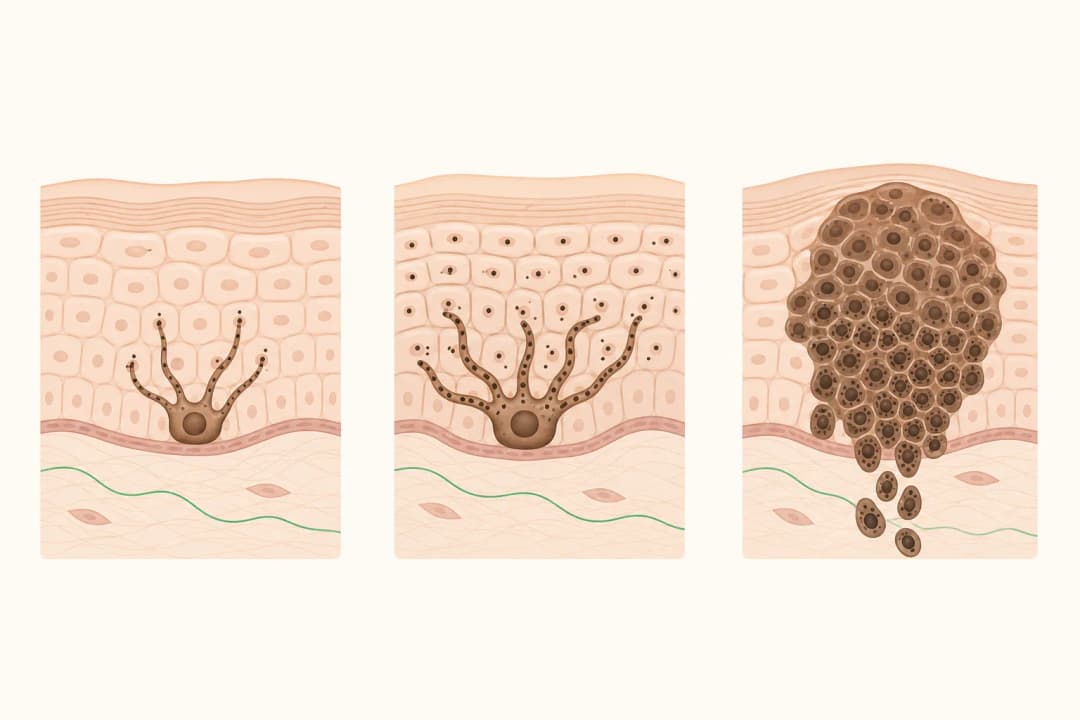
Melanoma in situ means abnormal melanoma cells are confined to the top layer of the skin. Treatment commonly removes the affected area with a margin of surrounding skin, and the pathology report guides whether the edges are clear. It is different from invasive Melanoma, which has grown deeper. Follow-up is still worthwhile because a person who has had one melanoma may develop another separate skin lesion. The original scar can remain firm, itchy, numb, or sensitive while it heals.
Looking after yourself
Attend the follow-up schedule provided by your dermatology or cancer team and keep a record of appointments and pathology results. Once the wound has healed, check your skin in good light, including the scalp, soles, nails, and areas that are difficult to see; a trusted person can help. Report a new spot or a mole that changes in size, shape, colour, or sensation. Use shade, clothing, and broad-spectrum sunscreen to reduce ultraviolet exposure, and avoid deliberate tanning. Ask before starting a new supplement or treatment marketed as cancer prevention.
When to seek care
Contact your care team promptly for a changing pigmented lesion, a sore that does not heal, bleeding, a growing lump near the scar, or enlarged lymph nodes. Urgent assessment is needed for severe wound redness, spreading warmth, pus, fever, or rapidly increasing pain. New neurological symptoms such as weakness, confusion, seizures, or a severe persistent headache need emergency attention, although they are not expected from melanoma in situ alone.
Questions for your doctor
Ask when the next skin examination is due, whether the excision margins are clear, how to inspect the scar, and which family members should help with checks. Clarify whether you need additional surgery, a Sentinel Lymph Node Biopsy, or any treatment beyond local excision based on your pathology.
Find care
General Clinics & Polyclinics in Abu Dhabi
That answer is general. If you want it applied to your own case, these are licensed general clinics & polyclinics listed in Abu Dhabi.
27 Ar Ruwwad St - Shakhbout City - MSH4 - Abu Dhabi - United Arab Emirates
Accepts: Daman, Thiqa, Cigna, MetLife +20 more
Al Ruwais, Al Dhafrah
Accepts: Daman, Thiqa, AXA, Cigna +16 more
Al Bahyah - Al Bahyah Old - Abu Dhabi - United Arab Emirates
Accepts: Daman, Thiqa, Cigna, Allianz Care +18 more
Abu Dhabi
Accepts: Daman, Thiqa, AXA, Cigna +27 more
Ordered by verification status and how complete each clinic's public record is, then alphabetically. This is a directory listing, not a ranking — Zavis does not rate or recommend providers.
A factual listing drawn from the DHA, DOH and MOHAP licence registers. It is not a referral, an endorsement, or advice that any of these providers is right for you.
Questions people ask
Can melanoma in situ come back?
The treated site can develop a local problem if abnormal cells remain, and a separate melanoma can occur elsewhere, so follow-up matters.
Do I need immunotherapy after melanoma in situ?
Most care is directed at complete local removal and surveillance; your pathology and clinician determine whether anything additional is appropriate.
Related
Related reading
Keep reading
Medical disclaimer. This page is general health information, not medical advice, and it cannot diagnose you. Always consult a licensed healthcare provider about your own symptoms and treatment. In an emergency in the UAE, call 998 for an ambulance.