
What should you know about incision for liver resection?
Short answer
An incision for liver resection is the surgical opening used to reach and remove part of the liver, with its care guided by the operation and your healing.
This answers one question. It is not a diagnosis and does not replace an assessment by a licensed doctor.
At a glance
- Also called
- Hepatectomy incision
- Main purpose
- Reach the liver for planned tissue removal
- Care focus
- Protect the wound while the abdominal wall heals
What the incision means
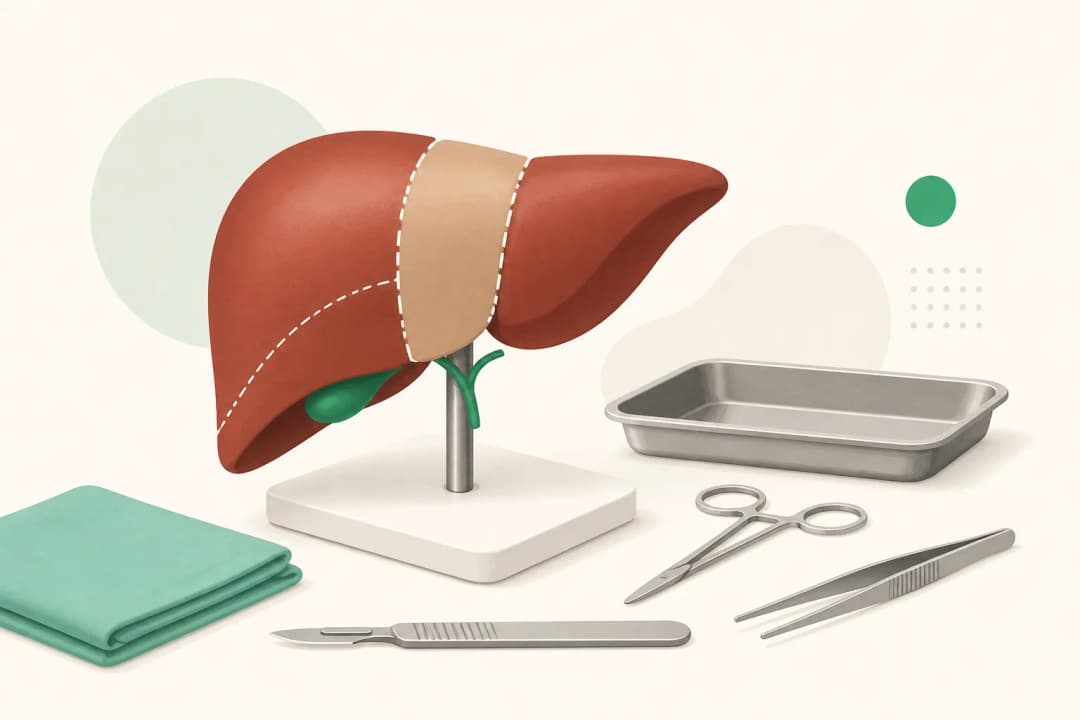
The surgeon may use an open incision across the upper abdomen or several smaller openings for a minimally invasive operation. The choice depends on the tumour's position, its size, the amount of liver planned for removal, and your previous surgery. The cut may be closed with stitches, clips, or medical adhesive. The liver resection itself may be used for liver cancer, liver metastases, or selected tumours that began elsewhere, including bowel cancer.
Tenderness, pulling, bruising, mild swelling, and tiredness can occur as the abdominal wall heals. Numbness or altered sensation around the scar may last longer than the surface soreness. Your team can explain whether the incision is covered, when dressing changes are due, and when bathing is suitable.
Caring for the incision
Follow the discharge instructions for washing, dressing, pain relief, and activity. Keep the area clean and dry as directed, avoid lifting or stretching beyond the limits given by your surgical team, and support the wound when coughing or standing if that feels helpful. Do not apply creams, powders, or antiseptics unless recommended. Attend planned checks so the wound and liver recovery can be assessed.
Ask whether your operation was open or minimally invasive, what closure material was used, and whether any stitches or clips need removal. Tumour ablation is a different treatment that destroys selected tumour tissue without removing the same section of liver.
When to seek care
Contact your surgical team promptly if the wound becomes increasingly red, hot, swollen, painful, or starts draining cloudy fluid, blood, or pus. Seek urgent help for wound separation, heavy bleeding, severe or worsening abdominal pain, repeated vomiting, fainting, confusion, breathing difficulty, or a high temperature with marked illness. These signs can reflect a wound or abdominal complication and should not be assessed by appearance alone.
Questions to ask
Ask where the incision will be, how long the dressing should stay on, which movements and lifting are restricted, how to recognise infection, and who to call outside clinic hours. You can also ask when driving, work, bathing, and follow-up imaging may be considered safe for your situation.
Questions people ask
Will the incision always be large?
No. The length and position depend on the surgical approach, the area being treated, and factors such as previous operations.
Can numbness around the scar be normal?
Altered sensation can occur as small skin nerves heal, but new or worsening pain, swelling, drainage, or wound opening should be reported.
Related
Related reading
Keep reading
Cancer care in the UAE
Hospitals & Medical Centers in Abu Dhabi
Most UAE cancer care is delivered inside hospital services rather than by standalone oncology clinics, so these are licensed hospitals & medical centers listed in Abu Dhabi. Confirm the specific cancer service exists before you travel, and know that asking for a second opinion is routine.
Ahalia Hospital Musaffah Building - Musaffah - Musaffah Industrial - Abu Dhabi - United Arab Emirates
Accepts: Daman, Thiqa, AXA, Cigna +26 more
Al Ruwais Industrial City - Abu Dhabi - United Arab Emirates
Accepts: Daman, Thiqa, AXA, Cigna +30 more
Abu Dhabi, Abu Dhabi
Accepts: Daman, Thiqa, AXA, Cigna +30 more
Second opinions are routine in cancer care and asking for one does not affect your treatment. How to arrange a second opinion in the UAE.
Ordered by verification status and how complete each clinic's public record is, then alphabetically. This is a directory listing, not a ranking — Zavis does not rate or recommend providers.
A factual listing drawn from the DHA, DOH and MOHAP licence registers. It is not a referral, an endorsement, or advice that any of these providers is right for you.
Medical disclaimer. This page is general health information, not medical advice, and it cannot diagnose you. Always consult a licensed healthcare provider about your own symptoms and treatment. In an emergency in the UAE, call 998 for an ambulance.