
How Is Head Lice Different in Children?
Short answer
Head lice in children spreads through close head-to-head contact, may be missed at first, and requires age-appropriate treatment and careful combing.
This answers one question. It is not a diagnosis and does not replace an assessment by a licensed doctor.
At a glance
- How it spreads
- Close head-to-head contact
- Best confirmation
- Finding live crawling lice
Why children need a tailored approach
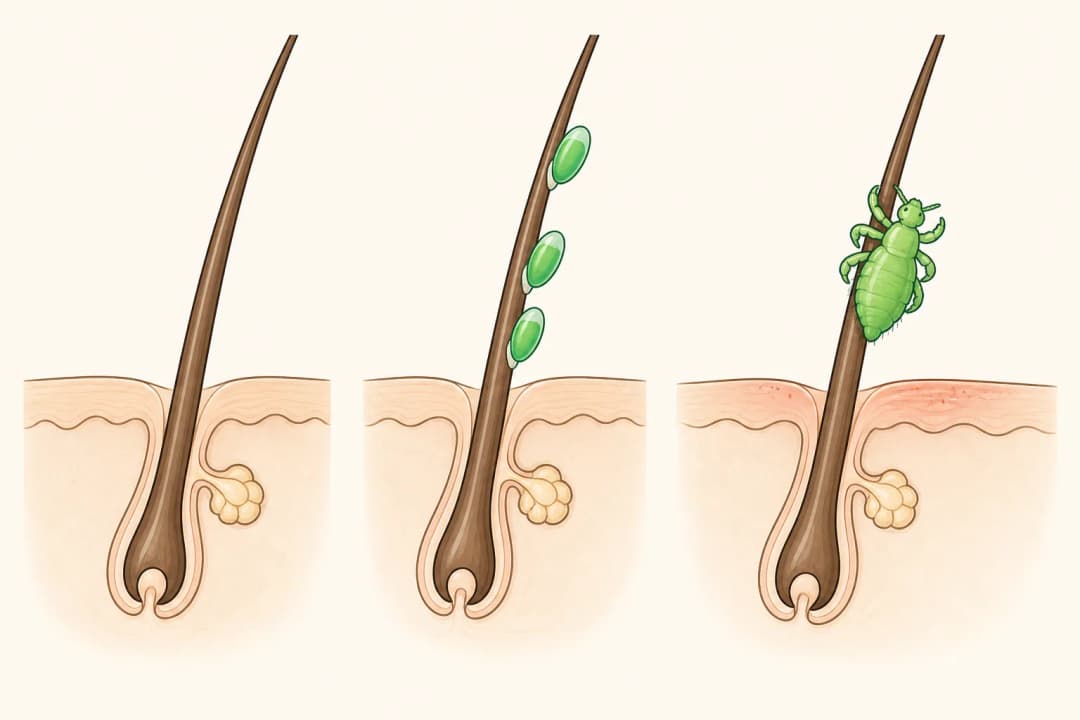
Children often play with their heads close together, so lice can pass between them without flying or jumping. Itching may take time to appear, and scratching can cause small sores behind the ears or at the back of the neck. Nits are attached firmly to hair near the scalp; dandruff usually moves more easily.
Age matters when choosing a lotion or shampoo. Some products are unsuitable for young children, and using extra product or repeating it too soon can irritate the scalp. Finding live crawling lice is more useful than treating every itchy scalp automatically.
Practical steps at home
Check the hair in bright light, separating small sections around the ears and nape. A fine-toothed lice comb on wet, conditioned hair can remove live lice and eggs; repeat checks as directed by a pharmacist or clinician. Follow the product label exactly and ask for advice when the child is very young, has eczema, or has open sores.
Tell close household contacts to check their own hair, but treat only people with confirmed live lice or a clinician's recommendation. Avoid sharing combs, hats, hair accessories, and pillows during the treatment period. Wash recently used bedding and clothing, while avoiding harsh fumigation products.
When to seek medical advice
Arrange medical advice if the scalp has spreading redness, pus, increasing tenderness, fever, or extensive crusting from scratching. Ask a pharmacist or clinician if live lice remain after the complete label-directed treatment, if the child reacts to a product, or if you cannot tell lice from dandruff. Urgent help is needed for facial swelling or breathing difficulty after treatment.
Questions to ask your doctor
Ask which treatment is suitable for the child's age, when it should be repeated, how to comb effectively, and how to recognise live lice. Confirm whether irritated skin needs separate care and when the child can return to school or activities.
Find care
General Clinics & Polyclinics in Abu Dhabi
That answer is general. If you want it applied to your own case, these are licensed general clinics & polyclinics listed in Abu Dhabi.
27 Ar Ruwwad St - Shakhbout City - MSH4 - Abu Dhabi - United Arab Emirates
Accepts: Daman, Thiqa, Cigna, MetLife +20 more
Al Ruwais, Al Dhafrah
Accepts: Daman, Thiqa, AXA, Cigna +16 more
Al Bahyah - Al Bahyah Old - Abu Dhabi - United Arab Emirates
Accepts: Daman, Thiqa, Cigna, Allianz Care +18 more
Abu Dhabi
Accepts: Daman, Thiqa, AXA, Cigna +27 more
Ordered by verification status and how complete each clinic's public record is, then alphabetically. This is a directory listing, not a ranking — Zavis does not rate or recommend providers.
A factual listing drawn from the DHA, DOH and MOHAP licence registers. It is not a referral, an endorsement, or advice that any of these providers is right for you.
Questions people ask
Can head lice jump from one child to another?
No. Lice move by crawling, most often during close head-to-head contact.
Should every family member use lice treatment?
No. Check household members carefully and treat confirmed cases according to age-appropriate advice.
Related
Related reading
Keep reading
Medical disclaimer. This page is general health information, not medical advice, and it cannot diagnose you. Always consult a licensed healthcare provider about your own symptoms and treatment. In an emergency in the UAE, call 998 for an ambulance.