
How effective is PRP injection for patellar tendinitis?
Short answer
PRP injection may help some people with persistent patellar tendinitis, but improvement is not assured and progressive tendon rehabilitation remains essential.
This answers one question. It is not a diagnosis and does not replace an assessment by a licensed doctor.
At a glance
- Main support
- A possible addition for persistent tendon symptoms.
- Core treatment
- Progressive loading remains central to tendon recovery.
- Return to sport
- Pain relief does not alone show readiness for jumping.
What PRP may change
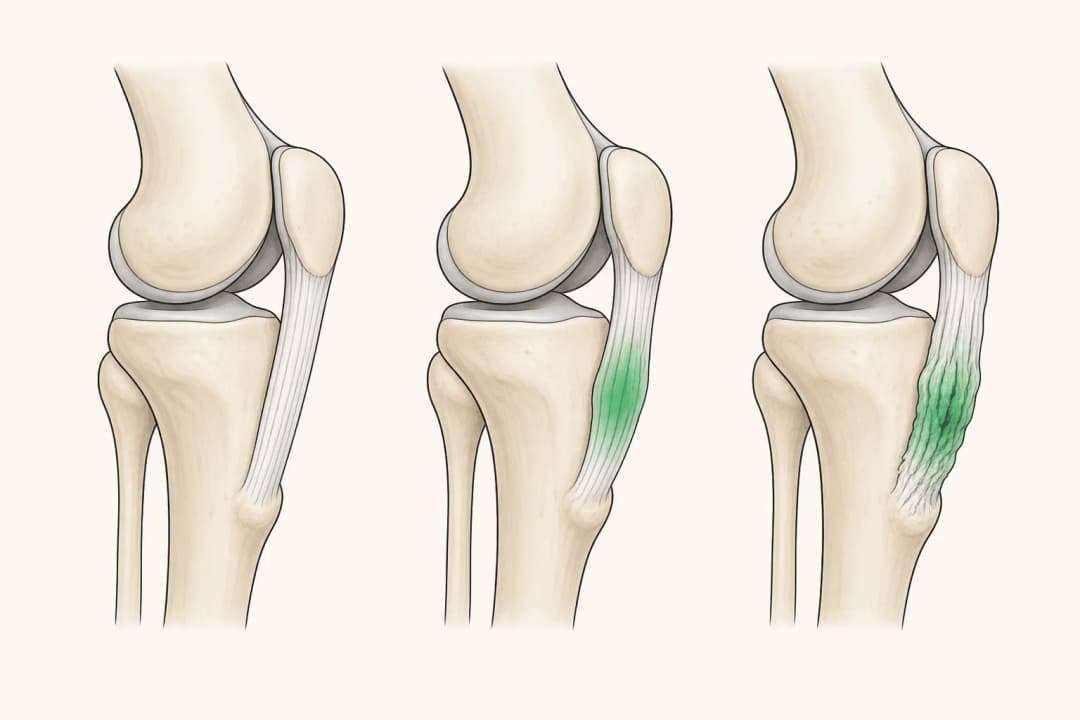
Patellar tendinitis, also called patellar tendinopathy, affects the tendon connecting the kneecap to the shinbone. PRP is prepared from your blood and placed near the affected tendon. The proposed aim is to support a more suitable local healing response and make loading more tolerable. It does not immediately restore tendon capacity, and pain relief alone does not prove that the tendon is ready for jumping. A clinician should also check whether the pain comes from the tendon rather than the kneecap joint, a bursa or another structure. The [Patellar Tendinitis](/conditions/patellar-tendinitis/) guide gives additional condition background.
Build recovery around loading
A useful plan usually increases tendon load in stages: comfortable isometric work, controlled strengthening, faster movements and eventually jumping or sport drills when strength and symptoms allow. Avoid sudden spikes in running or jumping while the tendon is irritable. If PRP is chosen, ask how long heavy activity should pause and when the loading programme restarts. Use pain, next-day stiffness and function to guide progression with your physiotherapist. Details about preparation and aftercare are covered in the [PRP Injection](/treatments/non-surgical-orthopedics/prp-injection/) guide.
When to seek care promptly
Seek prompt assessment after a sudden snap, a new gap in the tendon, inability to straighten the knee, marked swelling or difficulty taking weight. Following an injection, report increasing warmth, redness, drainage, fever or rapidly worsening pain to the treating service.
Questions for your doctor
Is the patellar tendon definitely the pain source? What loading stage am I at now? What change would justify PRP, and how will we measure it? When can I safely resume jumping or sport?
Find care
General Clinics & Polyclinics in Abu Dhabi
That answer is general. If you want it applied to your own case, these are licensed general clinics & polyclinics listed in Abu Dhabi.
27 Ar Ruwwad St - Shakhbout City - MSH4 - Abu Dhabi - United Arab Emirates
Accepts: Daman, Thiqa, Cigna, MetLife +20 more
Al Ruwais, Al Dhafrah
Accepts: Daman, Thiqa, AXA, Cigna +16 more
Al Bahyah - Al Bahyah Old - Abu Dhabi - United Arab Emirates
Accepts: Daman, Thiqa, Cigna, Allianz Care +18 more
Abu Dhabi
Accepts: Daman, Thiqa, AXA, Cigna +27 more
Ordered by verification status and how complete each clinic's public record is, then alphabetically. This is a directory listing, not a ranking — Zavis does not rate or recommend providers.
A factual listing drawn from the DHA, DOH and MOHAP licence registers. It is not a referral, an endorsement, or advice that any of these providers is right for you.
Questions people ask
Can PRP repair a torn patellar tendon?
A significant tear needs specific assessment. PRP should not be treated as an instant repair, and the rehabilitation or surgical plan depends on the injury.
Can I jump after a PRP injection?
Return to jumping should wait until your clinician and physiotherapist confirm suitable strength, movement control and symptom response.
Related
Related reading
Keep reading
Medical disclaimer. This page is general health information, not medical advice, and it cannot diagnose you. Always consult a licensed healthcare provider about your own symptoms and treatment. In an emergency in the UAE, call 998 for an ambulance.