
What should you know about himalaya alopecia areata?
Short answer
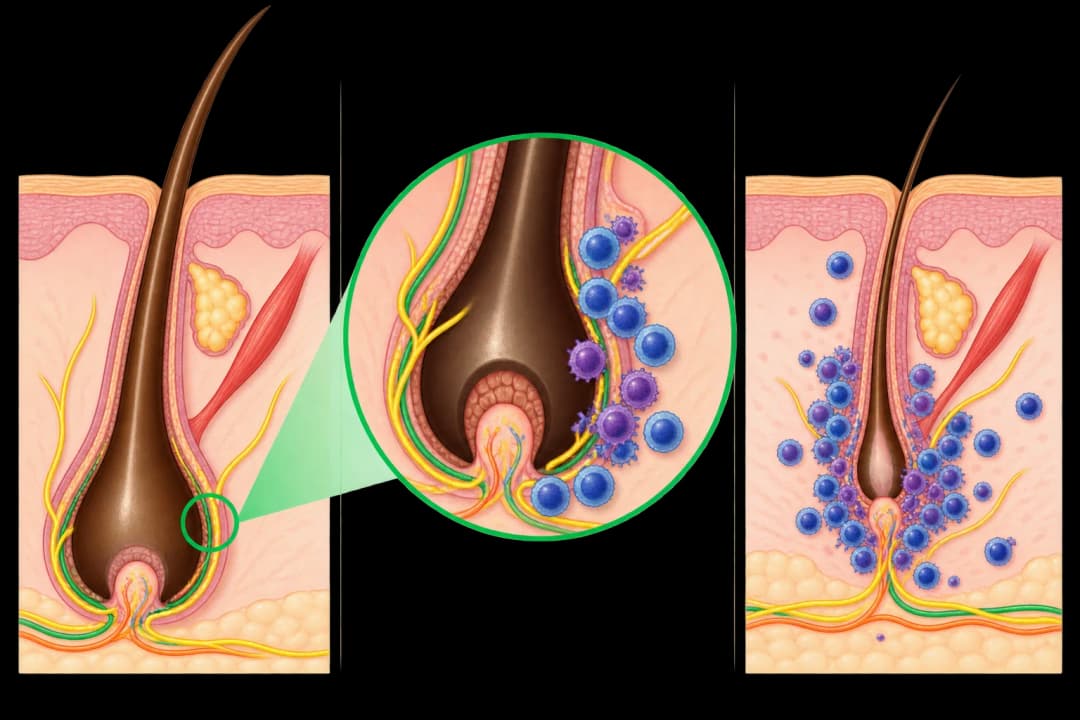
Alopecia areata is an immune-mediated condition that can cause sudden smooth patches of hair loss on the scalp or body.
This answers one question. It is not a diagnosis and does not replace an assessment by a licensed doctor.
At a glance
- Typical appearance
- Smooth, well-defined patches without obvious scale
- Possible sites
- Scalp, eyebrows, eyelashes, beard, or body
- Care focus
- Confirm the diagnosis and tailor treatment to the pattern
Recognising the pattern
Alopecia Areata commonly appears as one or more smooth, well-defined bald patches without obvious scaling. Short tapered hairs may appear around a patch, and eyebrow, eyelash, beard, or body hair can also be involved. The course is unpredictable: hair may regrow, new patches may develop, or both may happen over time.
This condition is not the same as ordinary shedding, and a diagnosis should consider scalp infection, pulling, inflammation, medicines, and other causes. A clinician may inspect the hair and skin, ask about nail changes or other immune conditions, and order tests when the history suggests them.
Treatment and support
Arrange a dermatology assessment, particularly when patches are expanding or involve brows and lashes. Treatment is chosen according to the extent, location, age, duration, and general health. Options may include Steroid Injection Into The Skin, Topical Corticosteroids, Oral Corticosteroid Treatment, or JAK Inhibitor Treatment. Protect exposed scalp from sun and cold, and consider cosmetic support while deciding on care.
When to seek care
Seek prompt review for painful, crusted, oozing, or scaly areas, because these findings can suggest a different or additional scalp problem. Contact a clinician quickly if eyebrow or eyelash loss affects eye protection, or if hair loss spreads rapidly and causes significant distress.
Questions for your doctor
Ask whether the pattern fits Alopecia Areata, whether tests are needed, which treatment matches your situation, how response will be monitored, and what to do if new patches appear.
Find care
General Clinics & Polyclinics in Abu Dhabi
That answer is general. If you want it applied to your own case, these are licensed general clinics & polyclinics listed in Abu Dhabi.
27 Ar Ruwwad St - Shakhbout City - MSH4 - Abu Dhabi - United Arab Emirates
Accepts: Daman, Thiqa, Cigna, MetLife +20 more
Al Ruwais, Al Dhafrah
Accepts: Daman, Thiqa, AXA, Cigna +16 more
Al Bahyah - Al Bahyah Old - Abu Dhabi - United Arab Emirates
Accepts: Daman, Thiqa, Cigna, Allianz Care +18 more
Abu Dhabi
Accepts: Daman, Thiqa, AXA, Cigna +27 more
Ordered by verification status and how complete each clinic's public record is, then alphabetically. This is a directory listing, not a ranking — Zavis does not rate or recommend providers.
A factual listing drawn from the DHA, DOH and MOHAP licence registers. It is not a referral, an endorsement, or advice that any of these providers is right for you.
Questions people ask
Is alopecia areata contagious?
No. Alopecia areata is an immune-mediated condition and does not spread from person to person.
Can hair grow back after alopecia areata?
Hair can regrow in some people, but the course varies and new patches may occur, so follow-up can be useful.
Related
Related reading
Keep reading
Medical disclaimer. This page is general health information, not medical advice, and it cannot diagnose you. Always consult a licensed healthcare provider about your own symptoms and treatment. In an emergency in the UAE, call 998 for an ambulance.