
What should you know about forehead sleep lines?
Short answer
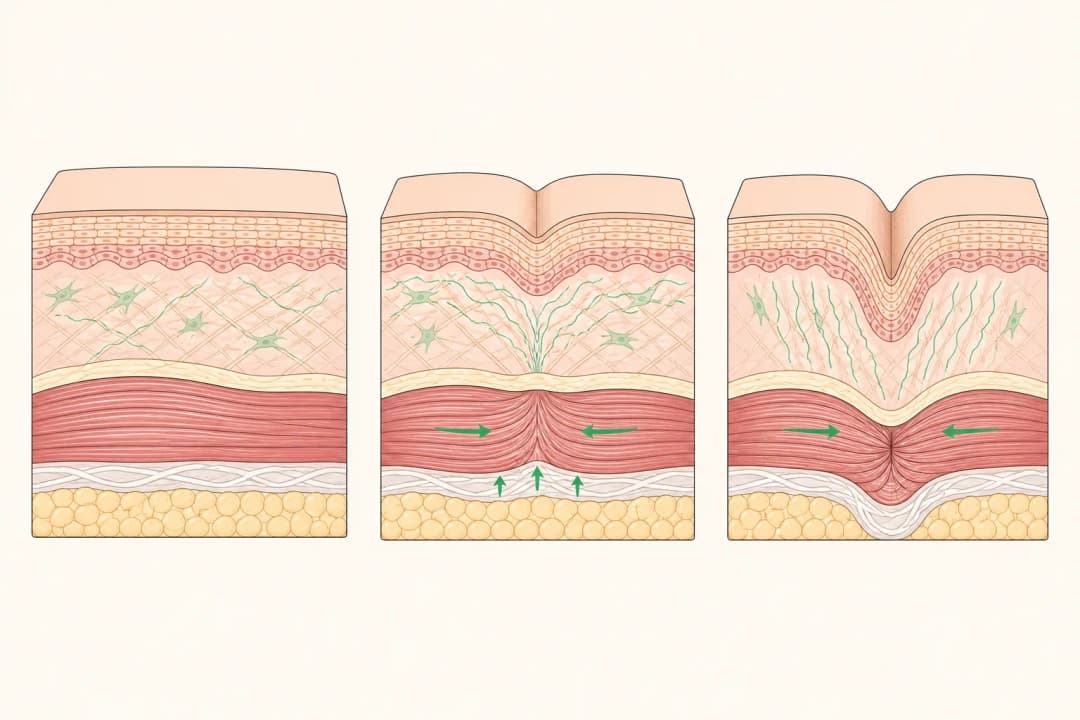
Forehead sleep lines are creases that can form when facial skin is repeatedly folded or pressed during sleep, then become more noticeable when reduced elasticity slows their recovery.
This answers one question. It is not a diagnosis and does not replace an assessment by a licensed doctor.
At a glance
- Main mechanism
- Repeated folding or pressure during sleep
- Appearance
- May fade after waking or persist
- Basic care
- Moisturiser and sun protection
How sleep lines develop
Pressure from a pillow, a preferred sleeping position, and natural facial movement can temporarily crease the skin. In younger, more elastic skin, these marks may fade after waking. With time, repeated folding, ultraviolet exposure, dryness, and expressive muscle activity can make the grooves linger. [Wrinkles](/symptoms/wrinkles/) is the broader term for these surface lines.
Sleep lines are usually a cosmetic texture concern rather than a sign of illness. Their position, depth, and persistence help a clinician distinguish them from irritation, a rash, or another skin change.
What may help
Apply a bland moisturiser and use daily sun protection. Avoid scrubbing the forehead or layering irritating products in an attempt to smooth it quickly. Changing pillow pressure may reduce repeated folding, although sleep position can be difficult to control.
If lines remain visible while your face is relaxed, a qualified clinician may discuss options that reduce muscle activity, including [Botox](/treatments/injectables/botulinum-toxin-injection/). Treatment should be tailored to forehead movement, brow position, skin quality, and your expression goals.
When to seek care
Book an assessment if a line is new and persistent with redness, scaling, itching, pain, bleeding, a lump, or a changing pigmented area. Seek urgent help for sudden facial weakness, vision disturbance, severe headache, or other abrupt neurological symptoms. A stable crease without these features generally allows a routine appointment.
Questions for your doctor
Ask whether the lines are mainly caused by sleep pressure, muscle movement, or skin texture; whether treatment could alter brow movement; what temporary effects to expect; and how to protect the result with skincare.
Find care
General Clinics & Polyclinics in Abu Dhabi
That answer is general. If you want it applied to your own case, these are licensed general clinics & polyclinics listed in Abu Dhabi.
27 Ar Ruwwad St - Shakhbout City - MSH4 - Abu Dhabi - United Arab Emirates
Accepts: Daman, Thiqa, Cigna, MetLife +20 more
Al Ruwais, Al Dhafrah
Accepts: Daman, Thiqa, AXA, Cigna +16 more
Al Bahyah - Al Bahyah Old - Abu Dhabi - United Arab Emirates
Accepts: Daman, Thiqa, Cigna, Allianz Care +18 more
Abu Dhabi
Accepts: Daman, Thiqa, AXA, Cigna +27 more
Ordered by verification status and how complete each clinic's public record is, then alphabetically. This is a directory listing, not a ranking — Zavis does not rate or recommend providers.
A factual listing drawn from the DHA, DOH and MOHAP licence registers. It is not a referral, an endorsement, or advice that any of these providers is right for you.
Questions people ask
Can changing my pillow remove sleep lines?
Reducing pressure may help limit new creasing, but established lines can persist because skin elasticity and muscle movement also matter.
Are sleep lines the same as forehead wrinkles?
Sleep lines are one possible pattern of forehead wrinkles, especially when creases follow repeated pressure or folding.
Related
Related reading
Medical disclaimer. This page is general health information, not medical advice, and it cannot diagnose you. Always consult a licensed healthcare provider about your own symptoms and treatment. In an emergency in the UAE, call 998 for an ambulance.