
What should you know about early stage melanoma?
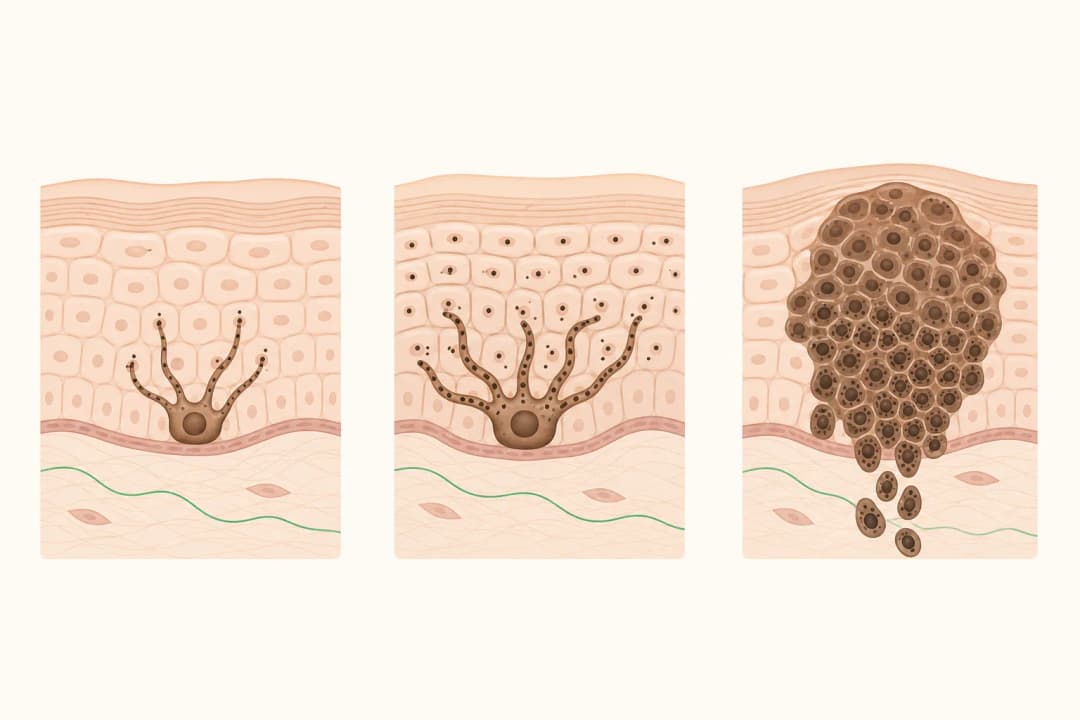
Short answer
Early stage melanoma is a melanoma identified before deeper or distant spread is established, so prompt specialist treatment and follow-up matter.
This answers one question. It is not a diagnosis and does not replace an assessment by a licensed doctor.
At a glance
- First step
- A focused skin examination and biopsy when indicated
- Common local treatment
- Removal with an appropriate margin
- After treatment
- Regular skin surveillance
What an early diagnosis involves
Melanoma may appear as a new mark or a change in an existing mole: uneven colour, an irregular border, one half unlike the other, growth, or a new symptom such as bleeding or persistent itching. A skin examination cannot determine the full stage by appearance alone. A biopsy shows whether melanoma is present and provides features that guide the next decision, including how deeply it extends and whether additional assessment is useful.
Treatment and follow-up
See a dermatologist or skin cancer team and bring attention to any changing mark rather than covering it with cosmetic products. The main local treatment is usually removal of the melanoma with an appropriate margin; this may be called [Surgical Excision] or [Skin Cancer Surgery]. Some people need wider [Tumour Removal Surgery] or further staging, while others need only skin checks after local treatment. Treatment such as [Immunotherapy] is considered according to stage and individual findings, not simply because a mole looks unusual.
When to seek prompt care
Arrange a timely appointment for a mark that changes in size, shape, colour, or surface, or develops bleeding, crusting, pain, or persistent itch. Seek urgent medical help for severe illness, new neurological symptoms, or sudden breathing difficulty. These symptoms do not diagnose [Brain Metastases], but they require assessment rather than waiting for a routine skin check.
Questions for your doctor
Ask what the biopsy shows, what margin is planned, whether further staging is indicated, and how the procedure may affect the site. Ask how to examine your skin, protect it from ultraviolet exposure, and schedule [Follow-Up After Cancer Treatment].
Find care
General Clinics & Polyclinics in Abu Dhabi
That answer is general. If you want it applied to your own case, these are licensed general clinics & polyclinics listed in Abu Dhabi.
27 Ar Ruwwad St - Shakhbout City - MSH4 - Abu Dhabi - United Arab Emirates
Accepts: Daman, Thiqa, Cigna, MetLife +20 more
Al Ruwais, Al Dhafrah
Accepts: Daman, Thiqa, AXA, Cigna +16 more
Al Bahyah - Al Bahyah Old - Abu Dhabi - United Arab Emirates
Accepts: Daman, Thiqa, Cigna, Allianz Care +18 more
Abu Dhabi
Accepts: Daman, Thiqa, AXA, Cigna +27 more
Ordered by verification status and how complete each clinic's public record is, then alphabetically. This is a directory listing, not a ranking — Zavis does not rate or recommend providers.
A factual listing drawn from the DHA, DOH and MOHAP licence registers. It is not a referral, an endorsement, or advice that any of these providers is right for you.
Questions people ask
Does every changing mole mean melanoma?
No. Many skin marks change for other reasons, but a changing mark should be assessed so the cause is clear.
Can early melanoma have no symptoms?
Yes. A visible change may be the only clue, which makes attention to new or evolving marks useful.
Related
Related reading
Keep reading
Medical disclaimer. This page is general health information, not medical advice, and it cannot diagnose you. Always consult a licensed healthcare provider about your own symptoms and treatment. In an emergency in the UAE, call 998 for an ambulance.