
Does physiotherapy treat patellar tendinitis?
Short answer
Physiotherapy can help treat patellar tendinitis by reducing aggravating load and progressively rebuilding tendon capacity.
This answers one question. It is not a diagnosis and does not replace an assessment by a licensed doctor.
At a glance
- Common focus
- Progressive tendon loading
- Helpful adjustment
- Reduce painful jumping and running temporarily
How treatment works
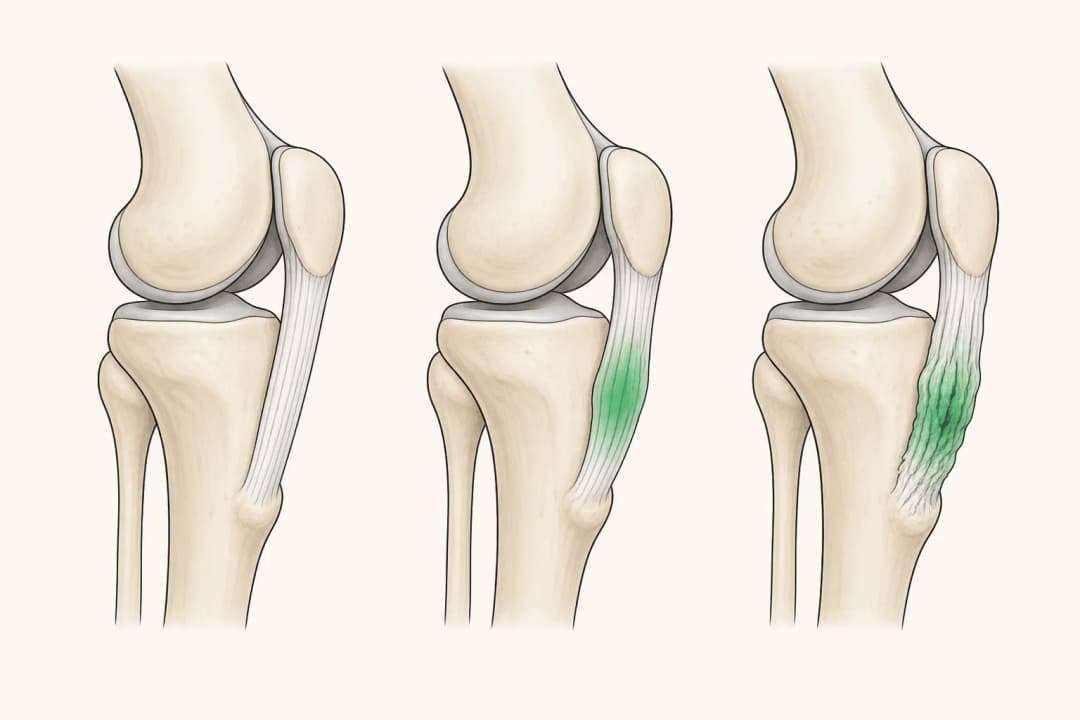
Patellar tendinitis, also called jumper's knee, affects the tendon connecting the kneecap to the shin. Repeated jumping, running or heavy knee loading can irritate it, causing pain at the front of the knee. A physiotherapist checks strength, flexibility, movement technique and training demands. Treatment may include temporary activity changes, education about pain, and exercises that progress from isometric muscle work to controlled strengthening. The aim is to make the tendon and surrounding muscles better able to handle daily and sporting loads.
Practical next steps
Reduce or pause the activity that clearly increases pain, while keeping comfortable movement such as easy walking if advised. Follow the exercise dosage rather than adding extra repetitions when the knee feels better. Gradual loading matters: sudden return to sprinting, jumping or deep squats can flare symptoms. Supportive footwear and a review of training surfaces or technique may be useful. Read more about [Patellar Tendinitis](/conditions/patellar-tendinitis/) and [Physiotherapy](/treatments/physiotherapy-and-rehabilitation/physiotherapy/).
When to seek care
Seek prompt medical care if pain began with a sudden pop, the knee rapidly swelled, you cannot straighten it, or you cannot bear weight. Arrange review if pain is worsening despite reduced loading, keeps returning, or interferes with sleep or ordinary walking. Sudden loss of strength may indicate a more serious tendon injury.
Questions to ask
Ask which activities are safe now, how pain should guide exercise, and what progression should come before running or jumping. Clarify whether another knee problem could be contributing and how improvement will be checked.
Find care
General Clinics & Polyclinics in Abu Dhabi
That answer is general. If you want it applied to your own case, these are licensed general clinics & polyclinics listed in Abu Dhabi.
27 Ar Ruwwad St - Shakhbout City - MSH4 - Abu Dhabi - United Arab Emirates
Accepts: Daman, Thiqa, Cigna, MetLife +20 more
Al Ruwais, Al Dhafrah
Accepts: Daman, Thiqa, AXA, Cigna +16 more
Al Bahyah - Al Bahyah Old - Abu Dhabi - United Arab Emirates
Accepts: Daman, Thiqa, Cigna, Allianz Care +18 more
Abu Dhabi
Accepts: Daman, Thiqa, AXA, Cigna +27 more
Ordered by verification status and how complete each clinic's public record is, then alphabetically. This is a directory listing, not a ranking — Zavis does not rate or recommend providers.
A factual listing drawn from the DHA, DOH and MOHAP licence registers. It is not a referral, an endorsement, or advice that any of these providers is right for you.
Questions people ask
How long does physiotherapy take to help?
Progress varies with tendon irritability, workload and consistency; improvement is usually judged by function and tolerance of gradual loading.
Should I stop all activity?
Usually the goal is to modify aggravating loads while preserving comfortable movement, according to your clinician's advice.
Related
Related reading
Keep reading
Medical disclaimer. This page is general health information, not medical advice, and it cannot diagnose you. Always consult a licensed healthcare provider about your own symptoms and treatment. In an emergency in the UAE, call 998 for an ambulance.