
What should you know about different kinds of melanoma?
Short answer
Different kinds of melanoma are identified by where they begin, how they grow, and how they appear on the skin.
This answers one question. It is not a diagnosis and does not replace an assessment by a licensed doctor.
At a glance
- Main types
- Superficial spreading, nodular, lentigo maligna, and acral lentiginous melanoma
- Confirmation
- A biopsy is needed to identify the type
- Key follow-up
- Regular skin and lymph-node assessment may be advised
How melanoma types differ
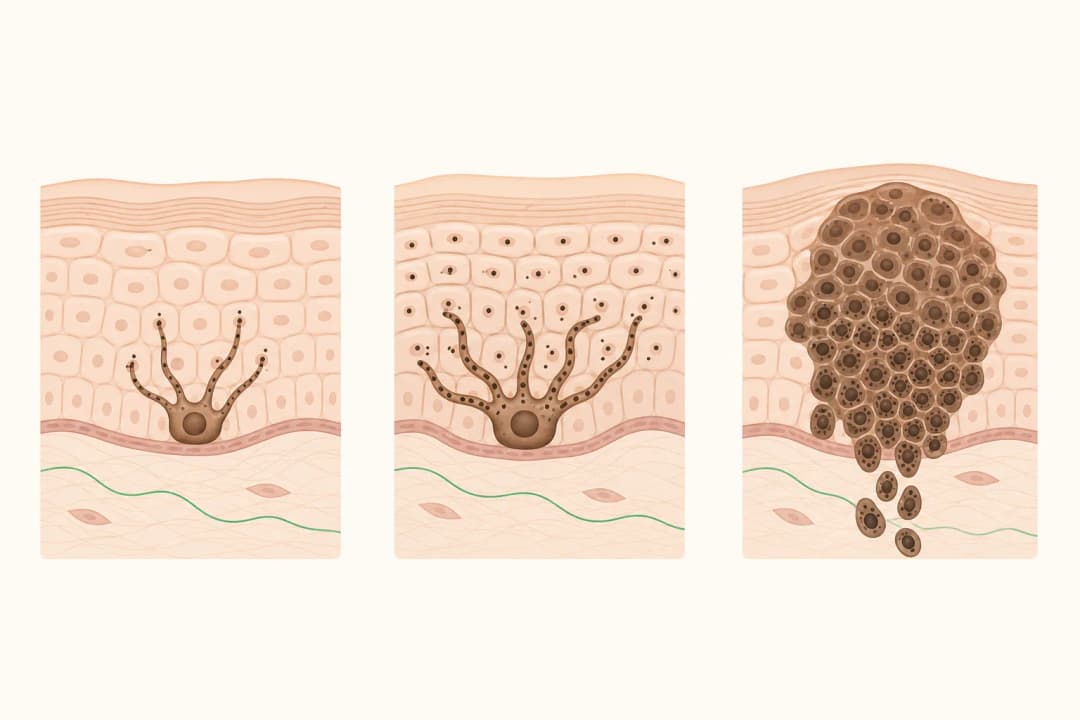
Superficial spreading melanoma tends to grow across the upper skin before becoming deeper. Nodular melanoma more often forms a raised lesion that grows downward early. Lentigo maligna melanoma usually starts in sun-damaged skin, often on the face, scalp, or neck. Acral lentiginous melanoma begins on the palms, soles, or beneath a nail and may be harder to notice. A melanoma can also develop in the eye or other less visible sites. The type is confirmed by examining a biopsy, not by appearance alone.
Melanoma is a serious skin cancer, but its outlook and treatment depend on depth, spread, location, and other findings. A diagnosis does not mean that cancer has spread elsewhere. Staging may include a careful skin and lymph-node examination, imaging in selected situations, and sometimes a sentinel lymph node biopsy.
What to do next
Arrange a dermatology assessment for a new or changing dark mark, especially when it shows uneven halves, an irregular edge, several colours, or clear change over time. Do not scrape, burn, or repeatedly pick at it. Photographing the area beside a ruler can help you describe change, while a clinician’s examination remains necessary. If melanoma is suspected, surgical excision is commonly used to remove the lesion for diagnosis and treatment. Further skin cancer surgery, tumour removal surgery, or immunotherapy may be considered according to the stage and site.
When to seek care
Book a prompt dermatology appointment for a mole or mark that is enlarging, bleeding, crusting, persistently itchy, painful, or changing in colour or shape. Seek urgent medical care for severe symptoms such as sudden weakness, confusion, seizures, or a severe new headache, particularly if you already have melanoma, because these symptoms can have causes that need immediate assessment. Follow-up after cancer treatment helps clinicians look for recurrence and new skin changes.
Questions for your doctor
Ask which melanoma type the biopsy shows, how deep it is, whether the edges are clear, and whether lymph-node assessment is needed. You can also ask how often your skin should be checked, which symptoms should trigger an earlier visit, and whether close relatives need advice about skin surveillance.
Find care
General Clinics & Polyclinics in Abu Dhabi
That answer is general. If you want it applied to your own case, these are licensed general clinics & polyclinics listed in Abu Dhabi.
27 Ar Ruwwad St - Shakhbout City - MSH4 - Abu Dhabi - United Arab Emirates
Accepts: Daman, Thiqa, Cigna, MetLife +20 more
Al Ruwais, Al Dhafrah
Accepts: Daman, Thiqa, AXA, Cigna +16 more
Al Bahyah - Al Bahyah Old - Abu Dhabi - United Arab Emirates
Accepts: Daman, Thiqa, Cigna, Allianz Care +18 more
Abu Dhabi
Accepts: Daman, Thiqa, AXA, Cigna +27 more
Ordered by verification status and how complete each clinic's public record is, then alphabetically. This is a directory listing, not a ranking — Zavis does not rate or recommend providers.
A factual listing drawn from the DHA, DOH and MOHAP licence registers. It is not a referral, an endorsement, or advice that any of these providers is right for you.
Questions people ask
Can melanoma look like an ordinary mole?
Yes. Melanoma can resemble a mole, so a new or changing lesion should be assessed rather than judged by colour alone.
Does every melanoma grow in the same way?
No. Some spread across the surface first, while others become raised or deeper earlier; biopsy and staging clarify the pattern.
Related
Related reading
Keep reading
Medical disclaimer. This page is general health information, not medical advice, and it cannot diagnose you. Always consult a licensed healthcare provider about your own symptoms and treatment. In an emergency in the UAE, call 998 for an ambulance.