
What should you know about crown breakage in natural hair?
Short answer
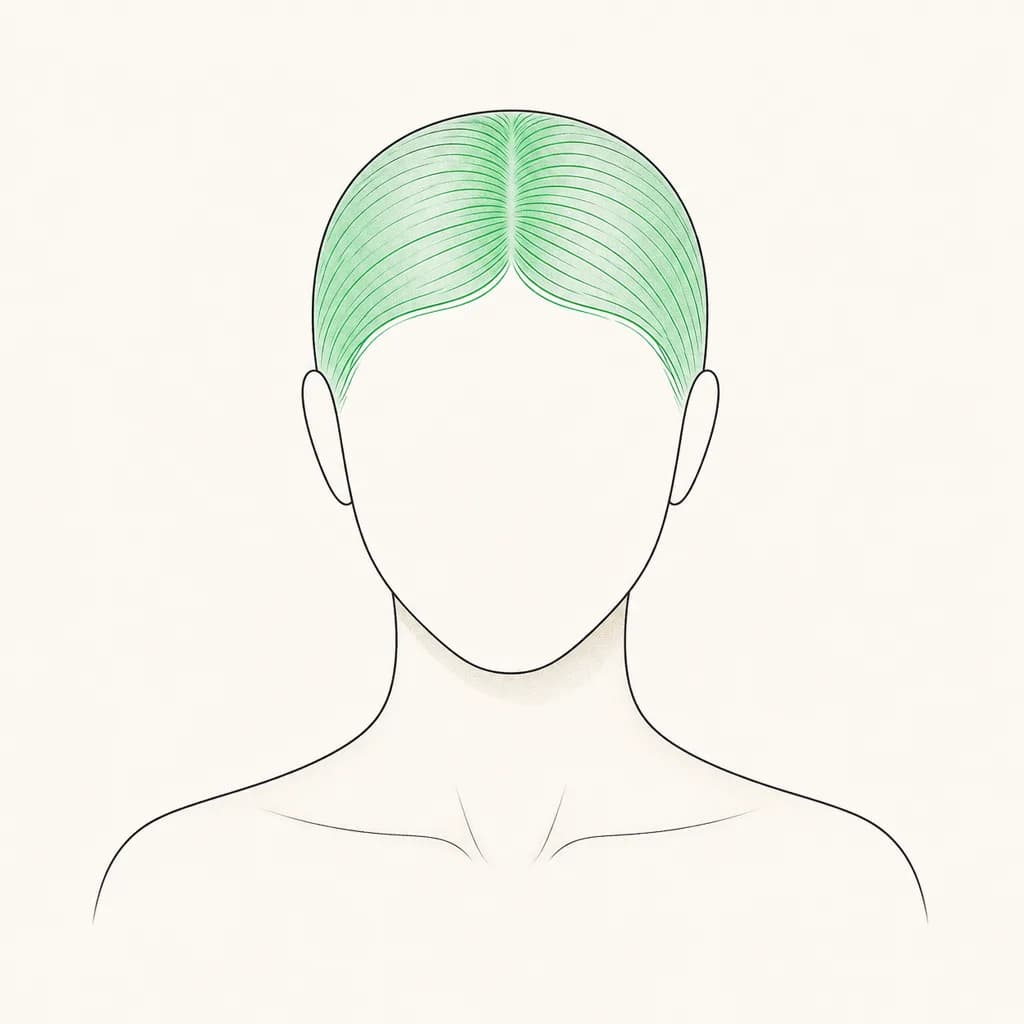
Crown breakage in natural hair is usually shaft damage from tension, dryness, friction, or detangling rather than hair leaving the follicle.
This answers one question. It is not a diagnosis and does not replace an assessment by a licensed doctor.
At a glance
- Check first
- Compare short, frayed ends with hairs shed from the root.
- Reduce stress
- Use sectioned detangling, loose styles, lower heat, and less rubbing.
How to read the pattern
Natural curls and coils can bend repeatedly at the same point, making the crown look shorter or less dense even while the scalp is covered. Shrinkage can also make different lengths harder to compare. Frequent combing, dry detangling, tight updos, extensions, uncovered sleep, and repeated manipulation may add stress.
Look for short pieces with frayed ends, not only hairs with a bulb at one end. Burning, itching, scale, sores, or smooth patches need a scalp assessment. Scalp ringworm may involve scaling and broken hairs; traction alopecia relates to ongoing pulling and can begin around tightly held styles.
Gentler care for curls and coils
Detangle in sections with conditioner or another product that gives slip, beginning at the ends and supporting the hair near the roots. Choose loose styles, vary parting and placement, and give the crown breaks between protective looks. Limit heat and repeated edge brushing, and avoid forcing knots through resistance.
Keep hair moisturised according to how it responds, protect it from rubbing at night, and ask a stylist to avoid tension at the crown. If breakage began after a product change or service, stop that trigger and bring the product details to a clinician if the problem persists.
When to seek care
Book a dermatology visit when breakage keeps progressing after styling changes, or when the crown is tender, itchy, scaly, red, or developing a smooth patch. Prompt evaluation is useful if hairs seem to be shedding from the root, because the management differs from care for damaged lengths.
Questions for your doctor
Can you tell whether the short hairs are broken or newly growing? Could my styling pattern be causing traction? What scalp findings would require treatment, and how should I adapt my routine while the crown recovers?
Find care
General Clinics & Polyclinics in Abu Dhabi
That answer is general. If you want it applied to your own case, these are licensed general clinics & polyclinics listed in Abu Dhabi.
27 Ar Ruwwad St - Shakhbout City - MSH4 - Abu Dhabi - United Arab Emirates
Accepts: Daman, Thiqa, Cigna, MetLife +20 more
Al Ruwais, Al Dhafrah
Accepts: Daman, Thiqa, AXA, Cigna +16 more
Al Bahyah - Al Bahyah Old - Abu Dhabi - United Arab Emirates
Accepts: Daman, Thiqa, Cigna, Allianz Care +18 more
Abu Dhabi
Accepts: Daman, Thiqa, AXA, Cigna +27 more
Ordered by verification status and how complete each clinic's public record is, then alphabetically. This is a directory listing, not a ranking — Zavis does not rate or recommend providers.
A factual listing drawn from the DHA, DOH and MOHAP licence registers. It is not a referral, an endorsement, or advice that any of these providers is right for you.
Questions people ask
Why does natural hair break at the crown?
The crown may receive repeated tension, friction, heat, or manipulation, and tightly curved strands can be vulnerable at bends.
Should I stop protective styles?
Choose styles that feel comfortable, are not tight, and can be removed without pulling or heavy detangling.
Related
Related reading
Keep reading
Medical disclaimer. This page is general health information, not medical advice, and it cannot diagnose you. Always consult a licensed healthcare provider about your own symptoms and treatment. In an emergency in the UAE, call 998 for an ambulance.