
What should you know about CCCA causes?
Short answer
CCCA likely develops through a mix of follicle inflammation, inherited susceptibility, and repeated scalp stress rather than one proven cause.
This answers one question. It is not a diagnosis and does not replace an assessment by a licensed doctor.
At a glance
- Condition type
- Inflammatory scarring hair loss
- Pattern
- Often starts around the crown and expands outward
- Contributors
- Susceptibility, inflammation, traction, and irritation
Possible contributors
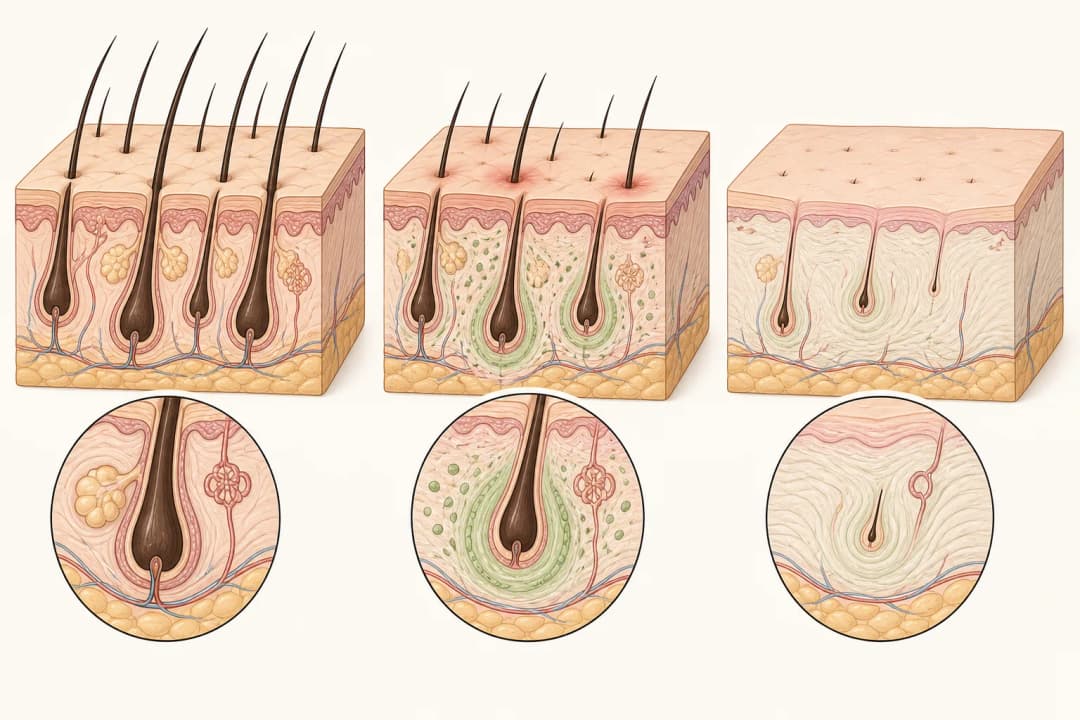
CCCA is a form of scarring alopecia in which inflammation harms follicles, often beginning at the crown. Family history may increase susceptibility. Tight styles, extensions, chemical relaxers, heat, or painful grooming can add traction or irritation, but these factors do not explain every case. Symptoms such as burning, tenderness, itching, scale, or pustules can signal active inflammation. A dermatologist may examine the scalp closely and use a biopsy when the diagnosis is uncertain.
Practical next steps
Keep a record of when shedding, breakage, or scalp discomfort began. Pause any style or product that causes pain, pulling, or burning, and handle the scalp gently. Do not blame yourself or assume one styling habit caused the condition. Medical treatment is directed at reducing inflammation and protecting follicles; options can include prescribed anti-inflammatory medicines and, in selected situations, oral treatment.
When to seek care
Arrange a dermatology assessment for widening thinning at the crown, a smooth shiny patch, or persistent scalp discomfort. Seek prompt care for pustules, crusting, drainage, spreading redness, or rapidly changing hair density. Early evaluation can clarify whether inflammation is active and whether follicles may still be protected.
Questions for your doctor
Ask what findings support CCCA, whether a biopsy is useful, which exposures to stop, and how you will know that scalp inflammation is settling.
Find care
General Clinics & Polyclinics in Abu Dhabi
That answer is general. If you want it applied to your own case, these are licensed general clinics & polyclinics listed in Abu Dhabi.
27 Ar Ruwwad St - Shakhbout City - MSH4 - Abu Dhabi - United Arab Emirates
Accepts: Daman, Thiqa, Cigna, MetLife +20 more
Al Ruwais, Al Dhafrah
Accepts: Daman, Thiqa, AXA, Cigna +16 more
Al Bahyah - Al Bahyah Old - Abu Dhabi - United Arab Emirates
Accepts: Daman, Thiqa, Cigna, Allianz Care +18 more
Abu Dhabi
Accepts: Daman, Thiqa, AXA, Cigna +27 more
Ordered by verification status and how complete each clinic's public record is, then alphabetically. This is a directory listing, not a ranking — Zavis does not rate or recommend providers.
A factual listing drawn from the DHA, DOH and MOHAP licence registers. It is not a referral, an endorsement, or advice that any of these providers is right for you.
Questions people ask
Is CCCA caused only by hair products?
No. Products and styling practices may irritate or stress follicles, but CCCA involves inflammation and susceptibility and does not have one confirmed cause.
Can tight hairstyles worsen CCCA?
Repeated pulling or painful styling can add stress to follicles, so gentler, looser options are sensible while the scalp is assessed.
Related
Related reading
Keep reading
Medical disclaimer. This page is general health information, not medical advice, and it cannot diagnose you. Always consult a licensed healthcare provider about your own symptoms and treatment. In an emergency in the UAE, call 998 for an ambulance.